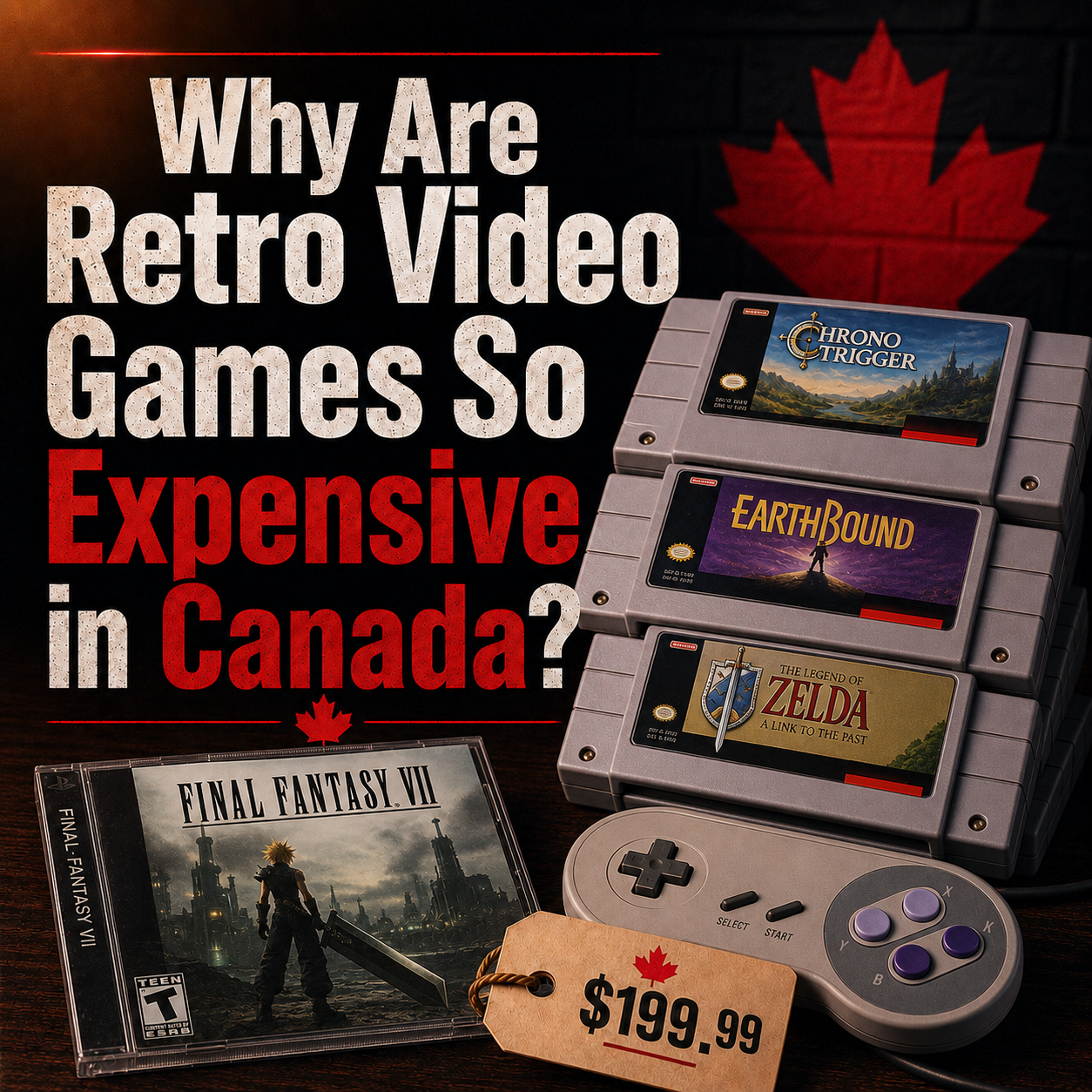
Why Are Retro Video Games So Expensive in Canada?
Retro game prices can feel confusing, especially when an old game costs more today than it did when it was new. This guide explains what actually affects used video game prices, why some games get expensive, and how Canadian shoppers can tell the difference between a fair price and a bad deal.
Summary
Retro video game prices are not based on age alone. They are affected by supply, demand, condition, authenticity, completeness, shipping costs, Canadian availability, and whether the game has been cleaned, inspected, tested, and backed by a real warranty.
A cheap marketplace listing is not always the best deal. A more expensive copy may be worth it if it is authentic, cleaner, complete, better protected, easier to return, or sold by a trusted Canadian retro game store.
Retro video game prices can feel strange if you are just getting back into collecting.
A game that originally sold for $49.99 or $59.99 might now be $20, $80, $200, or more depending on the title. Meanwhile, another game from the exact same console might still be sitting in the bargain bin.
So what gives?
The short answer is that retro game prices are not random. They are based on how many people want the game, how many clean copies are available, whether the game is authentic, what condition it is in, whether it is complete, and how much risk the buyer is taking.
In Canada, prices can also be affected by shipping costs, exchange rates, smaller local supply, and the extra work required to properly clean, inspect, test, and warranty used games.
The most important thing to remember: Expensive does not always mean overpriced. A fair retro game price depends on condition, authenticity, demand, completeness, seller trust, and the total cost to get that game safely into your hands.
Old Does Not Always Mean Cheap
A common mistake is assuming that because a game is old, it should automatically be cheap.
That is not how collectibles work.
Retro games are no longer being produced in their original physical format. There are only so many original NES, Super Nintendo, Nintendo 64, GameCube, PlayStation, Sega Genesis, Dreamcast, Game Boy, Nintendo DS, Wii, Xbox, and other older games still circulating.
Every year, more copies get lost, damaged, thrown out, modified, water-damaged, sun-faded, scratched, or added permanently to private collections.
Once a game is out of print, the price is usually controlled by how many people want it compared to how many clean, working, authentic copies are actually available.
Supply and Demand Drive Retro Game Prices
The biggest factor in retro game pricing is demand.
Some games are wanted by almost everyone who collects for a system. Popular Nintendo franchises, Pokémon games, Mario titles, Zelda games, Kirby games, survival horror games, RPGs, Capcom classics, Atlus releases, cult favourites, and low-print titles often hold stronger value because collectors are actively looking for them.
Other games may be old, but not especially desirable. Annual sports games, common licensed games, and titles that were produced in huge numbers may stay inexpensive because there are still lots of copies available and fewer people chasing them.
This is why two games from the same console can have completely different prices. Age matters, but demand matters more.
| Pricing Factor | Impact | Why It Matters |
|---|---|---|
| High demand franchise | High | Series like Pokémon, Mario, Zelda, Kirby, and popular RPGs are constantly searched for by collectors and players. |
| Low supply or hard-to-find title | High | If clean copies rarely come through trade-ins or local collections, replacement cost goes up. |
| Complete-in-box copy | Medium/High | Boxes, manuals, inserts, and original cover art are often harder to find than the game itself. |
| Authentic cartridge or disc | High | Authentic games have more collector value than reproduction, counterfeit, or questionable copies. |
| Clean condition | Medium | Labels, cases, manuals, disc surfaces, pins, and shells all affect value. |
| Untested or as-is listing | Very High Risk | A lower price may come with a much higher chance of problems, no return, and no support. |
| Canadian shipping and availability | Medium | Canadian buyers often deal with smaller supply, higher shipping costs, and currency conversion on U.S. listings. |
Condition Matters More Than Many Buyers Realize
Condition can make a huge difference in price.
A clean cartridge with a good label, no marker, no peeling, no rattling, and no corrosion is not the same as a cartridge with a torn label, sun fading, grime, loose screws, or dirty pins.
For disc-based games, condition can be even more important. A scratched disc, cracked case, missing manual, water-damaged cover art, or disc-only copy is not equal to a clean complete copy.
When collectors compare prices, they need to compare like with like.
- Loose cartridge or loose disc
- Original case but no manual
- Complete in box
- Original cover art
- Printed replacement cover art
- Factory sealed
- Graded
- Damaged or untested
A $90 copy of a game may seem expensive until you realize the cheaper copy you saw online was disc-only, scratched, missing the case, listed as untested, or shipping from outside Canada.
Loose, Complete-in-Box, Sealed, and Graded Games Are Different Markets
One of the biggest pricing differences in retro collecting is completeness.
A loose game is just the cartridge or disc by itself. A complete-in-box game, often called CIB, usually includes the original game, original case or box, and original manual.
Sealed games are still in their original factory wrapping. Graded games are typically sealed or collectible-condition games that have been authenticated and graded by a third-party grading company.
Those are not the same product.
For many collectors, the box and manual are a major part of the value. Cardboard boxes for NES, Super Nintendo, Nintendo 64, Game Boy, Game Boy Advance, and similar systems were often thrown away, crushed, torn, or damaged.
That makes clean original boxes much harder to find than loose cartridges.
This is one reason a loose copy of a game might be affordable while a complete copy of the same game costs several times more.
Authenticity Affects Price
Authenticity is a major issue in retro game collecting.
Some games are heavily counterfeited, especially valuable cartridge games. Pokémon games, Game Boy Advance games, Nintendo DS games, rare Super Nintendo games, and certain RPGs are common targets for fakes and reproduction copies.
A fake game may look close enough to fool a casual buyer, but it is not worth the same as an authentic copy. It may also have poor build quality, save issues, compatibility problems, or incorrect internal parts.
This is why authentication matters. A properly inspected authentic game from a trusted store may cost more than a random marketplace listing, but you are also reducing your risk.
Cheap is not always a deal. A reproduction or fake game may cost less because it has little collector value, may not work properly long-term, and may not be accepted for trade-in by a reputable retro game store.
If you are specifically shopping for Pokémon games, read our guide: How to Avoid Buying Fake Pokémon Games in Canada.
Canadian Supply Is Smaller Than the U.S. Market
Retro game collectors in Canada often feel pricing pressure because the available supply is smaller.
The United States has a much larger population and a much larger used game market. That means more local copies, more sellers, more shops, and more listings.
Canadian collectors often have fewer local options, especially for harder-to-find games.
Buying from the U.S. can sometimes help, but it also creates new costs.
- Currency conversion
- International shipping
- Possible duties or taxes
- Longer delivery times
- Harder returns
- Greater risk if the condition is not as described
A price that looks cheaper in U.S. dollars may not be cheaper once it lands at your door in Canada.
Shipping Costs Affect Online Retro Game Prices
Shipping is another factor that affects used game pricing in Canada.
Canada is geographically huge, and shipping a package from Ontario to British Columbia, Alberta, Nova Scotia, Newfoundland, or the territories can be expensive.
Even small games require packaging, labour, tracking, and carrier fees.
For a private seller, shipping might be a one-time inconvenience. For a store shipping orders every day, shipping costs are part of the real cost of doing business.
This is why it is important to compare the full checkout price, not just the sticker price.
A game listed for $49.99 with high shipping may not be a better deal than a $59.99 copy with discounted shipping, better packaging, faster handling, and warranty protection.
Testing, Cleaning, and Warranty Add Value
When you buy from a random online seller, the listing might say “untested,” “worked last time I used it,” or “as is.” That can be risky.
At Power Up Gaming, used products are cleaned, inspected, and backed by warranty. That extra process takes time, staff, equipment, and experience, but it also gives customers more confidence when buying used games, consoles, and accessories.
For cartridge games, that may include checking the contacts, cleaning the shell, inspecting for obvious damage, and confirming that the game is authentic.
For battery-backed games, save batteries may also need attention. For disc games, condition matters heavily. Some CD and DVD-based discs can be professionally refinished, but not every disc can be saved.
Blu-ray format games, including many newer PlayStation and Xbox formats, require stricter handling because they are not treated the same way as older CD and DVD-style discs.
For more detail, read these guides:
- Can Scratched Video Game Discs Be Fixed?
- Why Your Retro Console Won’t Read Games
- Why Do Old Game Saves Stop Working?
Store Prices and Marketplace Prices Are Not the Same Thing
It is common for customers to compare a store price to the cheapest listing they can find online. That comparison is not always fair.
A private marketplace listing might be cheaper because the seller has no warranty, no staff, no rent, no payment processing fees, no cleaning process, no return policy, no customer support, and no obligation to help if something goes wrong.
A store has to account for the full cost of offering a safer buying experience.
What a Store Price May Include
- Purchasing the item from a customer
- Cleaning and inspecting the item
- Testing when possible
- Replacing cases, sleeves, or batteries when needed
- Checking authenticity on high-risk titles
- Processing payments
- Staff time
- Rent and utilities
- Shipping supplies
- Warranty and return support
- Losses from defective items, fraud, damage, and returns
That does not mean every store price is automatically fair. It does mean that a store price and a random “as-is” listing are not offering the same level of protection.
Rarity Is Not Always Obvious
Some expensive games are obviously rare. Others surprise people.
A game does not need to be famous to be valuable. Sometimes a title becomes expensive because it had a low print run, released late in a console’s life, reviewed poorly at launch, was overlooked by players, or became popular years later through YouTube, speedrunning, collecting communities, or nostalgia.
Other times, a game becomes expensive because it belongs to a category collectors love.
- RPGs
- Horror games
- Pokémon games
- First-party Nintendo games
- Capcom titles
- Atlus games
- Limited-print releases
- Late-generation releases
- Games with unique controllers or accessories
Price is not always about how “good” the game is. It is about how many people want it and how many clean, authentic copies are available.
Nostalgia Has Real Buying Power
Retro gaming is emotional.
People are not just buying plastic, discs, and circuit boards. They are buying the game they played with their sibling, the console they had at Christmas, the RPG they never finished, the Pokémon game they traded away, or the system they always wanted as a kid.
That nostalgia creates demand.
When a generation reaches adulthood and has more disposable income, games from their childhood often become more collectible.
This has happened with NES, Super Nintendo, Nintendo 64, GameCube, PlayStation 1, PlayStation 2, Game Boy, Game Boy Advance, Nintendo DS, Wii, Xbox 360, and more.
As younger collectors age into the hobby, systems that once felt “too new to be retro” can start heating up quickly.
Some Games Are Expensive Because They Are Hard to Replace
For a store, the price of a game is also affected by how hard it is to get another copy.
If a common game sells, replacing it may be easy. If a rare GameCube, Pokémon, Sega Saturn, Dreamcast, Nintendo 64, or PlayStation RPG sells, replacing it might take weeks, months, or longer.
That matters because stores need inventory. A store cannot price every hard-to-find item like it is easy to restock.
If a game rarely comes through trade-ins and sells quickly whenever it appears, the price will usually reflect that demand.
A Retro Game Store Owner’s Perspective
When customers ask why a retro game costs what it does, the answer is rarely just “because it is old.” The real answer is usually a mix of demand, condition, authenticity, availability, and replacement cost.
For Power Up Gaming, trust matters. Customers should be able to buy used games without worrying that a random listing photo was misleading, that a fake game slipped through, or that an “untested” item becomes their problem after purchase.
A trusted store price includes more than the item. It includes the work, risk, inspection, support, and warranty behind it.
How to Tell If a Retro Game Price Is Fair
Before deciding whether a retro game is overpriced, look at the full picture.
Fair Price Checklist
- Is the game authentic?
- Is it loose, complete, sealed, or graded?
- Is the label, case, manual, or cover art original?
- Is the game clean?
- Has it been tested or inspected?
- Does it include a warranty or return option?
- Is the seller in Canada?
- How much is shipping?
- Are there possible import costs?
- Is the cheaper listing actually in comparable condition?
- Is the seller trusted?
The cheapest listing is not always the best deal. A fair price is about value, not just the lowest number.
Red Flags When Comparing Retro Game Prices
Some low prices are legitimate. Others come with warning signs that should make buyers slow down.
Pricing Red Flags
- The game is dramatically cheaper than every other copy.
- The listing uses stock photos instead of actual item photos.
- The seller says “untested” on an expensive game.
- The seller avoids questions about authenticity.
- The game is listed as reproduction, repro, custom, or replacement.
- The seller has multiple suspiciously clean copies of expensive games.
- The listing hides damage, missing manuals, or printed cover art.
- The seller offers no return option if the item is not as described.
- The price looks good until shipping, currency conversion, or import costs are added.
How to Save Money on Retro Games in Canada
Retro collecting can get expensive, but there are ways to collect smarter.
1. Buy Games Before They Become Trendy
When a system starts gaining collector attention, prices can move quickly. If you are interested in a console, do not wait until everyone else starts chasing the same library.
2. Be Flexible on Condition
If you only want complete, mint-condition copies, you will usually pay more. If you are mainly interested in playing the game, a loose copy or a copy with minor cosmetic wear may be a better value.
3. Watch Monthly Specials
Power Up Gaming regularly runs monthly specials and sale offers. Checking the current sales page can help you find better deals on games, consoles, accessories, and overstock items.
4. Use Loyalty Rewards
Power Up Gaming Rewards members earn points on eligible purchases and can redeem those points for future savings. If you collect regularly, rewards can help reduce the cost of future purchases.
Learn About Power Up Gaming Rewards
5. Trade In Games You Are Not Playing
If you have games, consoles, or accessories sitting around that you no longer use, trading them in can help fund the games you actually want.
6. Compare Total Cost, Not Just Item Price
A cheaper game with expensive shipping, no warranty, and questionable condition may cost more in the long run than a properly inspected copy from a trusted Canadian store.
Are Retro Games Overpriced?
Some listings are absolutely overpriced. That is true in every collectible market.
But expensive does not always mean overpriced.
A game may cost more because it is popular, hard to find, authentic, complete, clean, tested, warrantied, or difficult to replace. The key is understanding what you are actually paying for.
If you are only looking for the cheapest possible copy, private marketplaces may sometimes have lower prices. If you want a cleaner, safer, more reliable buying experience, a trusted retro game store can offer value beyond the sticker price.
Our Take
Retro game prices in Canada are shaped by more than nostalgia. Supply, demand, condition, authenticity, shipping, exchange rates, testing, warranty, and availability all play a role.
The best way to shop is to compare similar copies, understand condition differences, avoid suspicious listings, and buy from sellers who clearly explain what you are getting.
A game being old does not automatically make it cheap. A game being expensive does not automatically make it overpriced.
What matters is whether the price makes sense for the exact copy you are buying.
Shop Retro Games in Canada
Browse Power Up Gaming for retro games, modern games, consoles, accessories, collectibles, and gaming gear. Our used products are cleaned, inspected, and backed by warranty so you can shop with more confidence.
Shop Retro Games Shop Pokémon Games View Current Sales Trade In Your GamesFAQ
Why are old video games so expensive now?
Old video games can become expensive when demand is higher than supply. Popular franchises, low-print games, clean condition copies, complete-in-box games, and authentic cartridges often cost more because collectors are actively looking for them.
Are retro games more expensive in Canada?
They can be. Canadian collectors often deal with a smaller local supply, higher shipping costs, currency conversion when buying from the U.S., and fewer available copies compared to the American market.
Why is one retro game cheap while another game for the same console is expensive?
Price depends on demand, rarity, condition, and collectability. A common sports game may be inexpensive, while a popular RPG, horror game, Pokémon game, or late-release title for the same system may be much harder to find.
Is complete-in-box worth more than loose?
Usually, yes. Complete-in-box games often include the original game, case or box, and manual. Since many older boxes and manuals were lost or damaged, complete copies are often worth more than loose cartridges or discs.
Are marketplace prices better than store prices?
Sometimes marketplace listings are cheaper, but they may also come with more risk. A private seller may not offer cleaning, inspection, testing, warranty, returns, or customer support. Always compare the full value, not just the lowest price.
How can I save money on retro games?
You can save by watching monthly specials, joining rewards programs, trading in games you no longer play, buying loose copies instead of complete copies, and comparing the full cost including shipping and condition.
Does Power Up Gaming buy retro games?
Yes. Power Up Gaming buys and trades eligible games, consoles, accessories, and collections both in-store and through qualifying online trade-in requests.
Is the cheapest retro game listing usually the best deal?
Not always. The cheapest listing may have missing parts, worse condition, no warranty, no return option, high shipping, or authenticity concerns. Always compare the full cost and risk.
Why are Pokémon games so expensive?
Pokémon games are expensive because demand is high, many players and collectors want them, and authentic copies are harder to find in clean condition. Some Pokémon titles are also heavily counterfeited, which makes trusted authentic copies more valuable.
Why do complete retro games cost so much more?
Complete copies often include the original case, box, manual, inserts, or cover art. Since many of those pieces were lost or damaged over time, complete copies are often harder to find than loose games.
Source note: This article is a buyer-education guide from Power Up Gaming based on common retro game pricing factors, including supply, demand, condition, authenticity, completeness, Canadian availability, shipping costs, testing, and warranty protection. It is intended as general shopping guidance for retro game buyers in Canada.