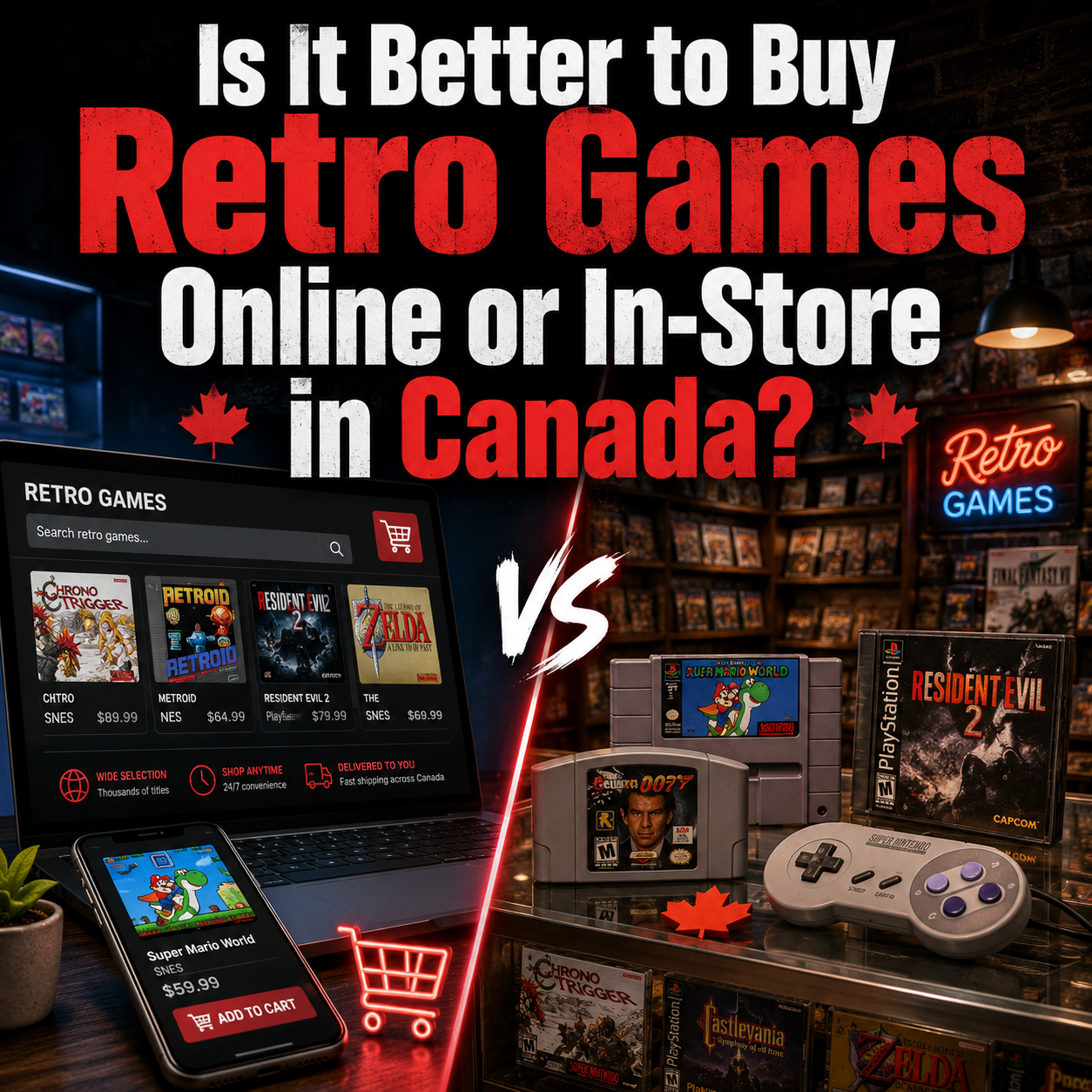
Is It Better to Buy Retro Games Online or In-Store in Canada?
Buying retro games online can be convenient, but shopping in-store gives you a different kind of confidence. This guide explains the pros, cons, risks, and safest ways to buy used games, consoles, and collectibles in Canada.
Summary
There is no single perfect way to buy retro games. Online shopping gives you convenience, selection, and Canada-wide access. In-store shopping gives you the chance to inspect items, ask questions, compare condition, and avoid some of the risks that come with private sellers and vague marketplace listings.
The safest option depends on what you are buying. Common, lower-priced games are usually less risky. Expensive games, Pokémon cartridges, complete-in-box items, rare titles, consoles, and “untested” marketplace listings deserve more caution.
Buying retro games in Canada is very different than it was years ago.
At one time, most people found used games at local stores, garage sales, flea markets, pawn shops, or from friends. Now, Canadian buyers can shop from retro game stores, online marketplaces, Facebook Marketplace, Kijiji, eBay, Amazon sellers, collector groups, private sellers, and online stores across the country.
That gives buyers more options, but it also creates more confusion.
Should you buy online because there is more selection? Should you buy in-store because you can see the item first? Is a private seller cheaper? Is a retro game store safer? Does warranty matter? What about fakes, scratched discs, shipping damage, missing manuals, or untested consoles?
The honest answer is that both online and in-store buying can be good. The better choice depends on the item, the seller, the price, the condition, and how much risk you are willing to accept.
The simple rule: The more expensive, rare, fragile, or commonly faked the item is, the more important it becomes to buy from a seller you trust.
Buying Retro Games Online: The Pros
Online shopping is popular for a reason. It gives Canadian retro game buyers access to far more inventory than they may find locally.
If you live outside a major city, your local options may be limited. Even if you live near game stores, the specific title you want may not be available on the shelf that day. Online shopping lets you search by console, title, series, condition, price, and availability without driving from place to place.
Online buying can be especially useful when you are looking for:
- A specific game title
- A replacement copy of a childhood favourite
- A less common console accessory
- Games for a system that is not common locally
- Multiple items from the same store
- Canada-wide shipping without needing to travel
For many buyers, online shopping is the easiest way to build a collection over time.
Buying Retro Games Online: The Risks
The biggest downside of online shopping is that you cannot physically inspect the item before buying it.
Photos, descriptions, and seller reputation become extremely important. A listing may look good at first glance, but still leave out details that matter.
Common online buying risks include:
- Scratched discs
- Dirty cartridge contacts
- Fake or reproduction games
- Printed cover art instead of original artwork
- Missing manuals or inserts
- Broken cases
- Untested consoles
- Weak disc drives or worn cartridge slots
- Stock photos instead of actual item photos
- Shipping damage
- No return option
This does not mean online shopping is bad. It means the seller matters.
Buying online from a trusted Canadian retro game store is very different than buying from a random seller with one blurry photo and the words “worked last time I checked.”
Be careful with “untested.” Untested does not always mean broken, but it does mean you are accepting more risk. This is especially true for expensive games, disc-based consoles, handheld systems, and cartridge games with save batteries.
Buying Retro Games In-Store: The Pros
Shopping in-store gives buyers something online shopping cannot: the ability to see the item before buying it.
You can look at the cartridge label, check the case, inspect the manual, ask questions, compare copies, and get a better feel for the condition. For many collectors, that matters.
In-store shopping can be especially helpful when buying:
- Complete-in-box games
- Higher-priced cartridges
- Older consoles
- Controllers and accessories
- Handheld systems with screens
- Games with condition-sensitive labels or boxes
- Items being purchased as gifts
Another major benefit is support. If you have questions about compatibility, condition, batteries, cables, controllers, or whether a game is a good fit, you can ask someone before buying.
Buying Retro Games In-Store: The Downsides
In-store shopping is not perfect either.
The biggest limitation is availability. A store can only sell what it currently has in stock. If a rare game has not come in through a trade-in or collection purchase, it may not be available that day.
In-store shopping also requires travel. If you are not close to a retro game store, getting there may not be convenient. That is one reason online shopping has become so important for Canadian collectors.
There is also the timing issue. A popular game may sell before you arrive, especially if the store’s inventory is live online and available to customers across Canada.
Best of both worlds: Many Canadian buyers use both options. They shop online when they know exactly what they want, and visit in-store when they want to browse, inspect condition, ask questions, or trade in items.
Online vs In-Store: Quick Comparison
Here is a simple way to compare the two options.
| Buying Method | Best For | Main Risk |
|---|---|---|
| Online retro game store | Convenience + protection | You rely on photos, descriptions, shipping, and the store’s accuracy. |
| In-store retro game store | Inspection + advice | Selection is limited to what is currently in stock. |
| Private marketplace seller | Potential deals | Condition, authenticity, testing, and returns may be uncertain. |
| eBay or auction-style listing | Hard-to-find titles | Total cost may rise with shipping, currency conversion, duties, and condition risk. |
| Garage sale or flea market | Treasure hunting | Items are often untested, dirty, incomplete, or sold as-is. |
| Random online store with no reputation | Usually not ideal | Authenticity, returns, support, and item accuracy may be unclear. |
Private Sellers vs Retro Game Stores
Private sellers can be a great source of retro games. Many real collections come from regular people selling games they owned for years.
The tradeoff is risk.
A private seller may not know how to test a console properly. They may not know how to spot a fake cartridge. They may not understand the difference between original cover art and printed replacement cover art. They may also have no return option once the sale is complete.
A retro game store usually costs more than the cheapest private listing, but that price may include services and protection that a private seller does not provide.
What a Trusted Store Can Add
- Cleaning and inspection
- Testing when possible
- More accurate item descriptions
- Warranty protection
- Return support
- Trade-in options
- Staff knowledge
- Authenticity checks on high-risk titles
- Better packaging for shipped orders
- A real business standing behind the sale
That does not mean every private sale is bad. It means buyers should understand what they are giving up when they choose the cheapest option.
When Buying Retro Games Online Makes Sense
Online buying makes a lot of sense when the seller is reputable and the listing is clear.
It is especially useful when you already know what you want. If you are searching for a specific game, accessory, replacement controller, or console model, online shopping can save a lot of time.
Online buying is also helpful when you are comparing different systems, building a wish list, or shopping from outside the store’s local area.
Online buying usually makes the most sense when:
- The seller has clear photos and descriptions
- The item condition is explained properly
- The store or seller has a good reputation
- The item includes warranty or return protection
- The shipping cost is reasonable
- You are buying common or lower-risk items
- You are buying from a Canadian seller and avoiding surprise import costs
When Buying In-Store Is Better
In-store buying is usually better when condition matters a lot.
If you are picky about labels, boxes, manuals, cases, screen condition, controller feel, or console condition, seeing the item in person can make a big difference.
In-store buying is also useful when you are not completely sure what you need. For example, you may need help figuring out which cables work with a console, whether a controller is compatible, or whether a disc-based system is the right choice for your setup.
In-store buying is often better for:
- Complete-in-box games
- Expensive cartridges
- Pokémon games and other commonly faked titles
- Older consoles
- Controllers where button feel matters
- Handheld systems with screens
- Items being purchased as gifts
- Collectors who care about exact condition
If you are near Barrie, visiting Power Up Gaming in person lets you browse one of Canada’s largest retro game selections while also getting help from staff who work with used games every day.
What Canadian Buyers Need to Watch For
Canadian buyers have a few extra things to consider when shopping for retro games.
A price from a U.S. seller may look cheaper at first, but the final cost can change quickly after currency conversion, shipping, possible duties, taxes, and return complications.
Marketplace listings can also vary heavily by region. A game that appears often in Toronto or Vancouver may be harder to find in smaller cities or rural areas. That can make online shopping from a Canadian retro game store more useful.
Before buying from outside Canada, always compare the full cost, not just the listed price.
Canadian Buyer Checklist
- Check whether the price is in Canadian or U.S. dollars.
- Confirm the shipping cost before comparing prices.
- Consider possible duties, taxes, or brokerage fees.
- Check whether returns are realistic from Canada.
- Look for Canadian sellers when you want faster shipping and easier support.
- Compare the full checkout price, not just the item price.
Be Extra Careful With Expensive or Commonly Faked Games
Some games deserve more caution than others.
Pokémon games, valuable Game Boy Advance titles, Nintendo DS Pokémon games, rare Super Nintendo games, certain RPGs, and other high-demand cartridges are common areas where buyers need to be careful.
A fake or reproduction game may look close enough in a photo to fool a casual buyer. It may even boot up and play. That does not mean it is authentic, reliable, or collectible.
If authenticity matters, do not rely only on the phrase “tested and working.” Functionality and authenticity are not the same thing.
For more help, read: How to Avoid Buying Fake Pokémon Games in Canada.
Disc Games Need Their Own Kind of Caution
Cartridges have authenticity and contact issues. Disc games have condition issues.
A disc may look acceptable in photos but still have scratches, resurfacing marks, cracks, pinholes, label damage, or read issues. Some discs can be professionally refinished, while others cannot be fixed safely or reliably.
Disc condition matters most when buying older CD and DVD-based games, especially if the game is expensive or hard to replace.
For more detail, read: Can Scratched Video Game Discs Be Fixed?.
Consoles Are Riskier Than Games
Buying a used game has some risk. Buying a used console usually has more.
Older consoles can have weak lasers, worn cartridge slots, bad capacitors, yellowed plastic, loose power ports, broken controller ports, dead batteries, missing covers, noisy fans, or inconsistent read problems.
Some issues do not show up in a quick test. A console might turn on but still struggle after warming up, reading certain discs, or playing for longer periods.
This is why warranty matters more on consoles than it does on many lower-priced games.
If you are troubleshooting a console, this guide may help: Why Your Retro Console Won’t Read Games.
Console warning: Be careful with private listings that only say “powers on.” A console powering on does not mean it reads games properly, saves properly, outputs video correctly, or works with all controller ports.
Questions to Ask Before Buying Retro Games Anywhere
Whether you are shopping online or in-store, asking the right questions can protect you from bad purchases.
Buyer Checklist
- Is this the actual item I will receive?
- Are the photos clear and current?
- Is the game authentic?
- Is the cover art original or printed?
- Is the manual included?
- Has the item been tested or inspected?
- Does the item include warranty or return support?
- Are there scratches, label damage, marker, cracks, or missing pieces?
- Is the seller located in Canada?
- What is the full price after shipping and taxes?
- Can the seller answer basic questions confidently?
Red Flags When Buying Retro Games Online
Some listings should make you slow down before sending money.
Online Listing Red Flags
- The price is far lower than every other copy.
- The seller only uses stock photos.
- The listing says “untested” on an expensive item.
- The seller refuses to send more photos.
- The seller avoids questions about authenticity.
- The condition description is vague.
- The game is listed as reproduction, repro, custom, or replacement.
- The seller has no return option.
- The shipping cost makes the deal less attractive.
- The item is described only as “powers on.”
Price Should Not Be the Only Factor
It is tempting to sort by the lowest price and buy the cheapest copy.
Sometimes that works. Other times, the cheapest copy is cheap for a reason.
A lower-priced listing may have worse condition, missing parts, no manual, printed cover art, no warranty, expensive shipping, fake cartridge concerns, or no return support.
When comparing prices, compare the full value:
- Item condition
- Completeness
- Authenticity
- Seller trust
- Testing
- Warranty
- Shipping
- Return options
- Total cost in Canadian dollars
The cheapest listing is not always the best deal.
For a deeper look at pricing, read: Why Are Retro Video Games So Expensive in Canada?.
A Retro Game Store Owner’s Perspective
Online and in-store shopping both have a place. Some customers know exactly what they want and prefer to order online. Others want to browse, compare condition, ask questions, and see items in person before buying.
From a store perspective, the most important thing is trust. Whether someone buys online or visits in person, they should know what they are getting, understand the condition, and have support if something goes wrong.
Used games are not all equal. Cleaning, inspection, testing, accurate descriptions, warranty support, and authenticity checks all matter, especially as prices rise.
So, Is Online or In-Store Better?
Neither option is automatically better for every buyer.
Online is better when you want convenience, selection, and Canada-wide access. In-store is better when you want to inspect condition, ask questions, compare copies, or buy higher-risk items with more confidence.
The safest buying method is not really about online versus in-store. It is about buying from a seller who is honest, accurate, knowledgeable, and willing to stand behind what they sell.
Our Take
If you are buying common, lower-priced games from a trusted seller, online shopping can be easy and safe.
If you are buying expensive games, commonly faked cartridges, complete-in-box items, consoles, handhelds, or gifts, it is worth being more careful. In-store shopping can help, but buying online from a trusted retro game store can also be a strong option when the descriptions are clear and the warranty support is real.
The best approach for many Canadian collectors is to use both.
Shop online when you know what you want. Visit in-store when you want to browse, inspect, ask questions, or trade in your games. Either way, focus on condition, authenticity, seller trust, and total value.
Shop Online or Visit Us In-Store
Power Up Gaming carries retro games, modern games, consoles, accessories, collectibles, and gaming gear. Shop online with Canada-wide shipping or visit us in Barrie, Ontario to browse in person.
Shop Retro Games Shop Consoles View Current Sales Trade In Your GamesFAQ
Is it safe to buy retro games online?
It can be safe if you buy from a trusted seller with clear photos, accurate descriptions, reasonable shipping, and warranty or return support. The risk is higher with vague marketplace listings, stock photos, and untested items.
Is it better to buy retro games in-store?
In-store buying is often better when condition matters, especially for complete-in-box games, expensive cartridges, consoles, handheld systems, and items being bought as gifts. You can inspect the item and ask questions before buying.
Are private sellers cheaper than retro game stores?
Sometimes, yes. Private sellers may have lower prices because they do not offer the same testing, cleaning, warranty, return support, staff knowledge, or business overhead as a store. The lower price may also come with more risk.
What should I check before buying a used game online?
Check whether the photos show the actual item, whether the condition is clearly described, whether the game is authentic, whether the manual or case is included, what shipping costs, and whether there is a return option.
Should I buy expensive retro games online?
You can, but expensive games require more caution. Buy from a trusted seller, avoid vague listings, confirm authenticity, check condition carefully, and make sure the seller stands behind the item.
Are Pokémon games safe to buy online?
Pokémon games can be bought online safely from trusted sellers, but buyers should be careful. Many Pokémon games are commonly faked, especially valuable Game Boy Advance and Nintendo DS titles.
Is “tested and working” enough?
Not always. A game or console may turn on but still have other issues. For cartridges, authenticity and saving may matter. For consoles, reading games, controller ports, video output, and long-term reliability may also matter.
Why do retro game stores cost more than marketplace sellers?
A retro game store may include cleaning, inspection, testing, staff knowledge, warranty support, return handling, payment processing, rent, packaging, and customer service in the price. A private seller may not offer those protections.
What is the safest way to buy retro games in Canada?
The safest way is to buy from a trusted Canadian seller that clearly describes condition, checks authenticity when needed, offers warranty or return support, and stands behind what they sell.
Can I trade in games instead of buying outright?
Yes. Trading in games, consoles, or accessories you no longer use can help reduce the cost of building your collection and make it easier to pick up the items you actually want.
Source note: This article is a buyer-education guide from Power Up Gaming based on common risks and benefits of buying used retro games online, in-store, through private sellers, and from Canadian retro game stores. It is intended as general shopping guidance for retro game buyers in Canada.