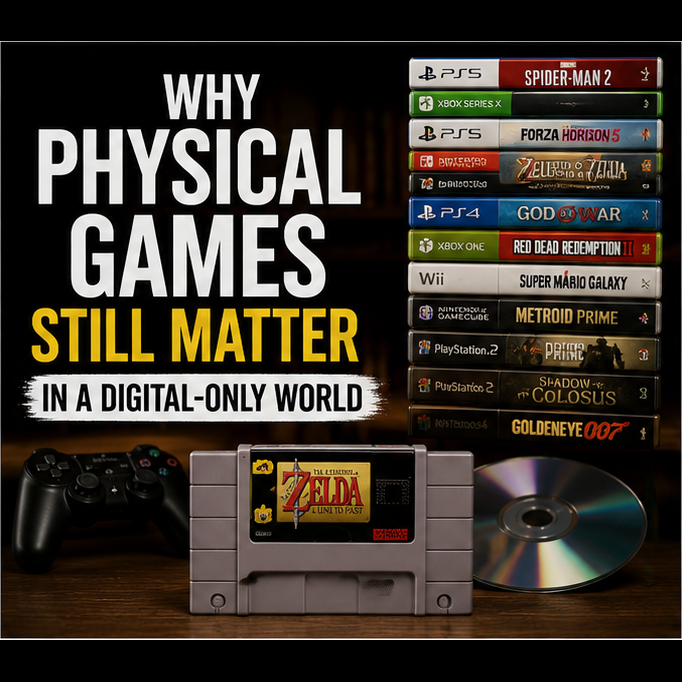
Why Physical Games Still Matter in a Digital-Only World
Summary
Digital games are convenient, but physical games still matter. Discs, cartridges, cases, manuals, artwork, collector editions, and used games give players something that digital libraries often cannot: ownership, flexibility, display value, resale value, trade-in value, and long-term preservation.
As more gaming moves toward downloads, subscriptions, cloud services, and digital storefronts, physical games become even more important for collectors and players who want control over their libraries. When a digital store closes, when licensing changes, or when a game disappears from an online shop, physical copies can become the best way to keep that game accessible.
At Power Up Gaming, we carry a large rotating selection of used video games, including retro games, modern games, consoles, accessories, collectibles, and gaming gear. Whether you collect Nintendo, PlayStation, Xbox, Sega, handhelds, or modern physical releases, physical gaming is still very much alive.

Digital Games Are Convenient, But Convenience Is Not the Same as Ownership
Digital games are easy to buy, easy to install, and easy to access from your account. There is nothing wrong with enjoying digital games. For many players, digital libraries are useful and convenient.
But convenience is not the same as ownership.
When you buy a physical game, you own a disc, cartridge, case, or collectible item that exists outside of a digital storefront. You can put it on a shelf, lend it to a friend, trade it in, sell it, gift it, collect it, or play it on original hardware. With digital games, your access depends on an account, a storefront, a license, an internet connection, platform rules, and long-term support from the company that sold it.
That difference matters. A digital library can be convenient, but a physical library gives players more control.

Digital Storefronts Do Not Last Forever
One of the biggest reasons physical games still matter is that digital stores can close.
We have already seen this happen. The Wii U and Nintendo 3DS eShops closed for new purchases in 2023. The Xbox 360 Store and Marketplace closed for new purchases in 2024. Players who already purchased content may still be able to redownload certain games or DLC, but new buyers can no longer shop those original storefronts the way they once could.
That is a major reminder that digital access can change. A game that feels easy to buy today may not be available tomorrow. Licensing issues, store closures, delistings, expired music rights, publisher changes, and platform transitions can all affect whether a game remains available digitally.
Physical games are not perfect, but they are an important safety net. If a game exists on disc or cartridge, players and collectors have another way to preserve it.

Physical Games Help Preserve Gaming History
Video games are not just entertainment. They are part of cultural history.
Every console generation tells a story. The NES helped revive home gaming. The Super Nintendo and Sega Genesis defined the 16-bit era. The PlayStation brought 3D gaming to the mainstream. The Nintendo 64 introduced countless players to analog control and local multiplayer. The PS2 became one of the biggest gaming libraries of all time. The Xbox 360, PS3, and Wii helped shape online gaming, motion controls, achievements, digital stores, and HD game design.
Physical games preserve those eras in a way that digital listings cannot fully replace. A physical copy includes the artwork, case design, rating labels, inserts, manuals, cartridge shells, disc art, and sometimes even maps, posters, registration cards, or bonus content.
Collectors are not just buying plastic cases. They are preserving the way games were originally sold, played, displayed, and remembered.
If you enjoy the history of older games and consoles, you may also like our article on the rise of retro gaming.

Physical Games Can Be Sold, Traded, Gifted, and Shared
One of the biggest advantages of physical games is flexibility.
If you finish a physical game and no longer want it, you can sell it, trade it, or give it to someone else. If your friend wants to borrow a game, you can hand it to them. If you want to build store credit toward another game, a physical copy has trade-in value.
Digital games usually do not work that way. Once a digital game is tied to your account, it usually stays there. You cannot easily lend it, resell it, or trade it in.
That makes physical games valuable even when they are common. A physical game is not just a license on an account. It is an item that can keep moving through the gaming community.
That is also part of why used game stores matter. Used games give players a way to buy, sell, trade, collect, and keep older games circulating long after their original retail life.

Physical Games Have Collectible Value
Digital games can be fun to play, but they are difficult to collect in the same way.
A physical game can have condition, rarity, artwork, variants, special editions, manuals, inserts, sealed copies, complete-in-box versions, and shelf appeal. A digital game does not have those same collector details.
Collectors care about condition. They care about original artwork. They care about whether a game is loose, complete, sealed, damaged, resurfaced, original, reprinted, or part of a special release. They care about labels, cases, manuals, maps, strategy guides, and packaging differences.
That is why physical collecting remains strong. A digital library can hold games, but a physical collection tells a story.
You can browse our full selection of used video games or check out our strategy guides and video game magazines if you enjoy collecting beyond the games themselves.

Physical Games Can Become Harder to Find Over Time
Some physical games stay common for years. Others become harder to find very quickly.
Collector demand, low print runs, licensing issues, late-generation releases, niche genres, RPGs, horror games, special editions, and discontinued systems can all affect availability. A game that sits in bargain bins today may become a collector title later.
That does not mean every physical game will become valuable. Many games will always remain common. But physical copies have a market because they are finite. Once a game is out of print, no new original copies are being made.
That is one of the reasons collectors pay attention to systems like PlayStation 3, Xbox 360, and Nintendo Wii U. These systems are old enough to feel nostalgic, but many games are still affordable enough to collect before prices climb higher.

Physical Games Are Better for Display and Nostalgia
There is something different about seeing a shelf full of games.
A digital library might have hundreds of titles, but it does not feel the same as looking at cases, cartridges, manuals, and artwork. Physical games make a collection visible. They become part of a room, a memory, and a personal history.
For many players, the case art alone is part of the nostalgia. Seeing a row of NES carts, SNES boxes, N64 games, GameCube cases, PS2 spines, Xbox 360 cases, Wii games, DS cartridges, or Switch cases can bring back a whole era of gaming.
Physical games are not just about playing. They are about remembering.

Physical Games Make Gift Giving Better
Physical games are also better gifts.
A digital code can be useful, but it does not have the same feeling as handing someone an actual game. Physical games can be wrapped, displayed, opened, collected, and remembered. For birthdays, holidays, collectors, kids, nostalgic players, and retro fans, a physical game feels more personal.
Used games can also make gift giving more affordable. Instead of buying one expensive new release, you may be able to build a small stack of used games for the same budget.
Our video game sale section is a great place to look for deals, monthly specials, and budget-friendly physical games.
Physical Games Support Used Game Stores and Local Gaming Communities
Physical games help keep used game stores alive.
When players buy, sell, and trade physical games, those games keep circulating through the community. Local stores help clean, inspect, organize, price, test, warranty, and resell those games. That gives players a safer way to shop used games than random online listings with unknown condition.
Used game stores also become places where people discover games they were not searching for. A player might walk in for a PS4 game and leave with an original Xbox title, a Nintendo DS game, a strategy guide, a GameCube controller, or a weird Wii game they forgot existed.
Digital stores are efficient, but they are not the same as browsing a real used game selection. Discovery is part of the fun.
Physical Does Not Always Mean Perfect
Physical games still have limitations.
Discs can scratch. Cartridges can need cleaning. Cases can break. Manuals can go missing. Save batteries can die. Some modern physical games still require downloads, updates, patches, or online servers. Not every disc contains the complete final version of a game.
That is why condition matters. When buying physical games, check the disc, cartridge, label, case, artwork, manual, inserts, and compatibility. For valuable games, authenticity also matters.
At Power Up Gaming, our used games are cleaned and inspected, and many disc-based games are backed by warranty. If you want to learn more about disc condition, read our article: Can Scratched Video Game Discs Be Fixed?
If you are worried about counterfeit games, especially with older cartridges, read our guide: How to Spot Fake Retro Games Before You Buy.

Digital and Physical Can Both Have a Place
This is not about saying digital games are bad.
Digital games are convenient. They are useful for indie games, sales, travel, quick access, and modern consoles with limited shelf space. Some games are only available digitally, and some players prefer not to store physical copies.
But physical games still offer something important. They give players more control, more flexibility, more collectible value, and a stronger connection to gaming history.
The best approach for many players is a mix. Use digital when it makes sense, but do not ignore physical games. If there are games you truly care about, games you want to preserve, or games you may want to collect long term, physical copies are still worth considering.
Why Physical Games Still Matter for Retro Collectors
For retro collectors, physical games are the entire point.
Retro gaming is built around original hardware, original cartridges, original discs, original cases, original artwork, and the feeling of playing games the way they were first experienced. Emulation, digital collections, and remasters can be useful, but they do not fully replace original physical media.
A Nintendo 64 cartridge, a PlayStation disc, a GameCube case, a DS cartridge, a Wii game, or an Xbox 360 disc all represent a specific time in gaming. The physical object is part of the experience.
That is why players still search for physical copies of older games. It is not only about playing. It is about collecting, preserving, remembering, and owning a piece of gaming history.
What Physical Games Should You Buy First?
If you are building a physical game collection, start with the games that matter to you personally.
Buy the games you loved as a kid. Buy the games you missed. Buy the games you want to replay. Buy the games your kids, friends, or partner will enjoy. Buy the games that make you excited to put a console on and actually play.
After that, watch for categories that tend to become more collectible:
- RPGs and JRPGs
- Horror games
- First-party Nintendo titles
- Late-generation releases
- Licensed games
- Low-print titles
- Complete-in-box games
- Special editions
- Games with manuals, maps, or inserts
- Games that are no longer available digitally
You do not need to collect everything. A good physical collection should reflect what you actually enjoy.
Final Thoughts: Physical Games Are Still Worth Owning
Physical games still matter because they give players something digital libraries cannot fully replace.
They offer ownership, trade-in value, resale value, giftability, display value, nostalgia, preservation, and long-term collecting potential. They help keep gaming history alive and give players more control over the games they care about.
Digital gaming is not going away, but physical gaming is not dead. For collectors, retro fans, budget-conscious players, families, and anyone who cares about preserving games, physical copies still have a real place.
You can shop our current selection of used video games, video game consoles, and sale items at Power Up Gaming. We ship across Canada from our Barrie, Ontario store.
FAQ
Are physical games still worth buying?
Yes, physical games are still worth buying because they can be collected, displayed, traded, sold, gifted, and preserved. They also give players more control than digital-only purchases.
Are digital games better than physical games?
Digital games are convenient, but physical games offer ownership, resale value, trade-in value, display value, and collecting potential. The best option depends on how you play and collect.
Can digital games disappear?
Yes, digital games can be delisted, storefronts can close, and licensing can change. Players may still keep access to some previously purchased content, but new purchases may no longer be possible after a store closes.
Why do collectors prefer physical games?
Collectors prefer physical games because they include artwork, cases, cartridges, discs, manuals, inserts, variants, special editions, and condition differences. These details make physical games more collectible than digital downloads.
Do physical games increase in value?
Some physical games increase in value, especially RPGs, horror games, low-print titles, late-generation releases, special editions, complete-in-box games, and games that are no longer easy to buy digitally. Not every game becomes valuable.
Are used games safe to buy?
Used games can be safe to buy when they are cleaned, inspected, tested when needed, and backed by a reliable return or warranty policy. Condition matters, especially for discs, cartridges, cases, and labels.
Should I buy loose or complete games?
Loose games can be fine for players, but complete games are usually better for collectors. Original cases, cover art, manuals, inserts, and packaging can all affect collector value.
Why do physical games matter for game preservation?
Physical games help preserve gaming history because they exist outside of digital storefronts. They keep older games, artwork, packaging, and hardware experiences available after digital stores or services change.
Are physical games better gifts?
Physical games often make better gifts because they can be wrapped, opened, displayed, collected, and remembered. They feel more personal than a digital code or account purchase.
Where can I buy physical used video games in Canada?
You can buy physical used video games in Canada from Power Up Gaming. We carry retro games, modern games, consoles, accessories, sale items, strategy guides, magazines, collectibles, and more online and from our retail store in Barrie, Ontario.