Summary
Fake retro games are everywhere now, especially for high-demand titles like Pokémon, Fire Emblem, Castlevania, Zelda, Mario, Metroid, EarthBound, Chrono Trigger, and other collectible cartridge games. Some fakes are obvious, with blurry labels, cheap plastic, wrong screws, bad fonts, and strange board layouts. Others are much harder to catch, especially when sellers use poor photos, stock images, vague wording, or modern counterfeit cartridges that have gotten better over time.
The most important rule is simple: never trust one clue by itself. A real-looking label does not guarantee a real cartridge. A stamped number does not guarantee a real game. A game booting on a console does not guarantee it is authentic. Counterfeit games have improved, and verification communities warn that many older “easy tricks” are no longer foolproof because fake cartridges now copy shell details, labels, markings, and molded features more closely than before. (Game Verifying)
This guide explains how to spot common fake retro games, including Game Boy, Game Boy Color, Game Boy Advance, Nintendo DS, NES, SNES, Nintendo 64, Sega Genesis, and disc-based games. It also explains why Pokémon games are counterfeited so often, why reproduction games are not the same as authentic originals, and why buying from a trusted store like Power Up Gaming can help reduce the risk of getting burned.
Power Up Gaming has never knowingly or willingly sold a fake game in our history. That is something we take seriously. Fake games are getting harder and harder to spot, which is why we are careful about what we sell and why we keep a collection of fake games in-store as reference examples. We use them to compare labels, shells, boards, plastic, printing, screws, and other details when something feels off.

Why Fake Retro Games Are Such a Big Problem
Retro games used to be cheap.
That sentence hurts now, doesn’t it?
There was a time when Game Boy Advance games, Nintendo DS games, Nintendo 64 cartridges, and even many Super Nintendo titles were sitting in bins, yard sales, pawn shops, and dusty closets without anyone treating them like tiny plastic investments. Now the market is different. Collectors want complete libraries. Pokémon games are expensive. Certain GameCube, GBA, DS, SNES, N64, and NES titles can sell for serious money.
Whenever prices go up, fakes follow.
Counterfeiters usually chase games with high demand and high resale value. That is why fake Pokémon games are so common. A fake copy of a common sports game is not worth much effort. A fake Pokémon Emerald, Pokémon HeartGold, Pokémon SoulSilver, FireRed, LeafGreen, Platinum, Black 2, or White 2 can fool someone out of real money.
Nintendo describes counterfeit games and systems as one form of video game piracy, alongside illegal software, circumvention devices, and system modifications. (Nintendo Support) For collectors, though, the problem is not only that fake games exist. The bigger problem is that fake games get mixed into the used market. Once they are traded, resold, gifted, flipped, or bundled into lots, someone down the chain may honestly believe they own a real copy.
That is how a fake becomes somebody else’s headache.
Reproduction, Counterfeit, Bootleg, and Fake: What Is the Difference?
People use these words interchangeably, but they do not always mean the same thing.
A counterfeit game is made to look like a real official game and is usually sold as authentic. This is the big problem. A fake Pokémon Emerald being sold as a real Pokémon Emerald is not a harmless alternative. It is deception.
A reproduction cartridge is usually a modern-made cartridge that plays a game, ROM hack, translation, homebrew, or reissued version. Some people use reproductions for fan translations, unreleased games, or affordable play copies. The issue is transparency. A reproduction clearly sold as a reproduction is very different from a reproduction passed off as an original.
A bootleg is an unauthorized copy. It may not even try to look original. Some bootlegs are obvious weirdness, like “999 in 1” carts, strange labels, strange game names, or menus full of mystery ROMs. Others try harder to look official.
A label swap is when someone takes a real cartridge and puts a different label on it. This can happen with cartridge games, disc games, DS games, Switch games, and boxed games. In some cases, a cheap game gets relabeled to look like an expensive one.
A replacement label is not always malicious. Some collectors replace damaged labels for display purposes. But if the game is being sold as fully original, a replacement label should be disclosed.
The key is honesty.
At Power Up Gaming, the concern is not whether someone personally wants a clearly marked reproduction for their own shelf. The concern is fakes being represented as real, especially when customers are paying authentic-game prices.
The Golden Rule: Use Multiple Clues
Do not authenticate a game based on one single thing.
A fake game might have:
A decent-looking label
A real-looking shell
The right screw type
A stamped number
A correct-looking back
A working save file
A title screen that looks normal
And it can still be fake.
The best approach is to check several layers:
Price
Seller behaviour
Listing wording
Photos
Label
Shell
Screw type
Cartridge code
Region code
Board or PCB
Save behaviour
Weight and plastic feel
Manual, box, and inserts
Known authentic reference photos
The more valuable the game, the more proof you should want.
A $12 loose copy of a common sports game does not need a forensic investigation. A $200 Pokémon game absolutely does.

Marketplace Red Flags Before You Even See the Game
A lot of fakes can be spotted before you ever hold them.
Be careful when a listing has:
Stock photos only
No photo of the back
No photo of the pins
No close-up of the label
No photo of the board for high-value games
“Authentic” written aggressively in the title
“Reproduction” hidden in the description
“Repro” buried at the bottom
“Custom cartridge”
“Replacement shell”
“Fan version”
“New save battery” with no proof
“Rare version” with no details
Huge quantity available
Price far below market
Shipping from a region known for bulk counterfeit listings
Seller refuses extra photos
Seller says “I don’t know anything about games”
Seller says “untested” on an expensive, easy-to-test cartridge
That last one is a classic.
“Untested” can be honest. But when someone is selling a valuable Pokémon game, and they somehow know the exact market value but cannot test it or photograph the board, your eyebrows should go up so high they need their own postal code.


Why Pokémon Games Are Counterfeited So Often
Pokémon is the counterfeit king.
That is because Pokémon games have the perfect storm of resale value, nostalgia, demand, and small cartridge size. They are easy to ship, easy to list, easy to fake badly, and profitable when people do not know what to look for.
The most commonly faked Pokémon games include:
Pokémon Red
Pokémon Blue
Pokémon Yellow
Pokémon Gold
Pokémon Silver
Pokémon Crystal
Pokémon Ruby
Pokémon Sapphire
Pokémon Emerald
Pokémon FireRed
Pokémon LeafGreen
Pokémon Diamond
Pokémon Pearl
Pokémon Platinum
Pokémon HeartGold
Pokémon SoulSilver
Pokémon Black
Pokémon White
Pokémon Black 2
Pokémon White 2
The GBA Pokémon games are especially notorious. Pokémon Ruby, Sapphire, Emerald, FireRed, and LeafGreen are frequent targets because real copies are desirable, valuable, and easy for counterfeiters to imitate from the outside. Nintendo DS Pokémon games are also heavily faked, especially the later and more expensive ones like HeartGold, SoulSilver, Platinum, Black 2, and White 2.
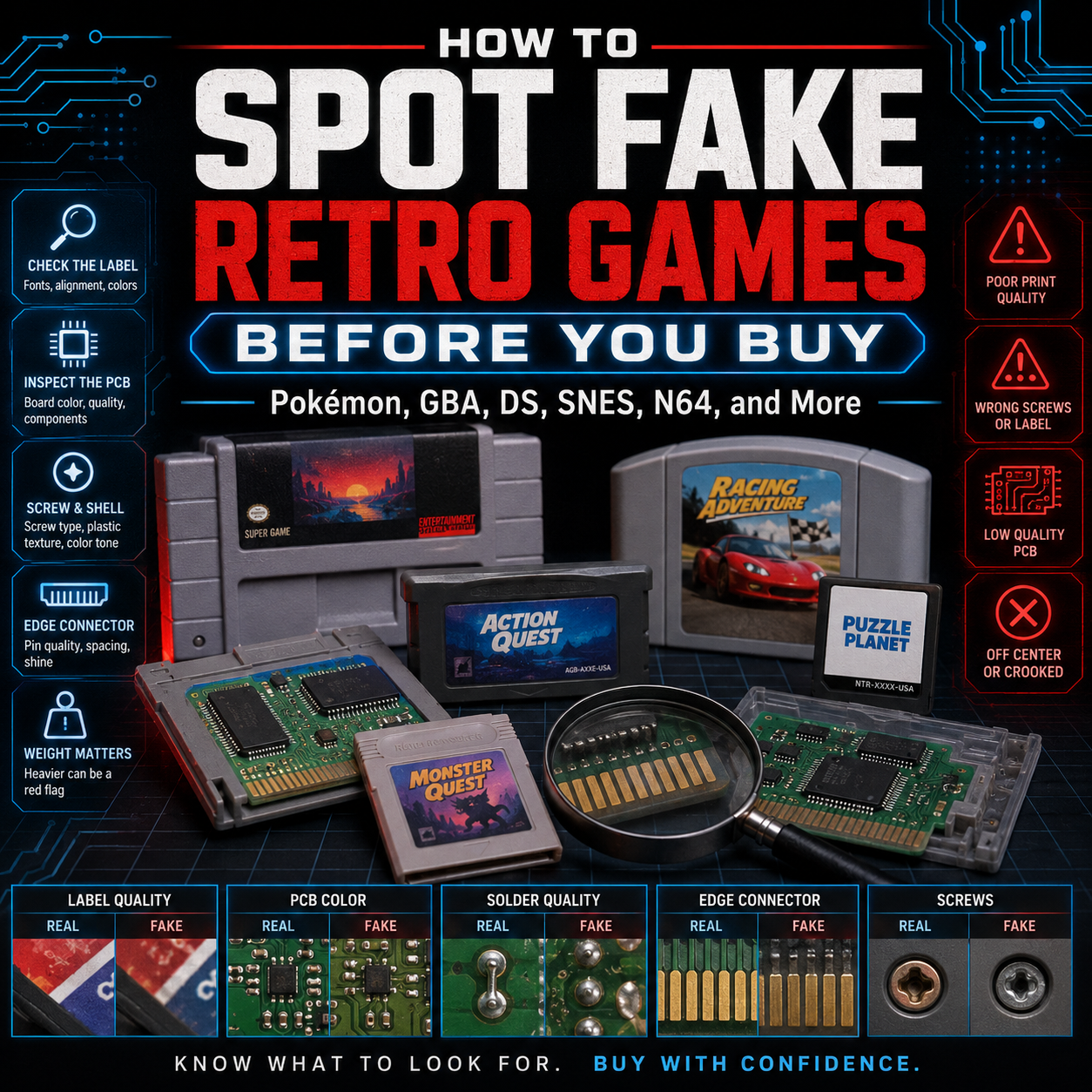
This is one of the biggest reasons a guide like this needs pictures. Pokémon fakes can be spotted visually, but the tiny details matter.

The Fast First Check: Does the Price Make Sense?
Price is not proof, but it is a warning light.
If a game normally sells for $150 and someone is offering multiple copies for $39.99, be careful.
Cheap does not always mean fake. Sometimes people underprice things. Sometimes sellers do not know what they have. Sometimes condition is poor. Sometimes it is a Japanese copy, a PAL copy, or missing the manual.
But counterfeiters rely on excitement. They want you to think, “I need to grab this before someone else does.”
Slow down.
Before buying a suspiciously cheap game, check:
Sold listings, not asking prices
Condition
Region
Whether it is authentic or reproduction
Whether the seller has many copies
Whether the photos are real
Whether the label matches known authentic copies
Whether the board has been photographed
A deal that disappears when you ask for a board photo was never a deal.
Labels: The Easiest Thing to Fake, But Still Useful
Labels are the first thing most people check, and they can catch a lot of bad fakes.
Look for:
Blurry printing
Wrong colours
Bad cropping
Text too close to the edge
Wrong font weight
Overly glossy sticker finish
Faded-looking art on a supposedly mint game
Bad spelling
Missing accent marks
Incorrect rating logo
Incorrect Nintendo seal
Wrong game code
Wrong region code
Box art used where cartridge art should be
Labels that look too new for a 20 to 30-year-old game
Epilogue’s cartridge guide notes that label and shell checks can help, but also emphasizes checking multiple signs and, when possible, verifying the internal hardware and game data instead of relying on surface details alone. (Epilogue)
A real cartridge can have a replacement label. A fake cartridge can have a convincing label. A label can be printed from a high-resolution scan. A seller can swap a label onto another shell.
Use the label as a clue, not a verdict.
Cartridge Shells: Plastic Tells a Story
Official cartridges usually have consistent plastic quality. Fake cartridges often feel slightly wrong.
Common shell red flags include:
Plastic feels too light
Plastic feels brittle
Colour is slightly off
Shell is too glossy
Shell edges are rounded or soft
Seams are uneven
Screw hole looks wrong
Cartridge halves do not line up properly
Embossed text is too shallow or too sharp
Molded logos look off
Texture does not match original cartridges
The cartridge does not sit correctly in the console
This is especially useful with N64, SNES, NES, Game Boy, and GBA games. The more real cartridges you handle, the easier it becomes to notice when a fake feels “wrong.”
But this is also where counterfeiters have improved. GameVerifying warns that some older visual checks are unreliable because counterfeits can now copy molded lines and shell features more closely, and because real shells can be used with fake boards through recasing or relabeling. (Game Verifying)
At Power Up Gaming, this is where experience matters. When you handle thousands of games over the years, the weird ones stand out faster.
Screws and Security Bits
Many Nintendo cartridges use security screws rather than regular Phillips screws.
Common official screw types include:
3.8mm gamebit screws for many NES, SNES, N64, Game Boy, and Game Boy Color cartridges
Tri-wing screws for many Game Boy Advance cartridges
Small specialty screws on some later cartridge formats
A fake cartridge may use:
Phillips screws
Wrong-sized screws
Plastic fake screw shapes
Screws in the wrong place
Screws that strip easily
Screws that look too new or cheap
But again, one warning sign is not everything. Screws can be replaced. Shells can be swapped. A fake can use a convincing screw. A real game can have been opened for cleaning or battery replacement.
Screws help. They do not settle the case by themselves.

The Board Is Usually the Best Evidence
For valuable cartridge games, the internal board is often the best place to verify authenticity.
The board, also called the PCB, can reveal things a label cannot.
Look for:
Correct manufacturer markings
Correct board code
Correct chip layout
Mask ROM chips that match known authentic examples
Correct save chip or battery layout
Clean factory soldering
Proper gold contacts
No epoxy blob chips on games that should not have them
No modern flash board where an original mask ROM should be
No SD card slot hidden inside
No strange wire work
No cheap modern components where old ones should not be
Even digital verification tools can be imperfect. A recent Verge test of Epilogue’s GB Operator authentication feature found that the concept was useful, but it misidentified some authentic cartridges and missed some counterfeits, with physical inspection still remaining important. (The Verge)
That is the big lesson: tools are useful, but eyes and experience still matter.


How to Spot Fake Game Boy and Game Boy Color Games
Game Boy and Game Boy Color games are commonly faked, especially Pokémon and Zelda titles.
Check the label first:
Correct artwork
Correct colour
Correct ESRB or regional rating
Sharp text
Proper Nintendo seal
No spelling mistakes
No weird cropping
No “new” glossy label on an old-looking shell
Then check the shell:
Correct cartridge colour
Correct plastic texture
Proper molded details
Correct branding
Correct screw type
No strange seam gaps
No cheap transparent shell unless the original used one
Then check the board:
Correct board layout
Correct chip markings
Correct battery presence if the game used one
Clean factory soldering
No epoxy blob
No modern flash board pretending to be original
Pokémon games deserve extra care. Pokémon Red, Blue, Yellow, Gold, Silver, and Crystal are all targets. Crystal is especially faked because of its high value and distinctive cartridge shell.
Some Game Boy fakes still play, but saves may fail, clocks may not work, trading can behave badly, or the game may crash later.
How to Spot Fake Game Boy Advance Games
GBA fakes are everywhere.
The most commonly faked GBA titles include:
Pokémon Ruby
Pokémon Sapphire
Pokémon Emerald
Pokémon FireRed
Pokémon LeafGreen
Metroid Fusion
Metroid Zero Mission
Castlevania games
Final Fantasy games
Fire Emblem games
Zelda games
Mario Advance games
Exterior clues:
Label too glossy
Label art too dark or too bright
ESRB logo looks wrong
Game code is misplaced
Nintendo seal looks flat
Font weight looks too heavy
Plastic colour is off
Shell feels cheap
Screw is wrong
Back text looks shallow or incorrect
Internal clues:
Wrong board colour
Wrong chip layout
Blob chip
Missing expected board markings
Poor soldering
Wrong battery setup
Cheap flash memory
For GBA, especially Pokémon, the best advice is:
Exterior clues are a starting point.
Board inspection is the serious check.
Multiple clues beat one trick every time.
Special Notes for GBA Pokémon Games
Pokémon GBA games have some extra signs collectors often check.
For Ruby, Sapphire, and Emerald:
Cartridge shell colour should match the title
Label should have correct shine and colour for that release
Label placement should be precise
Game code should match the title and region
Internal board layout should match known authentic examples
The battery setup should make sense for the game
Clock-based events should behave properly if the battery works
For FireRed and LeafGreen:
Cartridge colours matter
Label art and shine matter
Code placement matters
Board inspection matters
Be careful with “new battery” claims. A real GBA Pokémon game can have a replaced battery, but sellers sometimes use that phrase to make a fake sound serviced.
A new battery does not make a fake real.

How to Spot Fake Nintendo DS Games
Nintendo DS games can be tricky because they are small, and fakes have gotten better.
Commonly faked DS games include:
Pokémon Diamond
Pokémon Pearl
Pokémon Platinum
Pokémon HeartGold
Pokémon SoulSilver
Pokémon Black
Pokémon White
Pokémon Black 2
Pokémon White 2
Mario Kart DS
New Super Mario Bros.
Animal Crossing: Wild World
Chrono Trigger
Dragon Quest games
Castlevania games
Things to check:
Front cartridge code
Back cartridge code
Label quality
Cartridge plastic
Nintendo logo embossing
Back text
Font sharpness
The small triangle or arrow area
Infrared cartridge shell on certain Pokémon games
Whether the code matches the game and region
GameVerifying cautions against relying too heavily on single DS checks, because counterfeit carts continue to evolve and some once-popular tells are no longer reliable on their own. (Game Verifying)
So, once again: use multiple clues.

Special Notes for Pokémon HeartGold and SoulSilver
Pokémon HeartGold and SoulSilver deserve their own warning.
These games used infrared features with the Pokéwalker, and legitimate cartridges are different from many standard DS cartridges. Collectors often check the cartridge shell under light because authentic infrared-compatible shells can appear reddish or translucent when held to a strong light source.
But do not use the light trick alone.
For HeartGold and SoulSilver, check:
Correct cartridge code
Correct shell type
Back code
Label quality
Nintendo logo
Infrared shell behaviour
Case and manual match
Whether Pokéwalker features work
Seller photos and price
These games are expensive enough that guessing is a bad plan.

What About Nintendo 3DS Games?
Fake 3DS cartridges are much less common than fake DS or GBA games, largely because the security and manufacturing are harder to replicate.
However, buyers should still watch for:
Region issues
Relabeled games
Fake cases or cover art
Bootleg multi-carts
Misleading listings
Damaged or resealed packaging
Seller claiming a PAL or Japanese game is “Canadian compatible”
The bigger 3DS problem for Canadian buyers is usually region locking, not cartridge counterfeiting. A Japanese 3DS game may be real and still not work on a Canadian 3DS.
So with 3DS, ask two questions:
Is it authentic?
Is it the right region?
What About Nintendo Switch and Switch 2 Games?
Fake Switch and Switch 2 physical games are not the same situation as fake GBA or DS games.
For Switch and Switch 2, the bigger problems are often:
Relabeled cartridges
Tampered cartridges
Stolen or suspicious second-hand copies
Flash cartridge tools
Digital account issues
Fake cases or cover art
Misrepresented region or language
Listings that are actually empty cases
With modern Nintendo cartridges, counterfeit physical game cards are more complicated than older GBA-style fakes, but buyers should still inspect labels, shell quality, back markings, and seller behaviour.
For Power Up Gaming, this is another reason trusted sourcing matters. Modern cartridges may not have the same fake market as GBA, but sketchy game media is still sketchy game media.
How to Spot Fake NES Games
NES fakes are less common than GBA Pokémon fakes, but they absolutely exist, especially for expensive titles.
Common targets include:
Little Samson
Panic Restaurant
Flintstones: Surprise at Dinosaur Peak
DuckTales 2
Bubble Bobble Part 2
Mega Man games
Castlevania games
Zelda games
Contra games
Check:
Label print quality
Cartridge plastic texture
Front and back shell fit
Screw type
Back label
Nintendo seal
Board markings
Chip layout
Whether the board matches the game
Whether the game has been converted from a donor cart
NES counterfeits can involve donor boards, reproduction boards, new shells, fake labels, or custom PCBs. A rare NES game should be opened and inspected before anyone pays rare NES money.

How to Spot Fake SNES Games
SNES games are a major counterfeit category because many valuable titles are expensive.
Common fake targets include:
EarthBound
Chrono Trigger
Mega Man X2
Mega Man X3
Final Fantasy III
Secret of Mana
Super Mario RPG
Harvest Moon
Pocky & Rocky games
Wild Guns
Ninja Warriors
Castlevania Dracula X
Check:
Label quality
End label alignment
Shell texture
Screw type
Front and back shell consistency
Back warning label
Board markings
Chip layout
CIC or security chip when applicable
Whether the board has EPROMs or modern flash parts
Whether the game is a known reproduction or conversion
One extra SNES issue is board swapping. Someone may use an authentic SNES shell, print a replacement label, and put a reproduction board inside. That can fool casual buyers from the outside.
For expensive SNES games, open the cart or buy from someone you trust.

How to Spot Fake Nintendo 64 Games
N64 fakes are extremely common now.
Common fake targets include:
Conker’s Bad Fur Day
Paper Mario
Mario Party 3
Super Smash Bros.
Pokémon Stadium 2
Zelda: Ocarina of Time
Zelda: Majora’s Mask
Banjo-Tooie
Kirby 64
Snowboard Kids 2
Worms Armageddon
Check:
Front label quality
Back label quality
Stamped number on back label
Shell plastic texture
Nintendo logo and molded text
Screw quality
Cartridge weight
Board shape
Board code
Chip markings
CIC chip
Contact quality
A lot of fake N64 games look “too clean.” The plastic may be too glossy. The label may be too sharp in the wrong way, too blurry in small text, or slightly misaligned. The back label may be wrong or missing a proper stamp.
But remember: stamp checks, shell texture, and label quality are only clues. Counterfeiters can copy more details now, and legitimate games can vary. Use several checks before making the call.
How to Spot Fake Sega Genesis Games
Sega Genesis and Mega Drive games can also be counterfeited, though the market is not as flooded as Pokémon GBA.
Common targets include:
MUSHA
Castlevania Bloodlines
Contra Hard Corps
Splatterhouse games
Streets of Rage games
Phantasy Star games
Shining Force games
Gunstar Heroes
Mega Man: The Wily Wars
OutRun
Truxton
Check:
Cartridge shell shape
Region shape differences
Label print quality
End label
Plastic texture
Screw type
Board markings
ROM chip markings
Whether the game is a reproduction or import
Whether the label region matches the cartridge
Genesis is extra tricky because North American Genesis, Japanese Mega Drive, and PAL Mega Drive releases can differ in shell shape, region, and label design. A game might be authentic but not the version the seller claims.
For Canadian buyers, authenticity and region both matter.
Disc-Based Games Can Be Fake Too
Most people think of fake cartridges, but disc-based games can be misrepresented too.
Disc-based issues include:
Burned CD-R or DVD-R copies
Fake printed labels
Reproduction artwork
Fake manuals
Reprinted inserts
Wrong disc in the case
Disc from another region
Greatest Hits version sold as black label
Loose disc paired with fake case art
Resealed used games sold as new
Counterfeit PC games
This is especially important for:
Sega Saturn
Sega CD
Dreamcast
GameCube
Wii
Some older disc systems can be modified to play burned games. That does not make the disc authentic.
For disc games, check:
Disc print quality
Ring codes
Case art paper quality
Manual print quality
Region markings
Barcode
ESRB logo
Disc underside
Whether the disc is pressed or burned
Whether the case matches the disc
At Power Up Gaming, disc condition is already a big part of buying and selling used games. Authenticity is another layer of that same quality-control mindset.
Fake Boxes and Manuals
Collectors care about complete-in-box games, and counterfeiters know that.
Fake boxes and manuals can be harder to spot because they may be paired with real cartridges.
Watch for:
Paper too glossy
Paper too thin
Cardboard too stiff
Colours too dark
Colours too bright
Blurry screenshots
Wrong fold lines
Wrong inner cardboard colour
Wrong registration marks
Pixelated text
Fonts that do not match
Missing legal text
Bad staples
Manual pages out of order
Reprinted inserts sold as original
For high-value complete games, the box and manual need authentication too.
A real cartridge in a fake box is not a fully authentic CIB copy.

The “It Boots, So It Must Be Real” Myth
A fake game can boot.
A fake game can play.
A fake game can save.
A fake game can even trade or connect sometimes.
That does not make it authentic.
Some fakes are built well enough to fool casual users. Others work at first but fail later. Common fake-game issues include:
Save files disappearing
Crashes
Bad translation
Broken real-time clock features
Inability to transfer Pokémon properly
Incompatibility with accessories
Incorrect game behaviour
Poor battery installation
Corrupted saves
Failure on original hardware
Working on clone consoles but not original consoles
Booting is a function test. It is not an authenticity test.
The “Stamped Number Means Real” Myth
Stamped numbers can help, but they are not proof.
Some authentic cartridges have stamps. Some stamps are faint. Some can wear away. Some labels are damaged. Some fakes now include stamped-looking marks.
Use stamps as one clue.
Do not buy an expensive game just because you saw a faint number on the label.
The “Heavy Means Real” Myth
Weight can help if you know what you are comparing, but it is not proof.
A fake cart can be close in weight. A real cart can feel different depending on board revision. A cartridge with battery, special chips, rumble, or different internal components may feel different from another game in the same system.
Weight is a clue, not a verdict.
The “My Friend Says It’s Real” Myth
Collector communities are helpful, but random confidence is not authentication.
A good verifier will usually say why they think something is real or fake. They will point to label details, shell details, board layout, codes, and known reference examples.
A bad verifier says:
“Looks good.”
That is not enough for expensive games.
Should You Open the Cartridge?
For cheap games, maybe not.
For expensive games, yes, unless you are worried about damaging a sealed or collector-grade item.
Opening a loose cartridge with the correct tool is often the best way to verify it. Use the right security bit and be gentle. Do not strip screws. Do not pry the shell like a raccoon trying to open a lunchbox.
Useful tools include:
3.8mm gamebit screwdriver
4.5mm gamebit screwdriver
Good lighting
Magnifying glass or loupe
Known authentic board photos
Clean work surface
Anti-static care if handling boards
For high-value loose cartridge games, a seller who refuses to show the board is asking you to trust them with your money.
That trust should be earned.
What About Authentication Apps and Devices?
Modern tools can help, but they are not magic.
Devices like cartridge readers, dumpers, and verification apps can identify ROM data, save files, and sometimes compare against known databases. These can be useful, especially for Game Boy, Game Boy Color, GBA, and SNES games.
Epilogue’s tools, for example, are designed to check internal hardware and game data against known releases, but real-world testing has shown that software-based authentication is not perfect and should not replace physical inspection. (Epilogue)
Use tools as part of the process, not as the entire process.
What to Ask an Online Seller Before Buying
Before buying an expensive cartridge, ask for:
Front photo
Back photo
Close-up of label
Close-up of back label
Photo of pins
Photo of the screw
Photo of the board
Photo of the cartridge beside a handwritten note with date/name
Photo of the case/manual if included
Confirmation of region
Confirmation whether it is original, reproduction, or replacement label
Confirmation whether it saves
Confirmation whether the battery has been changed
A serious seller should understand why you are asking.
A sketchy seller will get weird.
Buying From a Store vs Buying From Marketplace
Marketplace buying can be fun, but it has risk.
You may be dealing with:
Sellers who do not know games
Sellers who pretend not to know games
Flippers using stock photos
Sellers hiding reproduction wording
Lots with mixed authentic and fake games
Return problems
No warranty
No testing
No condition standards
Buying from a trusted game store helps because the store has a reputation to protect.
At Power Up Gaming, we buy, sell, test, clean, inspect, and handle used games every day. Authenticity matters because trust matters. Customers should not have to become forensic cartridge scientists just to buy a game for their collection.
That does not mean every used-game store is automatically perfect. It means a good store should have processes, experience, and accountability that a random marketplace listing does not.

Power Up Gaming’s Approach to Fake Games
Power Up Gaming has never knowingly or willingly sold a fake game in our history, and that is something we take seriously.
That does not mean fake games are easy to spot. In fact, the opposite is becoming more true every year. Counterfeit cartridges are getting better, labels are getting cleaner, shells are getting more convincing, and some of the old “easy tells” are no longer enough on their own.
That is why we are careful.
At Power Up Gaming, we inspect used games before selling them, especially higher-value cartridge games where counterfeits are most common. We look at labels, shells, screws, codes, boards, region, condition, and anything else that helps confirm whether a game is legitimate. When needed, we compare suspicious games against known authentic examples and known fake examples.
We also keep a collection of fake games in our store that we use as a reference. That collection helps us compare cartridge shells, labels, boards, print quality, plastic texture, screws, and other warning signs when something feels off. It also helps our team stay sharp, because fake games are not standing still. They are getting harder to detect.
For us, this is about trust. Customers should be able to buy from Power Up Gaming with confidence, knowing that authenticity matters to us just as much as condition, testing, and customer service.
Power Up Gaming’s Advice for Avoiding Fake Games
Here is the practical version.
If you are buying a common, inexpensive game, inspect the label, shell, region, and condition.
If you are buying an expensive cartridge, ask for board photos.
If you are buying Pokémon, be extra cautious.
If you are buying GBA or DS Pokémon online, assume you need proof.
If the seller avoids questions, walk away.
If the price is suspiciously low, slow down.
If the listing says “repro,” treat it as a reproduction, not an original.
If the game is for collecting, authenticity matters.
If the game is just for playing, be honest with yourself about whether you care about original hardware, save reliability, trading, resale value, and long-term collectability.
The safest way to buy authentic used games is to buy from people or stores that actually care whether the game is real.
Quick Checklist: How to Spot a Fake Retro Game
Before buying, check:
Is the price realistic?
Is the seller using real photos?
Does the seller have multiples of the same expensive game?
Does the listing use words like repro, reproduction, custom, or fan-made?
Does the label match known authentic examples?
Are the colours, fonts, and logo placement correct?
Does the rating logo make sense?
Does the game code match the title and region?
Does the shell colour and texture look right?
Are the screws correct?
Do the front and back shells line up properly?
Do the pins look right?
Has the board been photographed?
Does the PCB match known authentic examples?
Does the game save properly?
Does it work on original hardware?
Are the box and manual authentic too?
Is the region correct for your console?
If too many answers are “I don’t know,” be careful.
Final Thoughts
Fake retro games are not going away.
As long as collectors want expensive games, counterfeiters will try to make cheap copies look real. Pokémon, GBA, DS, SNES, N64, NES, and Sega Genesis games are all targets. Some fakes are laughably bad. Some are good enough to fool casual buyers. The only real defense is knowledge, patience, and proof.
Do not trust one clue. Do not trust stock photos. Do not trust a suspiciously cheap price. Do not trust “authentic” just because the seller typed it in the title.
Look at the label. Look at the shell. Look at the screws. Look at the codes. Look at the board. Compare against known authentic examples. Ask questions. Walk away when something feels wrong.
Power Up Gaming has never knowingly or willingly sold a fake game, and we work hard to keep it that way. We even keep fake games in-store as reference examples so we can compare suspicious trade-ins against known counterfeits. The fake-game market keeps evolving, so our process has to keep evolving too.
Retro collecting should be fun.
It should not feel like defusing a tiny plastic bomb.
FAQ
Are fake retro games common?
Yes. Fake retro games are common, especially for expensive and popular cartridge-based systems. Pokémon games, Game Boy Advance games, Nintendo DS games, SNES games, N64 games, NES games, and some Sega Genesis games are frequent targets.
What games are faked the most?
Pokémon games are among the most commonly faked, especially Pokémon Emerald, FireRed, LeafGreen, Ruby, Sapphire, Platinum, HeartGold, SoulSilver, Black 2, and White 2. Other expensive games like EarthBound, Chrono Trigger, Conker’s Bad Fur Day, Paper Mario, Fire Emblem, Castlevania, and rare NES/SNES titles are also commonly targeted.
Is a reproduction game the same as a fake game?
Not always. A reproduction game that is clearly sold as a reproduction is different from a counterfeit game being sold as authentic. The problem is when a reproduction or bootleg is passed off as a real original copy.
Can fake games still work?
Yes. Many fake games can boot and play. Some can even save. But they may have issues with save reliability, trading, accessories, crashes, game behaviour, and resale value. A game working does not prove it is authentic.
How can I tell if a GBA game is fake?
Check the label, shell, screw, back text, game code, plastic quality, and internal PCB. For expensive GBA games, especially Pokémon, the board is usually the best evidence.
How can I tell if a Nintendo DS game is fake?
Check the front code, back code, label quality, cartridge plastic, Nintendo logo, back text, region code, and whether the codes make sense for the game. Do not rely on one code alone because some fakes copy expected markings.
Are Pokémon DS games fake often?
Yes. Pokémon DS games are commonly faked, especially Platinum, HeartGold, SoulSilver, Black 2, and White 2.
Is Pokémon HeartGold supposed to be translucent?
Authentic HeartGold and SoulSilver cartridges are infrared-compatible and can appear reddish or translucent when held to a strong light source. This is a useful clue, but it is not the only thing you should check.
Are 3DS games fake?
Fake 3DS cartridges are much less common than fake DS and GBA games, but buyers should still watch for fake cases, reprinted artwork, region issues, and misleading listings.
Are Nintendo Switch games fake?
Traditional fake Switch cartridges are less common than fake older cartridges, but relabeled, tampered, suspicious, or altered game cards can still be a concern. Buyers should inspect labels, back markings, shell quality, and seller reputation.
Are fake games illegal?
Counterfeit games are unauthorized copies and can violate intellectual property rights. Nintendo describes counterfeit games and systems as part of video game piracy. (Nintendo Support)
Is it okay to buy reproduction games?
That depends on your personal use and the seller’s honesty. A clearly labeled reproduction sold as a reproduction is very different from a fake being sold as an authentic original. Collectors should never pay authentic-game prices for a reproduction.
Do fake games damage consoles?
Some fake cartridges are poorly made and may use questionable components. Not every fake will damage hardware, but cheap, poorly made cartridges are always a risk.
Does a stamped number mean my game is real?
No. A stamped number can be a helpful clue, but it is not proof. Some real games have faint or worn stamps, and some fakes now imitate stamped markings.
Does a real shell mean the game is real?
No. A real shell can contain a fake board. A real cartridge can also have a replacement label. Authentication needs multiple clues.
Should I open a cartridge before buying it?
For expensive loose cartridges, yes, a board photo is strongly recommended. Use the correct tool and be careful. For cheaper common games, opening may not be necessary.
What tools do I need to check a cartridge?
Useful tools include a 3.8mm gamebit screwdriver, 4.5mm gamebit screwdriver, tri-wing screwdriver, good lighting, a magnifying glass, and access to known authentic board photos.
Can Power Up Gaming check if a game is fake?
Power Up Gaming inspects authenticity as part of buying and selling used games. For valuable games, staff may need to inspect labels, shells, codes, screws, boards, and other details before making a determination.
Has Power Up Gaming ever sold fake games?
Power Up Gaming has never knowingly or willingly sold a fake game. We are very careful about authenticity, especially with high-value cartridge games, and we keep a collection of fake games in-store as reference examples to help compare suspicious labels, shells, boards, and other details.
Should I buy retro games from marketplace sellers?
You can, but it carries risk. Ask for real photos, board photos for expensive games, and proof of region and condition. If the seller avoids questions or uses vague wording, walk away.
Why buy from Power Up Gaming instead?
Buying from Power Up Gaming gives you a safer option than gambling on random marketplace listings. We handle used games every day, and authenticity, condition, testing, and customer trust matter to us.