Summary
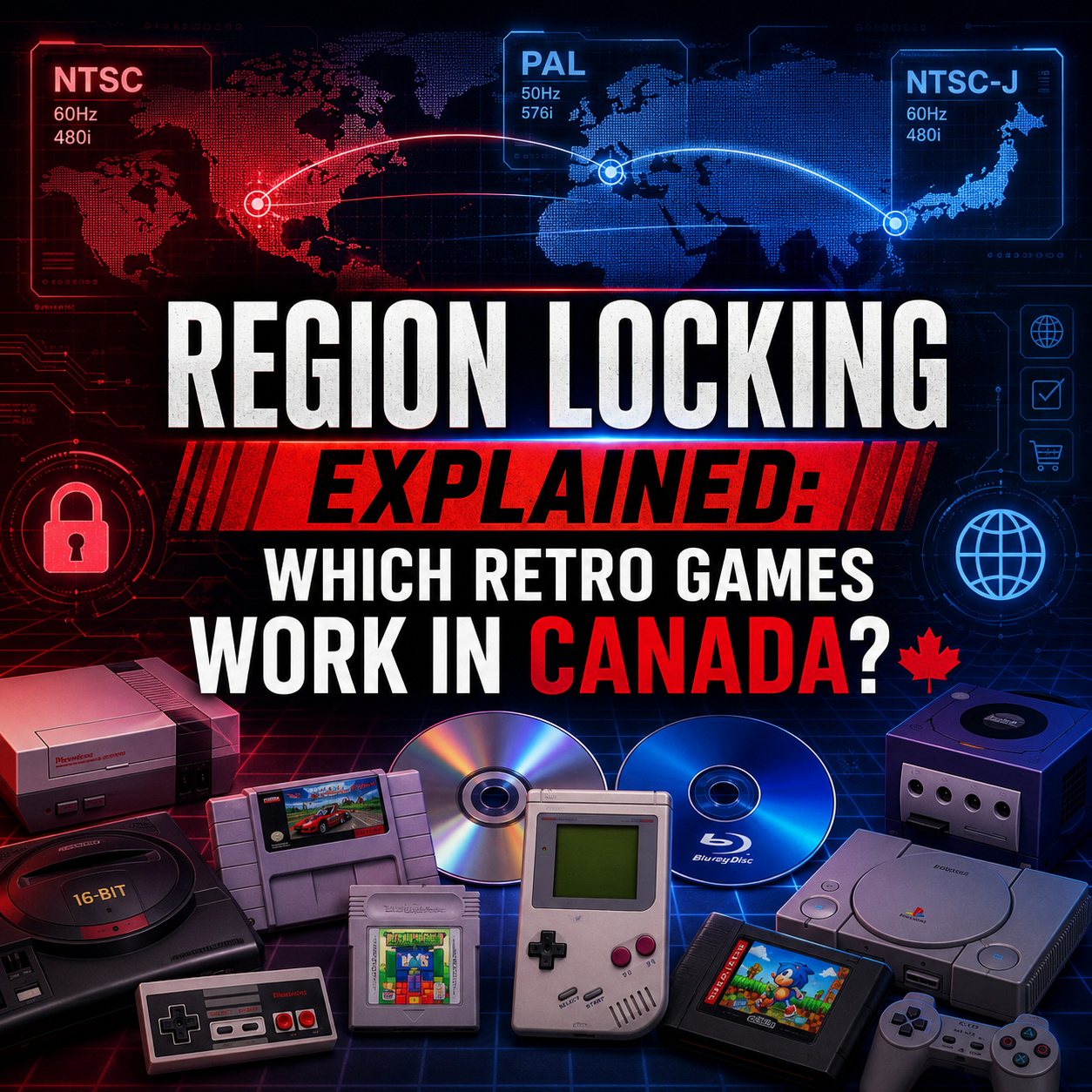
Region locking is one of the most confusing parts of buying retro games, especially if you are shopping online, buying imports, collecting Japanese exclusives, or trying to figure out whether a PAL game will work on a Canadian console. In Canada, most retro game buyers are dealing with NTSC-U/C, which generally means North America, including Canada and the United States. For Nintendo packaging, older systems often stated “FOR SALE, RENTAL AND USE ONLY IN THE USA, CANADA, MEXICO AND LATIN AMERICA,” while Nintendo 3DS packaging for the Americas says it plays on systems sold for the Americas only. Nintendo’s own support page notes that games and systems distributed throughout the Americas are treated as the same region. (Nintendo Support)
The short version is this: some consoles are region-free, some are region-locked, and some are only “sort of” region-locked because the cartridge shape, video format, power supply, language, or DLC region can still cause problems. Systems like Game Boy, Game Boy Color, Game Boy Advance, Nintendo DS, PSP, PS Vita, PlayStation 3, PlayStation 4, PlayStation 5, Xbox One, Xbox Series X, Nintendo Switch, and Nintendo Switch 2 are generally much easier for import collectors. Systems like NES, SNES, N64, GameCube, Wii, Wii U, Nintendo 3DS, PlayStation 1, PlayStation 2, Original Xbox, Xbox 360, Sega Saturn, Dreamcast, and TurboGrafx-16/PC Engine need more caution.
For Canadian players, the safest rule is simple: if you want the least hassle, buy North American / NTSC-U/C / Region 1 / Americas copies from a trusted store. If you want imports, learn the system first. A Japanese game might work perfectly, might need an adapter, might fit but not boot, might boot but run at the wrong speed, or might work fine until you try to buy DLC. Tiny little goblin details matter here.
Power Up Gaming helps take some of that risk out of buying used games by checking region, condition, compatibility, and system requirements before games hit the shelf. But if you are building a collection, especially from marketplace listings or overseas sellers, this guide will help you avoid buying something that looks awesome but does absolutely nothing when you put it in your Canadian console.

What Is Region Locking?
Region locking is a way for a console, game, disc, cartridge, digital store, or media format to limit what can be played in different parts of the world.
In retro gaming, this usually comes down to a few common regions:
NTSC-U/C: North America, including the United States and Canada
NTSC-J: Japan and some Asian markets
PAL: Europe, Australia, New Zealand, and many other regions
Region 1: Usually North America for DVDs
Region A: North America and Japan for Blu-ray movies
Americas: Common modern Nintendo and PlayStation language for Canada, the United States, Mexico, and parts of Latin America
A region lock can happen in different ways. It might be a chip inside the console. It might be a different cartridge shape. It might be a software check. It might be a digital account restriction. It might even be a video signal problem because older TVs and consoles were built around different broadcast standards.
This is why people get confused. “Region-free” does not always mean “everything works perfectly.”
A game can be region-free but still have:
-
No English language option
-
DLC that only works with a matching regional account
-
Slower PAL gameplay
-
Different video output
-
Different power requirements
-
Online services tied to a region
-
Different censorship or content changes
-
Different save file compatibility
-
Different update or patch behaviour
So when someone says, “Will this Japanese game work in Canada?” the real answer is usually:
What console?
What game?
What version?
Physical or digital?
Do you care about DLC?
Do you care about English text?
Are you using original hardware or a modern setup?
Annoying answer, yes. Accurate answer, also yes.

Canada, NTSC-U/C, PAL, and Why It Matters
Canada is part of the North American console ecosystem. For retro games, that usually means NTSC-U/C or USA/Canada.
Older analog gaming systems were deeply tied to TV standards. NTSC was used in North America, while PAL was used in much of Europe and Australia. Sony’s support documentation explains the basic technical difference: NTSC uses 525 interlaced lines at 29.97 frames per second, while PAL uses 625 interlaced lines at 25 frames per second. (Sony Canada)
For gamers, the practical version is this:
NTSC games usually run at 60Hz.
PAL games often run at 50Hz.
That means some PAL versions of games run slower, have borders, or feel different from their North American versions. Some PAL games were optimized well. Some were not. Some are totally fine. Some feel like they are running through molasses wearing ankle weights.
Canada also used the NTSC analog broadcast system historically. The CRTC described Canada and the United States as adopting the ATSC digital television standard to replace the North American analog NTSC broadcast system. (CRTC)
For modern HDMI consoles, this matters much less. For NES, SNES, Genesis, Saturn, PlayStation 1, PlayStation 2, and other classic systems, it can matter a lot.
Region Locking vs Video Format vs Power
These three things get mixed up constantly.
Region locking
This is whether the game is allowed to boot on your console.
Example: A European Wii game will not normally work in a Canadian Wii.
Video format
This is whether the console’s video output works properly with your TV.
Example: A PAL console may output a signal that an older North American TV does not handle correctly.
Power
This is whether the console can safely plug into Canadian power.
Example: Canada uses 120V power. Many Japanese consoles are close enough that people often use them carefully in North America, but European PAL consoles are usually built for higher voltage and may need proper power conversion. Do not just jam a random foreign console into the wall and hope the retro gods approve.
The Canadian Buyer’s Quick Rule
For Canadian players, the safest buying order is:
-
Canadian or U.S. copy
-
NTSC-U/C or Americas copy
-
Japanese copy only if you know the console is compatible
-
PAL copy only if you know the console, video output, power, and game speed situation
-
Digital import only if you understand account region and DLC rules
At Power Up Gaming, this is why we pay attention to region, labels, console compatibility, and whether a game makes sense for the average Canadian buyer. A Japanese import can be awesome, but only if the buyer understands what they are getting.

The Big Region Compatibility Chart for Canadian Retro Gamers
This chart focuses on Canadian users with standard North American consoles unless otherwise noted.
| Console | Canadian Region | Will Japanese Games Work? | Will PAL Games Work? | Buyer Notes |
|---|---|---|---|---|
| Atari 2600 | NTSC | Usually not region-locked, but video/timing can differ | Usually not ideal | NTSC/PAL differences can affect colour, speed, and display. |
| Atari 5200 | NTSC | Mostly a North American ecosystem | Not really relevant | Canadian buyers usually want NTSC North American games. |
| Atari 7800 | NTSC | Usually region-sensitive | PAL can be a problem | NTSC systems are safest with NTSC 7800 games. |
| Atari Lynx | Region-free | Yes | Yes | Good import-friendly handheld. |
| Atari Jaguar | Region-free for most practical collecting | Usually yes | Usually yes, but video standard can matter | Canadian buyers should still confirm TV/video setup. |
| Intellivision | NTSC | Generally no strict lock | PAL versions can differ | Focus on NTSC North American copies. |
| ColecoVision | NTSC | Generally no strict lock | PAL versions can differ | Canadian systems are NTSC. |
| Vectrex | Mostly region-free | Usually yes | Usually yes | Built-in screen avoids TV standard issues, but power still matters. |
| Odyssey 2 | NTSC | European Videopac compatibility is not simple | PAL versions can be an issue | Treat imports carefully. |
| NES | NTSC-U/C | Famicom games need an adapter | PAL NES games usually do not work properly | NES and Famicom cartridges are physically different, 72-pin vs 60-pin. (ConsoleMods) |
| Famicom | NTSC-J | Japanese system | North American games need adapter | Japanese exclusives are great, but accessories and RF/video quirks matter. |
| Super Nintendo | NTSC-U/C | Super Famicom games need physical slot consideration | PAL games normally blocked | North American and Japanese games are closer than PAL, but cartridge shape/tabs matter. |
| Super Famicom | NTSC-J | Native Japanese | PAL games normally blocked | Great import system for Japanese games. |
| Nintendo 64 | NTSC-U/C | Japanese carts are physically blocked unless modified/adapted | PAL games normally do not work | Canadian buyers should stick to NTSC-U/C unless buying imports knowingly. |
| GameCube | NTSC-U/C | No, not on stock Canadian hardware | No, not on stock Canadian hardware | GameCube is region-locked. |
| Wii | NTSC-U/C | No, not on stock Canadian hardware | No, not on stock Canadian hardware | Wii is region-locked, including Wii discs. |
| Wii U | Americas | No, not on stock Canadian hardware | No, not on stock Canadian hardware | Wii U is region-locked. |
| Nintendo Switch | Americas, but game cards mostly region-free | Yes, except China-region issues | Yes, except China-region issues | Nintendo says Switch game cards are not region-locked except Chinese-region exceptions. DLC must match region. (Nintendo Support) |
| Nintendo Switch 2 | Region-free game cards | Yes | Yes | Nintendo says Switch 2 game cards are not region-locked, but DLC and support can still vary by region. (Nintendo of Europe SE) |
| Game Boy | Region-free | Yes | Yes | One of the best import-friendly systems. |
| Game Boy Color | Region-free | Yes | Yes | Import-friendly. Language is the main issue. |
| Game Boy Advance | Region-free | Yes | Yes | Very import-friendly, especially for collectors. |
| Nintendo DS / DS Lite | Region-free for most DS games | Yes | Yes | Nintendo says older DS and DS Lite software is region-free. (Nintendo Support) |
| Nintendo DSi / DSi XL | Mixed | DS games usually yes, DSi-exclusive games no | DSi-exclusive games no | Nintendo says DSi-exclusive cards and DSiWare are region-locked. (Nintendo Support) |
| Nintendo 3DS / 2DS | Americas | No, not normally | No, not normally | 3DS family is region-locked. Canadian systems need Americas games. |
| Virtual Boy | Region-free in practice | Yes | No PAL library issue | Japanese and North American games are generally playable across systems. |
| Sega Master System | NTSC North America | Mark III/Japanese games are not simple | PAL games may have speed/video issues | Compatibility depends on cartridge/card format and region. |
| Sega Genesis | NTSC-U | Some Japanese games work, some need slot/region help | PAL games vary and may run at wrong speed | Japanese cartridge shape and later software region checks can matter. |
| Sega CD | NTSC-U | Japanese Mega-CD games do not normally work | PAL Mega-CD games do not normally work | Sega CD/Mega-CD is region-locked. |
| Sega 32X | NTSC-U | Region and base-console compatibility matter | PAL compatibility is messy | Match 32X, Genesis, and game region whenever possible. |
| Sega Saturn | NTSC-U | No, not stock | No, not stock | Saturn games are region-locked. Import collectors often buy Japanese Saturns. |
| Sega Dreamcast | NTSC-U | No, not stock | No, not stock | Dreamcast has regional lockout on retail GD-ROM games. (Wikipedia) |
| Sega Game Gear | Region-free | Yes | Yes | Handheld is import-friendly. |
| Sega Nomad | NTSC-U Genesis portable | Same as Genesis | Same as Genesis | Plays Genesis carts, so Genesis region quirks apply. |
| TurboGrafx-16 | North America | PC Engine HuCards do not fit/work without adapter/mod | PAL is uncommon and messy | TurboGrafx-16 and PC Engine HuCards are not directly compatible. (ConsoleMods) |
| TurboGrafx-CD / PC Engine CD | Mixed | CD games are generally region-free | Hardware/video/power still matter | ConsoleMods notes CD games are not region-locked, but system cards and HuCards differ. (ConsoleMods) |
| TurboExpress | North American TurboChip | PC Engine HuCards need adapter/mod | Not simple | Same card compatibility issue as TG16. |
| Neo Geo AES | Region-aware, not usually locked | Yes | Yes | Game language/bios behaviour can vary by console region. |
| Neo Geo CD | Region-aware, generally not locked | Yes | Yes | Region usually affects language/censorship, not booting. |
| Neo Geo Pocket Color | Region-free | Yes | Yes | Excellent import-friendly handheld. |
| 3DO | Generally region-free for games | Usually yes | Usually yes, but video can matter | Some region/video issues exist, but it is much more import-friendly than many systems. |
| CD-i | More media/video dependent than game-region focused | Case by case | Case by case | PAL/NTSC and disc format matter. |
| PlayStation 1 | NTSC-U/C | No, not stock | No, not stock | PS1 games are region-locked. |
| PlayStation 2 | NTSC-U/C | No, not stock | No, not stock | PS2 games are region-locked. DVD movie regions are separate. |
| PlayStation 3 | North American hardware | PS3 games generally yes | PS3 games generally yes | PS3 games are mostly region-free, but PS1/PS2 backward compatibility and movies are still region-sensitive. |
| PlayStation 4 | Region-free for most games | Yes | Yes | PlayStation says PS4 disc and digital games generally are not region-locked, but recommends buying your own region for support and service. (PlayStation.Blog) |
| PlayStation 5 | Region-free for games | Yes | Yes | PlayStation’s PS5 FAQ says PS5 games are not region-locked. (PlayStation.Blog) |
| PSP | Mostly region-free for games | Yes | Yes | UMD movies are a different story. |
| PS Vita | Region-free for physical games | Yes | Yes | Import-friendly, but PSN accounts and digital content need planning. |
| Original Xbox | NTSC-U/C | Some games are region-free, many are not | Some games are region-free, many are not | Original Xbox and Xbox 360 gave publishers region options. (ConsoleMods) |
| Xbox 360 | NTSC-U/C | Some games work, some do not | Some games work, some do not | Xbox 360 compatibility is game-by-game. Xbox support says Xbox 360 can only play discs sold in the same region as the console for DVDs, while game compatibility depends on disc region coding. (Xbox Support) |
| Xbox One | Modern Xbox region-free for games | Yes | Yes | Microsoft reversed Xbox One’s original regional restrictions before launch. (WIRED) |
| Xbox Series X | Modern Xbox region-free for games | Yes | Yes | Xbox support notes modern Xbox game discs are not coded to regions, while Blu-ray/DVD movies still use supported region formats. (Xbox Support) |
| Xbox Series S | Digital only | Digital region/account rules apply | Digital region/account rules apply | No disc drive, so physical region does not apply. |

Nintendo Region Locking Explained
Nintendo is one of the most important companies for this topic because its region policy changed dramatically depending on the system.
NES and Famicom
The North American NES and the Japanese Famicom are not cartridge-compatible without help. The Famicom uses 60-pin cartridges, while the NES uses 72-pin cartridges. ConsoleMods notes that when the Famicom became the NES in the United States, Nintendo redesigned the cartridges, making them physically larger and increasing the contacts from 60 to 72. (ConsoleMods)
For Canadian buyers, this means a Japanese Famicom game will not just slide into your NES. You need the right adapter, and even then, some extra-audio features from certain Famicom games may not behave exactly like they would on original Japanese hardware.
PAL NES games are a different problem. They are made for a different video standard and lockout environment. If you are shopping for a Canadian NES, stick with North American NES games unless you are deliberately building an import setup.
Super Nintendo and Super Famicom
The SNES is a little more tempting because North American and Japanese games are both 60Hz systems. That makes Japanese imports attractive.
The catch is physical cartridge shape and console tabs. Super Famicom cartridges do not fit properly in an unmodified North American SNES without dealing with the cartridge slot tabs. PAL games are a bigger issue because they involve different region chips and 50Hz timing.
For Canadian buyers, Japanese SNES imports can be worth exploring, especially for games where language does not matter much. PAL SNES games are usually not what you want for a standard Canadian setup.
Nintendo 64
The N64 is similar in spirit. Japanese N64 games are also NTSC, but cartridge shape and physical tabs prevent them from simply fitting in a stock North American console. PAL games are not recommended for a Canadian N64 unless you know exactly what you are doing.
A Japanese copy of Mario Kart 64 might be tempting. A random PAL N64 game from Europe is more likely to become a plastic rectangle of regret.
GameCube
GameCube is region-locked. Canadian GameCube consoles are NTSC-U/C and normally play North American GameCube games.
Japanese and PAL GameCube games will not run on a stock Canadian GameCube. There are import workarounds out there, but for a normal customer, the practical answer is: buy North American GameCube games for a Canadian GameCube.
This matters because GameCube collecting is expensive now. If you see a “great deal” online, make sure it is not a Japanese or PAL copy unless that is what you actually want.
Wii
The Wii is region-locked for disc games. A Canadian Wii normally plays North American Wii games.
A European Wii game will not work in a stock Canadian Wii. A Japanese Wii game will not work in a stock Canadian Wii.
This also matters for Wii consoles that play GameCube games. The Wii itself is backward compatible with GameCube games only on specific models, but the region rule still matters. A Canadian backward-compatible Wii is still looking for North American GameCube discs.
Wii U
The Wii U is region-locked. Canadian Wii U consoles use the Americas region. Japanese and European Wii U discs will not work on a stock Canadian Wii U.
This is extra important because Wii U collecting is heating up. Some Wii U games are becoming more desirable, and import listings can look cheaper. Cheaper does not help if it does not boot.
Nintendo Switch and Switch 2
Nintendo finally loosened up with the Switch era.
Nintendo’s own support page says that, with the exception of consoles and game cards distributed in the Chinese region, Nintendo Switch game cards are not region-locked. It also warns that DLC only works with games released for the same region as the DLC. (Nintendo Support)
Nintendo’s Switch 2 regional compatibility page also says Switch 2 game cards are not region-locked, while still warning that software, DLC, accessories, voltage, service, and support can vary by region. (Nintendo of Europe SE)
For Canadian players, this means physical Switch and Switch 2 imports are usually playable, but you still need to watch for:
-
DLC region
-
Language options
-
Censored or altered content
-
Online services
-
eShop cards
-
China-region exceptions
Nintendo Handheld Region Locking
Game Boy, Game Boy Color, and Game Boy Advance
These are some of the best import systems ever made. Game Boy, Game Boy Color, and Game Boy Advance games are generally region-free.
Canadian systems can play Japanese games. Japanese systems can play Canadian games. PAL is not really the issue because these are handhelds with their own screens.
The main issue is language. A Japanese Pokémon Green cartridge might physically work just fine, but unless you read Japanese, good luck naming your rival something clever.
Nintendo DS and DS Lite
Nintendo DS and DS Lite games are generally region-free. Nintendo support says older Nintendo DS and DS Lite software is region-free and can be played on Nintendo DSi and DSi XL systems from any region, although some later software could incorporate region encoding. (Nintendo Support)
For most Canadian buyers, regular DS games are import-friendly.
Nintendo DSi and DSi XL
The DSi is where things get weird.
Regular DS games are mostly region-free. But DSi-exclusive cards and DSiWare are region-locked. Nintendo support specifically says DSi-exclusive game cards are region-locked and that the DSi Shop is specific to the region the system was manufactured for. (Nintendo Support)
So if a game says it is DSi-enhanced or DSi-exclusive, slow down and check before buying an import.
Nintendo 3DS, 2DS, New 3DS, and New 2DS XL
The 3DS family is region-locked. Canadian 3DS systems are Americas-region systems.
That means a Japanese 3DS game will not work on a stock Canadian 3DS. A European 3DS game will not work on a stock Canadian 3DS.
Nintendo’s support page for identifying games from other regions says Nintendo 3DS family packaging for the Americas states “Plays on Nintendo 3DS systems sold for the Americas only.” (Nintendo Support)
This is one of the biggest traps in handheld collecting because Japanese 3DS games often look much cheaper online. They may be cheaper because they are not useful to the average Canadian 3DS owner.

Sega Region Locking Explained
Sega is beautifully messy. Wonderful games. Absolute compatibility goblin maze.
Sega Master System
Canadian Sega Master System owners should focus on North American Master System games.
Japanese Mark III and card-based releases involve different shapes and compatibility considerations. PAL games may create video speed issues. There are ways collectors deal with this, but for a normal Canadian buyer, North American games are safest.
Sega Genesis and Mega Drive
The Sega Genesis is called the Mega Drive outside North America. Many early Japanese Mega Drive games are close enough to North American Genesis games electrically, but the cartridge shells and console slots can differ. Some later games also include software region checks.
ConsoleMods notes that most Japanese games will not physically fit in a Genesis or PAL Mega Drive, making cartridge shape a form of lockout, and that some games have actual region coding or TMSS-related issues. (ConsoleMods)
For Canadian buyers:
-
North American Genesis games are safest.
-
Some Japanese Mega Drive games can be played with the right setup.
-
PAL Mega Drive games can run at the wrong speed or fail checks.
-
Language is often less of a problem for action games, shooters, and platformers.
-
RPGs and strategy games can be rough in Japanese unless you read the language.
Sega CD
Sega CD and Mega-CD games are region-locked. A North American Sega CD wants North American Sega CD games. Japanese Mega-CD and PAL Mega-CD games will not normally run on stock Canadian hardware.
This is a big one because Sega CD games are expensive now. Always check region before buying.
Sega 32X
The 32X is its own little pile of wires and chaos. Region compatibility depends on the base Genesis/Mega Drive, the 32X unit, and the game. PAL vs NTSC also matters.
For Canadian buyers, match everything to North America unless you are intentionally building an import setup.
Sega Saturn
Sega Saturn games are region-locked. A Canadian/North American Saturn will not play Japanese Saturn games on stock hardware.
This is painful because the Japanese Saturn library is incredible and often cheaper. Many collectors buy a Japanese Saturn specifically for imports instead of fighting the North American console. If you want Saturn imports, the cleanest path is usually buying the correct regional hardware.
Sega Dreamcast
Dreamcast retail games are region-locked. A North American Dreamcast normally wants North American games. Japanese and PAL Dreamcast games do not normally work on a stock Canadian Dreamcast. Dreamcast GD-ROM games were released as region-coded retail software, and the platform is widely documented as having regional lockout. (Wikipedia)
For Canadian buyers, this matters because some of the coolest Dreamcast games were Japan-only or PAL-only. Shenmue II on Dreamcast, for example, was not a standard North American Dreamcast release.
Sega Game Gear
Game Gear is much easier. It is generally region-free for games, though language and display variations still matter.
Japanese Game Gear imports can be fun for collectors.
Sega Nomad
The Sega Nomad is basically a portable Genesis, so Genesis cartridge compatibility rules apply. North American games are safest. Japanese and PAL compatibility depends on the same Genesis/Mega Drive issues.

PlayStation Region Locking Explained
Sony is a tale of two eras: strict early systems, much more relaxed modern systems.
PlayStation 1
PlayStation 1 games are region-locked. A Canadian PS1 wants North American PS1 discs.
Japanese PS1 games do not normally work on a stock Canadian PS1. PAL PS1 games do not normally work either.
Also, PS1 imports often create language issues. A Japanese fighting game or shooter might be manageable. A Japanese RPG is a commitment.
PlayStation 2
PlayStation 2 games are region-locked. Canadian PS2 systems want NTSC-U/C games.
Japanese and PAL PS2 discs will not normally work on a stock Canadian PS2. DVD movie region coding is separate, so a PS2’s ability to play DVD movies has its own region restrictions.
For Canadian buyers, this is especially important because PAL PS2 games sometimes look cheaper online. They are not a bargain if your console refuses them.
PlayStation 3
PlayStation 3 is much more import-friendly for PS3 games. Most PS3 games are region-free. The catch is that this does not automatically make everything region-free.
Watch for:
-
PS1 disc region restrictions
-
PS2 disc region restrictions on backward-compatible models
-
Blu-ray movie region restrictions
-
DVD movie region restrictions
-
DLC matching
-
Online servers or content differences
-
Language support
So yes, a Japanese PS3 game will usually play on a Canadian PS3. But if you buy DLC from the Canadian PlayStation Store for a Japanese disc, that DLC may not match.
PlayStation 4
PS4 is generally region-free for games. PlayStation’s official PS4 FAQ says that, in general, neither digital nor disc-based games are region-locked, although it recommends buying games from your region for the best customer service and notes that publishers may region-lock in uncommon cases. (PlayStation.Blog)
For Canadian buyers, this means import PS4 discs usually work. The bigger issue is DLC.
A Japanese PS4 disc may boot fine on your Canadian PS4, but Canadian DLC may not work with it. If you buy an import because it is cheaper, you may regret it when you want expansion content.
PlayStation 5
PS5 games are not region-locked. PlayStation’s PS5 FAQ directly answers “Are PS5 games region-locked?” with “No.” (PlayStation.Blog)
That said, the same practical warnings apply:
-
DLC should match the game region.
-
Language support varies.
-
Movie disc region is separate from game region.
-
Digital accounts and payment methods may be region-specific.
PlayStation’s support page also notes that PS5 Digital Edition models do not support disc-based games or media unless using compatible detachable drive options on supported models. (PlayStation)
PSP
PSP games are generally region-free. Canadian PSP systems can usually play Japanese and European PSP game discs.
UMD movies are different. They can be region-coded. So a Japanese PSP game might be fine, while a foreign UMD movie may not be.
PS Vita
PS Vita physical games are generally region-free. It is one of the better import-friendly handhelds.
The catch is account management. Vita is tied closely to PSN accounts, and juggling digital regions can be annoying. Physical imports are usually much easier than digital importing.

Xbox Region Locking Explained
Xbox is another “depends on the generation” situation.
Original Xbox
Original Xbox games can be region-locked, region-free, or compatible with more than one region depending on the disc. ConsoleMods explains that Microsoft gave publishers the option to choose the regions where Original Xbox and Xbox 360 games could be played. (ConsoleMods)
For Canadian buyers, this means a North American Original Xbox is safest with North American games.
Some imports work. Many do not. Check game-by-game.
Xbox 360
Xbox 360 region compatibility is famously inconsistent. Some games are locked to North America. Some are region-free. Some work across certain region combinations.
ConsoleMods documents Xbox and Xbox 360 disc region IDs, including America, PAL, Japan/Asia, and world-region discs, and notes that a Canadian Xbox can read discs matching America-compatible region IDs. (ConsoleMods)
This makes Xbox 360 imports tricky. A European copy of one game may work. A European copy of another game may not. A Japanese copy might be region-free, or it might be completely useless on a Canadian console.
When buying Xbox 360 imports, always check the specific game.
Xbox One
Xbox One is region-free for physical games. Microsoft originally had more restrictive plans, then reversed course before launch. Wired reported Microsoft’s reversal, including that Xbox One would be region-free and that disc-based games could be traded, lent, resold, gifted, and rented. (WIRED)
For Canadian buyers, Xbox One imports are usually safe for gameplay. DLC, digital purchases, and language still need checking.
Xbox Series X and Series S
Xbox Series X physical games are generally region-free. Xbox support notes that region-free Blu-ray discs and DVDs will play on any Xbox console and specifically notes that game discs for Xbox console are not coded to regions, while movie disc formats still follow supported region rules. (Xbox Support)
Xbox Series S is digital-only, so physical disc region does not apply. For digital content, account region, store region, payment methods, and availability may still matter. Xbox support warns that if your account region and physical location do not match, you can run into region-block errors or purchase problems. (Xbox Support)
TurboGrafx-16 and PC Engine Region Locking
This one is huge for collectors because Japanese PC Engine games are often more available and more affordable than North American TurboGrafx-16 games.
The problem: TurboGrafx-16 and PC Engine HuCards are not directly compatible.
ConsoleMods notes that the TurboGrafx-16 is not compatible with PC Engine HuCards and vice versa, though third-party adapters exist. (ConsoleMods)
For Canadian buyers:
-
TurboGrafx-16 uses North American TurboChip games.
-
Japanese PC Engine HuCards do not simply work in a stock TurboGrafx-16.
-
Adapters and region mods exist, but that is not the same as plug-and-play.
-
CD games are much more import-friendly, but system cards and hardware still matter.
ConsoleMods also notes that PC Engine and TurboGrafx CD drives can be interchangeable in some setups, and that CD games are not region-locked, while Japanese system cards will not work on TurboGrafx-16 and vice versa like HuCard games. (ConsoleMods)
In plain English: HuCards are the problem. CDs are easier, but the hardware ecosystem is still picky.
Neo Geo Region Locking
Neo Geo is different from most consoles. AES cartridges are generally not region-locked in the usual sense. Instead, the console’s BIOS region can affect language, censorship, and whether the game behaves like a Japanese, U.S., or European version.
That means a Japanese AES cartridge can usually work on a North American AES console, but the experience may change based on the console.
Neo Geo CD is similar. The games are generally more region-aware than region-locked.
For collectors, Neo Geo imports are usually about price, condition, authenticity, and language rather than basic boot compatibility.
3DO Region Locking
The 3DO is generally import-friendly compared to many other disc systems. Many 3DO games are not region-locked in the same strict way as PS1 or Saturn.
The bigger issue is video format and hardware. PAL and NTSC consoles can behave differently, and some titles may have compatibility quirks.
For Canadian buyers, North American 3DO games are safest, but imports are more realistic than on many other disc-based systems.
CD-i, Jaguar, Lynx, WonderSwan, and Other Oddballs
Not every retro system fits neatly into the Nintendo/Sega/Sony/Xbox map.
Atari Lynx
The Atari Lynx is generally region-free. Import games are usually fine.
Atari Jaguar
The Jaguar is generally import-friendly, though video format and display compatibility can still matter.
WonderSwan and WonderSwan Color
WonderSwan systems and games are Japanese-market products, and the games are generally not region-locked in the way console collectors usually mean. The real barrier is language.
Philips CD-i
CD-i is less about traditional region locking and more about disc type, video standard, and the specific player model. Treat PAL CD-i imports carefully in Canada.
Neo Geo Pocket Color
Neo Geo Pocket Color is region-free and import-friendly. Language matters more than compatibility.
The Difference Between Game Region and Movie Region
This trips people up all the time.
A console can be region-free for games but region-locked for movies.
For example:
-
PS5 games are not region-locked, but Blu-ray and DVD movie playback can still involve media region rules.
-
Xbox Series X game discs are not region-coded in the same way, but Blu-ray and DVD movies still have supported region formats.
-
PS2 games and DVD movies both have regional concerns, but they are not exactly the same system.
-
PSP games are generally region-free, but UMD movies may not be.
So if you are buying a console to play games, ask about game region.
If you are buying it to watch DVDs or Blu-rays, ask about movie region.
Those are not the same question.

DLC, Digital Stores, and Account Regions
Modern consoles made physical importing easier, but digital content created a new kind of region headache.
Nintendo says Switch DLC only works with games released for the same region as the DLC. Nintendo also says eShop cards only work for the country or region where they were intended to be sold. (Nintendo Support)
For PlayStation, the practical rule is similar: the disc may work, but DLC usually needs to match the game’s region. A Canadian PSN account buying Canadian DLC may not recognize a Japanese disc as the matching version.
Xbox digital content can also be affected by account region and physical location. Xbox support warns that mismatched account region and physical location can cause region block errors or purchase issues. (Xbox Support)
For collectors, this means:
-
Physical imports are often safer than digital imports.
-
DLC-heavy games should usually be bought in your own region.
-
Complete editions are safer than base-game imports.
-
Fighting games, RPGs, rhythm games, and modern games with expansion passes need extra care.
-
If you buy an import, assume Canadian DLC may not work unless you confirm first.
How to Identify a Game’s Region
Here are the easiest ways to check before buying.
Check the rating logo
For Canadian buyers:
ESRB usually means North America.
CERO means Japan.
PEGI means Europe.
USK means Germany.
ACB means Australia.
This is not perfect, but it is a strong clue.
Check the packaging text
Nintendo says older system packaging may include region text such as “FOR SALE, RENTAL AND USE ONLY IN THE USA, CANADA, MEXICO AND LATIN AMERICA.” For 3DS, Nintendo lists the Americas text as “Plays on Nintendo 3DS systems sold for the Americas only.” (Nintendo Support)
Check the spine and back cover
European games often have PEGI ratings and multilingual packaging.
Japanese games usually have Japanese text and CERO ratings.
North American games usually have ESRB ratings and English/French packaging in Canada.
Check the disc or cartridge code
Many systems have product codes that reveal the region. This is especially useful for PlayStation, Xbox 360, Nintendo DS, 3DS, GameCube, Wii, and Wii U.
Ask the seller for photos
Never trust a marketplace listing that uses a stock image. Ask for:
-
Front cover
-
Back cover
-
Disc or cartridge front
-
Disc underside if condition matters
-
Spine
-
Region code
-
Rating logo
-
Console compatibility text
If the seller refuses, that is your sign. The universe is trying to save you money.
Region Locking and Language
A game working does not mean you can read it.
This is especially important for:
-
Japanese RPGs
-
Strategy games
-
Visual novels
-
Adventure games
-
Menu-heavy sports games
-
Simulation games
-
Rhythm games with story content
-
Games with DLC stores
-
Online games
Some Japanese releases include English. Many do not.
Some Asian releases include English even when Japanese releases do not.
Some European releases include English and French, which can be great for Canadian buyers, but the game still might not work on a region-locked Canadian console.
Always check language support separately from region compatibility.
Should Canadian Collectors Buy Imports?
Yes, but selectively.
Imports can be amazing when:
-
The console is region-free.
-
The game is much cheaper in Japan.
-
Language does not matter.
-
The Japanese version has better cover art.
-
The game was never released in North America.
-
You collect variants.
-
You own the correct regional console.
-
You understand DLC limitations.
Imports can be a bad idea when:
-
You are buying for a kid who just wants it to work.
-
You are buying a gift.
-
The console is region-locked.
-
The game is text-heavy.
-
You need Canadian DLC.
-
You are using a stock Canadian console.
-
The seller is vague about region.
-
The price seems too good for a normally expensive game.
A $25 import copy of a $120 North American game is not automatically a deal. Sometimes it is cheaper because most local buyers cannot use it.
Power Up Gaming’s Advice for Canadian Buyers
For the average Canadian customer, we recommend buying North American copies unless you specifically know you want an import.
That does not mean imports are bad. Imports are awesome. Some of the coolest collections include Japanese Saturn games, Super Famicom RPGs, PC Engine shooters, Japanese Dreamcast exclusives, and region-free handheld games.
But there is a big difference between “I knowingly bought this import for my collection” and “I accidentally bought a game that does not work.”
At Power Up Gaming, we deal with this every day. Region matters when we buy, sell, trade, test, and explain games to customers. A game’s condition matters. Completeness matters. Authenticity matters. Region matters too.
A clean copy of a game is only useful if it works on the console you actually own.
Best Import-Friendly Retro Systems for Canadian Collectors
If you want to start importing games, these are some of the easiest systems to explore:
-
Game Boy
-
Game Boy Color
-
Game Boy Advance
-
Nintendo DS
-
PSP
-
PS Vita
-
PlayStation 3
-
PlayStation 4
-
PlayStation 5
-
Nintendo Switch
-
Nintendo Switch 2
-
Atari Lynx
-
Neo Geo Pocket Color
-
Game Gear
-
Neo Geo AES
-
Neo Geo CD
-
3DO, with some caution
-
TurboGrafx-CD / PC Engine CD, with hardware caution
These systems are generally friendlier to imports, but you still need to watch language, DLC, video, power, and special cases.
Most Dangerous Systems for Accidental Import Buying
These are the systems where Canadian buyers should be extra careful:
-
NES / Famicom
-
SNES / Super Famicom
-
Nintendo 64
-
GameCube
-
Wii
-
Wii U
-
Nintendo 3DS
-
PlayStation 1
-
PlayStation 2
-
Sega CD
-
Sega Saturn
-
Dreamcast
-
Original Xbox
-
Xbox 360
-
TurboGrafx-16 / PC Engine HuCard games
-
Sega 32X
-
PAL versions of almost anything pre-HDMI
These systems are not impossible to import for. They just require knowledge.
Final Thoughts
Region locking is one of those retro gaming topics that looks simple until you actually start buying games.
Canada is usually part of the North American gaming region, meaning Canadian buyers generally want NTSC-U/C, Region 1, Americas, or North American copies depending on the console. But every system has its own weird little rules. Some Japanese games work fine. Some do not fit. Some PAL games boot but run badly. Some discs are region-free but the DLC is not. Some handhelds do not care at all. Some consoles care deeply and will reject your import like a bouncer at a nightclub.
The safest advice is this:
If you want easy collecting, buy Canadian or U.S. copies.
If you want imports, research the exact console and game first.
If you are buying online, never assume. Check the rating logo, packaging, region code, photos, language, and DLC compatibility before spending money.
And if you want used games that have already been checked for compatibility, condition, and region, Power Up Gaming is here to help Canadian players buy with a lot less guesswork.

FAQ
What region are video games in Canada?
Canada is generally part of the North American region. For retro games, this is often called NTSC-U/C. For modern Nintendo systems, Canada is usually part of the Americas region. For DVDs, Canada is Region 1. For Blu-ray movies, Canada is Region A.
Are Canadian and U.S. games the same region?
Usually, yes. For most retro and modern gaming purposes, Canadian and U.S. physical games are the same region. Nintendo support specifically notes that games and systems distributed throughout the Americas are treated as the same region, and older Nintendo packaging may state that products are for use in the USA, Canada, Mexico, and Latin America. (Nintendo Support)
What does NTSC-U/C mean?
NTSC-U/C usually means North America, including the United States and Canada. It is the region Canadian collectors usually want for classic consoles.
What does PAL mean?
PAL refers to a video standard used in many European countries, Australia, New Zealand, and other regions. PAL games often run at 50Hz instead of the 60Hz common in North America and Japan.
Will PAL games work on Canadian consoles?
Usually not on region-locked retro consoles. Even when they can be made to work, they may have video, speed, or compatibility issues. Canadian buyers should be careful with PAL games.
Are Japanese games region-locked in Canada?
It depends on the console. Japanese Game Boy, Game Boy Color, Game Boy Advance, Nintendo DS, PSP, PS Vita, PS3, PS4, PS5, Switch, and Switch 2 games are generally easier to play. Japanese NES/Famicom, SNES/Super Famicom, N64, GameCube, Wii, Wii U, 3DS, PS1, PS2, Saturn, Dreamcast, and many Xbox/Xbox 360 games need more caution.
Can a Canadian NES play Famicom games?
Not directly. Famicom games use 60-pin cartridges, while the NES uses 72-pin cartridges. You need an adapter, and even then, some features may not behave exactly like original Famicom hardware.
Can a Canadian SNES play Super Famicom games?
Not without dealing with the cartridge slot shape. North American SNES consoles have plastic tabs that prevent Super Famicom cartridges from fitting normally. Electrically, many Japanese games are close to North American games because both are 60Hz, but the physical slot blocks them.
Can a Canadian Nintendo 64 play Japanese games?
Not normally, because the cartridge shape and console tabs block Japanese cartridges. Some collectors modify or adapt systems, but a stock Canadian N64 is safest with North American games.
Are GameCube games region-locked?
Yes. A Canadian GameCube normally plays North American GameCube games. Japanese and PAL GameCube games do not work on stock Canadian hardware.
Are Wii games region-locked?
Yes. A Canadian Wii normally plays North American Wii games. Japanese and PAL Wii discs do not work on a stock Canadian Wii.
Are Wii U games region-locked?
Yes. Wii U games are region-locked. A Canadian Wii U needs Americas-region Wii U games.
Are Nintendo Switch games region-free?
Mostly yes. Nintendo says Switch game cards are not region-locked except for Chinese-region exceptions. However, DLC must match the game region, and eShop cards only work in the country or region where they were intended to be sold. (Nintendo Support)
Are Nintendo Switch 2 games region-free?
Yes, Nintendo says Switch 2 game cards are not region-locked. However, Nintendo still recommends buying software and DLC made for your console’s region because support, DLC, accessories, and other factors can vary. (Nintendo of Europe SE)
Are Nintendo DS games region-free?
Most regular Nintendo DS games are region-free. Nintendo support says older Nintendo DS and DS Lite software is region-free, though DSi-exclusive software is region-locked. (Nintendo Support)
Are Nintendo 3DS games region-free?
No. Nintendo 3DS, 2DS, New 3DS, and New 2DS XL systems are region-locked. A Canadian 3DS needs Americas-region games.
Are PlayStation 1 games region-locked?
Yes. A Canadian PlayStation 1 normally plays North American PS1 games only.
Are PlayStation 2 games region-locked?
Yes. A Canadian PlayStation 2 normally plays North American PS2 games only.
Are PlayStation 3 games region-free?
Most PS3 games are region-free, but PS1 and PS2 backward compatibility, DVD movies, Blu-ray movies, and DLC can still have region restrictions.
Are PlayStation 4 games region-free?
Generally, yes. PlayStation’s PS4 FAQ says digital and disc-based PS4 games generally are not region-locked, although PlayStation recommends buying games in your own region for support and service. (PlayStation.Blog)
Are PlayStation 5 games region-free?
Yes. PlayStation’s PS5 FAQ says PS5 games are not region-locked. (PlayStation.Blog)
Are PSP games region-free?
PSP games are generally region-free, but UMD movies may be region-coded.
Are PS Vita games region-free?
Physical PS Vita games are generally region-free. Digital account management can still be annoying if you are dealing with multiple store regions.
Are Original Xbox games region-free?
Some are, but many are not. Original Xbox region compatibility depends on the game disc. North American games are safest for Canadian consoles.
Are Xbox 360 games region-free?
Some are, some are not. Xbox 360 is game-by-game. A Canadian Xbox 360 may play some Japanese or PAL games, but not others.
Are Xbox One games region-free?
Yes, Xbox One physical games are generally region-free.
Are Xbox Series X games region-free?
Yes, modern Xbox game discs are generally not region-coded, but Blu-ray and DVD movie regions are separate. Xbox support notes that game discs are not coded to regions, while movie disc formats still follow supported region rules. (Xbox Support)
Can I use Canadian DLC with an imported game?
Not always. This is one of the biggest modern region traps. DLC usually needs to match the game’s region. A Japanese or European disc may play on your Canadian console, but Canadian DLC may not recognize it.
Are imported games cheaper for a reason?
Often, yes. Japanese and PAL copies can be cheaper because fewer Canadian buyers can use them, or because the language limits demand. Always check region and language before assuming an import is a bargain.
Should I buy imported retro games?
Yes, if you know what you are buying. Imports are great for collectors, but they are not always beginner-friendly. If you want plug-and-play simplicity, buy North American versions.