Sony Is Ending PlayStation Discs. As a Retro Game Store Owner, I Think Gamers Should Be Worried.
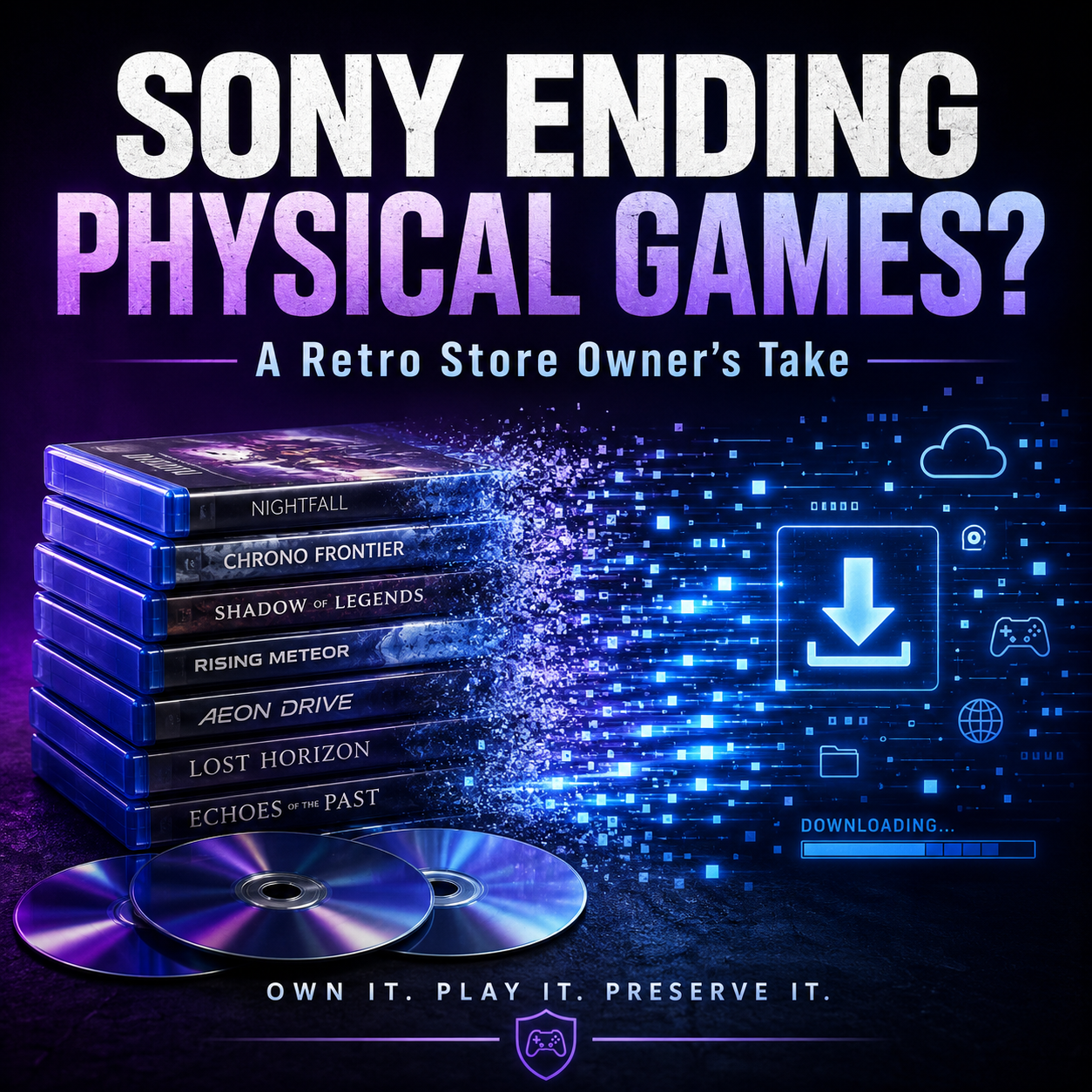
Sony has announced that physical disc production for new PlayStation games will be discontinued starting in January 2028. As a retro video game store, we think this matters for more than just collectors. It matters for ownership, preservation, trade-ins, affordability, and the future of how gamers access the things they pay for.
Summary
Sony’s move away from physical PlayStation discs is not surprising, but it should still concern gamers. Digital games are convenient, and plenty of players prefer them. The issue is not that digital exists. The issue is what happens when digital becomes the only option.
Physical games can be traded, resold, gifted, collected, preserved, lent to a friend, found years later, and played long after a digital storefront changes direction. From the perspective of a retro video game store, physical media is not just nostalgia. It is the reason so much of gaming history is still accessible today.
There are moments in the video game industry where something happens and everyone says, “Yeah, we all knew this was coming.” Sony ending physical disc production for new PlayStation games starting in January 2028 is one of those moments.
Digital games have been gaining ground for years. Players like convenience. Companies like control. Retailers have watched the shift happen generation by generation. So no, this is not shocking.
But just because something is expected does not mean it is good for gamers.
As a retro video game store, we see the value of physical media every single day. We see people hunting for childhood favourites. We see parents buying games they grew up with for their kids. We see collectors rebuilding lost libraries. We see customers trading in games they finished so someone else can enjoy them. We see games from 10, 20, 30, and even 40 years ago still moving from player to player.
That only happens because physical games survived.
What Sony Actually Announced
Sony announced that physical disc production for all new games releasing on PlayStation consoles will be discontinued starting in January 2028. After that point, new PlayStation games will be available through the PlayStation Store and through retailers in digital formats only.
Sony also stated that this transition does not impact games that already released, or games that will release before January 2028 in disc format.
That distinction matters. This does not mean every PlayStation disc you already own suddenly stops working. It does not mean every existing PS4 or PS5 game vanishes from store shelves overnight. But it does mark a major line in the sand for the future of PlayStation as a physical platform.
The concern is not that digital games exist. The concern is that physical games may no longer exist as an option for new PlayStation releases.
Digital Games Are Convenient. That Does Not Make Them Ownership.
Digital games are convenient. There is no point pretending otherwise.
You can buy a game from the couch. You can pre-load it. You do not have to swap discs. You do not have to worry about scratched media. You can have an entire library sitting on your console without needing shelf space.
That is all true.
But convenience and ownership are not the same thing.
When you buy a physical game, you have an item. You can lend it. You can trade it. You can sell it. You can put it on a shelf. You can give it to someone as a gift. You can bring it into a store like ours and turn it into credit toward something else.
When you buy digital, what you usually have is access. That access may last a very long time, but it is still tied to an account, a storefront, a console ecosystem, licensing terms, and the company continuing to support the infrastructure around it.
For a lot of players, that difference does not matter until it suddenly does.
Physical Games Keep the Used Game Market Alive
Used games are a major part of gaming culture. They make gaming more affordable. They help people try more games. They give finished games a second life. They let collectors find older titles without relying on digital storefronts, subscriptions, or whatever a platform holder decides to keep available.
When physical media disappears, the used game market for new releases disappears with it.
That is not a small thing.
A customer who buys a physical game for $89.99 can finish it and trade it toward the next one. Another customer can buy that same game used for less than new. A parent can stretch a gaming budget further. A collector can choose between loose, complete, sealed, standard, special edition, or whatever version matters to them.
Digital-only removes all of that. There is no second-hand copy. There is no trade-in value. There is no local resale market. There is only the price and availability controlled by the digital storefront.
This Matters Even More in Canada
Canadian gamers already know that new games are expensive. After tax, a new release can feel brutal, especially for families, younger gamers, and anyone trying to keep a hobby affordable.
Physical games help soften that. Not always immediately, but over time. A physical game can drop in price. It can show up used. It can be traded. It can be part of a collection. It can be sold to fund another purchase.
Digital sales can be great, but they happen on the platform holder’s schedule. If the game is not on sale, you wait. If the game is delisted, you may be out of luck. If you bought the wrong version, there may be no simple resale option. If you are done with it, there is nothing to trade.
For Canadian gamers, losing physical media means losing one of the few ways players can keep some control over the cost of gaming.
A Retro Game Store Owner’s Perspective
Why This Hits Different From Behind the Counter
At Power Up Gaming, we are not just looking at this as players. We are looking at it as a store that deals with the long-term life of video games every single day.
We see what happens to games after the hype cycle is over. We see what still matters 10 years later. We see which systems people come back to. We see which games become harder to find. We see which games become memories, collectibles, gifts, and pieces of gaming history.
The reason retro gaming exists in the form it does today is because people owned physical games.
Think about the systems people still collect for: NES, Super Nintendo, Nintendo 64, GameCube, Wii, PlayStation, PlayStation 2, PlayStation 3, Xbox, Xbox 360, Game Boy, DS, 3DS, PSP, Vita, and so many more.
Those libraries are still alive because physical copies are out there. Some are sitting in collections. Some are in stores. Some are in basements. Some are being traded in by people who have not touched them in years. Some are being rediscovered by a new generation.
That is preservation in the real world. Not perfect preservation, but practical preservation. The kind where someone can walk into a store, pick up an old game, bring it home, and play it.
If everything had been digital-only from the beginning, the retro gaming world would look very different. In many cases, it might barely exist at all.
Preservation Is Not Just a Collector Problem
People sometimes hear “game preservation” and think it only matters to hardcore collectors, museums, or people arguing online about sealed games.
It is bigger than that.
Preservation means a game can still be played after a storefront shuts down. It means a niche title has a chance to be discovered later. It means a game is not completely dependent on licensing agreements, server support, or a company deciding it is still worth keeping available.
Music, movies, books, and video games have all been affected by the shift from ownership to access. But games have an extra problem: they are often tied to hardware, accounts, patches, DLC, online services, and digital rights systems.
Physical media does not solve every preservation issue. Modern discs can still require patches. Some games ship incomplete. Some physical releases are little more than installers. But physical games still give players and collectors something that digital-only does not: a transferable, ownable object that can survive outside the original storefront.
The PS3 and PS Vita Store News Shows the Risk
Sony also announced changes to the PlayStation Store on PS3 and PS Vita. New purchases on those devices are being phased out, with global closures planned for PS3 and PS Vita in July 2027. Sony says previously purchased content will remain downloadable “for the foreseeable future.”
That phrase should make every gamer pause.
“For the foreseeable future” might mean a long time. It might be fine for years. It might not affect your current library at all in the short term.
But it is not the same as owning a disc.
With physical media, your access is not built entirely around a store remaining active. With digital-only libraries, access depends on the platform, your account, licensing, servers, and the company’s future decisions.
That does not mean digital purchases are worthless. It means they are different. Gamers should understand that difference before the industry quietly removes every alternative.
Collectors Should Pay Attention
When a company announces the end of physical media for future releases, collectors notice.
That does not automatically mean every PS4 or PS5 disc is going to skyrocket in value. Most games do not become rare just because they are physical. Sports titles, massive print runs, and common releases will likely remain common.
But some categories may become more interesting over time:
- Complete copies of desirable PS4 and PS5 games
- First-party PlayStation exclusives
- RPGs and horror games
- Limited-print releases
- Collector’s editions with physical extras
- Games with lower print runs
- Titles that later become delisted digitally
- Games with strong local multiplayer or offline value
The collector market is never guaranteed, and nobody should buy every disc they see expecting it to become valuable. But from a collecting standpoint, the final years of PlayStation physical releases are going to matter.
This Is Not Just About Sony
Sony is the headline right now, but this is not only a Sony issue.
The whole industry has been moving in this direction. Digital storefronts, subscription services, cloud gaming, downloadable content, live-service games, account-tied purchases, and digital-only consoles have all pushed gaming away from ownership and toward access.
Sony’s announcement feels big because PlayStation has such a long physical history. The original PlayStation, PS2, PS3, PS4, and PS5 all have physical libraries that shaped gaming culture. For many people, PlayStation memories are tied to cases, discs, manuals, cover art, greatest hits labels, rental stickers, scratched copies, and that feeling of finding something unexpected on a shelf.
When a brand that helped define disc-based gaming starts walking away from discs, it says a lot about where the industry wants to go.
What Gamers Can Do Now
Gamers do not need to panic, but they should be intentional.
- Buy physical copies of the games that matter most to you.
- Keep your cases, inserts, cover art, and discs in good condition.
- Do not assume every digital game will be available forever.
- Back up your save data where possible.
- Support physical releases when companies still offer them.
- Support local game stores that keep used games circulating.
- Think about whether you want access or ownership before choosing digital over physical.
Digital is not evil. Digital is useful. But digital should be a choice, not the only path forward.
Our Take
From where we stand, Sony ending physical disc production for new PlayStation games is bad for long-term ownership, bad for the used game market, bad for preservation, and bad for consumer choice.
It may be good for Sony. It may be convenient for many players. It may reflect where a large part of the market has already gone.
But the gaming industry is at its best when players have options.
Some people want digital libraries. Great. Some people want subscriptions. Great. Some people want physical games they can actually hold, trade, collect, lend, resell, and preserve. That should still be allowed to exist.
Physical games are not just plastic boxes and discs. They are part of how gaming history survives.
As a retro video game store, we believe that matters.
Keep Physical Gaming Alive
Looking for PlayStation games, retro classics, or physical copies to add to your collection? Browse Power Up Gaming online or bring your old games in for trade credit.
Browse PlayStation Games Trade In Your GamesFAQ
Is Sony ending all PlayStation physical games?
Sony has announced that physical disc production for new games releasing on PlayStation consoles will be discontinued starting in January 2028. Games already released, or releasing before January 2028 in disc format, are not impacted by that specific transition.
Will my current PS4 or PS5 discs still work?
Sony’s announcement is about production of physical discs for new games after the January 2028 transition. It does not say that existing PS4 or PS5 discs will stop working.
Does this mean PlayStation is going digital-only?
For new PlayStation game releases after the January 2028 cutoff, Sony says games will be available through the PlayStation Store and through retailers in digital formats only.
Are digital games bad?
No. Digital games are convenient and many players prefer them. The issue is not digital games existing. The issue is players losing physical media as an option.
Why do physical games matter?
Physical games can be collected, traded, resold, gifted, lent, preserved, and played years later without depending entirely on a digital storefront. That makes them important for players, collectors, local game stores, and gaming history.
Will PS4 and PS5 physical games become more valuable?
Some may become more collectible over time, especially desirable exclusives, RPGs, horror games, limited-print releases, complete copies, and games that become harder to find. However, not every physical game becomes valuable just because it is on disc.
Should I buy physical PlayStation games now?
If ownership, collecting, resale value, trade-in value, or long-term access matters to you, physical is still worth considering whenever it is available.
Source note: This article is an opinion piece from Power Up Gaming based on Sony Interactive Entertainment’s July 2026 PlayStation Blog announcements regarding physical disc production for new PlayStation games and PlayStation Store changes for PS3 and PS Vita.