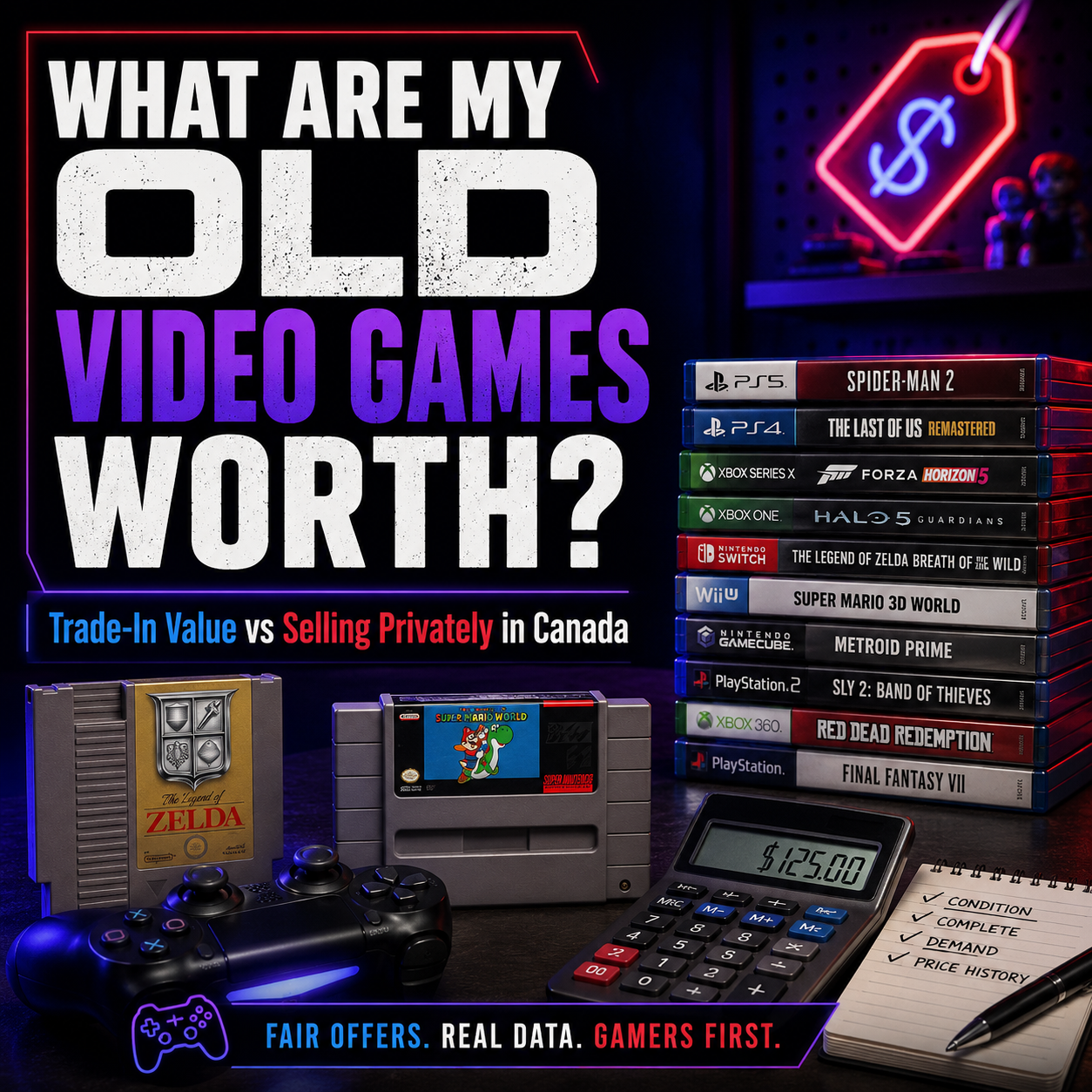
What Are My Old Video Games Worth? Trade-In Value vs Selling Privately in Canada
Wondering what your old video games, consoles, accessories, or collection are actually worth? The honest answer is that value depends on more than one number online. Condition, demand, completeness, current stock, testing, refurbishing, and how quickly an item is likely to sell all matter.
Summary
If you are looking up old video game prices online, it is important to understand the difference between asking price, sold price, private sale value, and trade-in value.
A private sale may get you more money, but it also takes time, photos, messages, shipping, meetups, buyer questions, no-shows, fees, and scam risk. A trade-in offer is usually lower than the final resale price because a store still has to inspect, test, clean, refurbish, list, warranty, process, and eventually resell the item.
At Power Up Gaming, we look at our own inventory, real sales history, current demand, condition, completeness, and market data when making trade-in offers. Store credit usually gives customers the best return, while cash or e-transfer offers may be lower or unavailable for some items.
One of the most common questions people ask when they find an old box of games is simple:
“What are my old video games worth?”
It sounds like there should be one easy answer. Search the game online, find a price, and that is the value.
In reality, video game value is more complicated than that.
A game can have one value if you sell it privately, another value if you trade it to a store, another value if it is complete in box, another value if it is scratched or damaged, and another value if a store already has too many copies sitting in inventory.
This guide explains how trade-in values actually work, why online prices do not always mean what people think they mean, and how to decide whether you should trade your games or try selling them privately.
The short version: Selling privately can sometimes get you more money. Trading to a store is usually about convenience, speed, safety, and avoiding the work and risk of selling everything yourself.
Listed Price Is Not Sold Price
One of the biggest mistakes people make is looking at an online listing and assuming that is what their game is worth.
A game listed for $100 has not necessarily sold for $100. Someone can ask any price they want. That does not mean buyers are paying it.
Sold listings are usually more useful than active listings because they show what buyers recently paid. Even then, you still have to look closely at condition, completeness, region, shipping cost, photos, whether the item was actually authentic, and whether the sale was comparable to your copy.
That is why tools like PriceCharting and eBay sold listings can be helpful, but they are not the whole story. They are data points, not automatic trade-in formulas.
Important: “I saw one listed online for $200” is not the same as “this item regularly sells for $200 in the same condition.” Asking prices can be inflated, outdated, incomplete, or based on a different version of the item.
How Power Up Gaming Looks at Game Value
At Power Up Gaming, the first thing we look at is our own real-world data. That includes our current inventory, our sales history, and how much interest we actually have in the item.
If we already sell a game regularly and know how quickly it moves, we may not need to look very far outside our own system. If it is a rarer item, an unusual variant, a boxed game, or something with a changing market, we may also look at outside tools such as PriceCharting or eBay sold listings.
But if outside market data says one thing and our real sales history says another, we are going to trust our real-world sales data. That is the data that tells us what customers are actually buying from us, how often, in what condition, and at what price.
That does not mean a customer has to agree with our offer. If someone feels their item is worth more than we can offer, they always have the option to sell it privately. In some cases, that may be the better choice for them.
What Affects Trade-In Value?
Trade-in value is based on more than what a game might sell for online. A store has to consider whether the item is desirable, how quickly it will move, what condition it is in, how much work it needs, and whether the store already has enough copies.
| Factor | How It Affects Value | Why It Matters |
|---|---|---|
| Current demand | Can increase value | Popular, rare, or fast-moving games may receive stronger offers because they are easier to resell. |
| Current stock | Can increase or decrease value | If we already have 20 copies of a game, adding a 21st copy is less valuable than adding a game we need. |
| Condition | Often makes a big difference | Better condition items usually sell faster and for more. Beat-up copies are often the last to sell. |
| Completeness | Can increase value | Original cases, manuals, inserts, boxes, cables, and controllers can all affect final value. |
| Testing and labour | Can reduce value | Items that need cleaning, resurfacing, testing, parts, or repair take time and money before they can be resold. |
| Authenticity | Can remove value completely | Counterfeit and reproduction games may have no trade-in value at all. |
| Market data | Useful but not final | Online data helps, but real sales history, local demand, condition, and store inventory still matter. |
Why We Cannot Pay eBay Prices for Trade-Ins
This is the part that can feel confusing if you have never worked behind the counter of a game store.
If a game sells in-store for $79.99, the trade-in value will not be $79.99. That does not mean the store is trying to be unfair. It means the store still has to do all the work and take all the risk between buying the item and selling it.
A store has to pay for lease costs, insurance, wages, utilities, payment processing fees, cleaning supplies, resurfacing equipment, testing time, repairs, product photography, website maintenance, packaging, warranty support, sales discounts, and all the other costs of running a real business.
The item also may not sell right away. Some games sell quickly. Some sit for months. Some common games sit even longer, especially if we already have multiple copies.
That is why trade-in value and retail price are not the same thing.
Trade-in value is not just “what the game is worth.” It is what the store can reasonably offer after considering resale price, demand, condition, stock levels, labour, business costs, and risk.
Trade Credit vs Cash or E-Transfer
At Power Up Gaming, store credit is usually the best value option because it lets us trade product for product. That makes more financial sense for the store, and it allows us to maximize the value customers receive when trading in games, consoles, or accessories.
Cash and e-transfer payouts may be lower than store credit. In some cases, we may not offer cash at all if our interest level is not high enough or if the item is slower moving.
For in-store trades, cash may be available on approved items. For many payouts, especially larger or online transactions, e-transfer is common. It is safer for a business not to keep large amounts of cash in the store, and most customers understand that when dealing with a reputable business.
Condition Can Make a Big Difference
Condition affects value because condition affects how quickly an item sells and how much customers are willing to pay.
If we have multiple copies of the same game, the best-condition copy is usually going to sell first. The roughest copy may sit the longest. If we keep getting cleaner copies, the worst-condition copy may keep getting pushed further back.
That is why condition matters even when the game technically works.
Disc-Based Games
Power Up Gaming has high standards for disc condition. No discs leave our store with scratches. If a disc comes in scratched, we have to decide whether it is worth taking in, whether it can be properly resurfaced, and whether the final result will meet our standards.
This matters even more for Blu-ray style discs, where we are especially careful. Some scratched discs are simply not worth bringing in.
Running damaged discs through a robotic disc refinisher costs money and takes time. That labour has to be factored into the trade-in value.
Cartridge Games
Cartridge games can also lose value because of condition issues. Label damage, marker, stickers, dirty contacts, corrosion, cracked shells, yellowing, heavy wear, or signs of moisture can all affect value.
Any time we have to spend extra labour cleaning, testing, repairing, or making an item presentable for resale, that affects the offer.
Consoles, Controllers, and Accessories
Consoles and accessories also need to be evaluated carefully. Missing cables, missing controllers, broken doors or flaps, heavy wear, yellowing, dirty systems, stick drift, weak buttons, damaged ports, missing battery covers, or untested hardware can all reduce value.
Systems need to be inspected and tested before final value is confirmed. A console that looks fine may still need cleaning, repair, parts, or further testing before it can be sold with confidence.
Completeness Matters
A loose game, a complete game, a boxed game, and a sealed game are not the same thing.
For many cartridge games, complete in box usually means the original box, cartridge, and manual. At Power Up Gaming, our Complete In Box category may also include some “in box” games that include the box and game but not the manual. The actual product photos, title, and description should show exactly what is included.
Missing manuals, damaged cases, printed cover art, replacement cases, missing inserts, crushed boxes, sun fading, tears, stickers, or water damage can all affect value.
For disc-based games, an original case and cover art will usually matter. A loose disc or a game with printed cover art is not usually worth the same as a clean complete copy.
What About Sealed Games?
Sealed games can be valuable, but they are also very subjective.
Some sealed games are desirable. Others are slow movers. Condition, seal quality, authenticity, demand, grading speculation, and collector interest all matter. A sealed game is not automatically a fast sale just because it is sealed.
For that reason, our interest level in sealed games can be lower than people expect. The market can be narrow, the buyer pool can be smaller, and the value can be harder to confirm compared with regular used games that customers are buying to play.
Old Does Not Automatically Mean Valuable
One of the biggest myths in retro gaming is that every old game is valuable.
Age can matter, but it is only one factor. Value is also affected by rarity, demand, popularity, condition, completeness, how many copies are available, how good the game is, whether people still want to play it, and how often it sells.
Nostalgia does not always equal market demand.
Some older games are extremely desirable. Some are common. Some are annual sports titles that many stores already have too many of. Some are games that may technically be old, but still sell for less than $10.
Low-Value and Slow-Moving Games
Low-value games can be tricky for trade-ins because there may not be enough resale value left after labour, testing, cleaning, listing, storage, and business costs.
Items that commonly receive low or no trade value may include:
- Most older annual sports titles
- Very common fitness games
- Common shovelware titles
- Games that usually sell for less than $10
- Heavily damaged or incomplete games
- Slow-moving duplicates we already have in quantity
This does not mean those games are worthless to everyone. It means they may not make sense for a store to buy, especially if they are already overstocked or unlikely to move quickly.
Items We Usually Do Not Buy
Some items are difficult to resell, support, verify, or warranty properly. Those items may be declined, offered at reduced value, or accepted only under specific circumstances.
Common Problem Items
- Reproduction cartridges
- Counterfeit games
- Fake Pokémon games or other fake high-demand titles
- Third-party or clone consoles
- Most PC games and PC products
- Damaged or non-working systems
- Most annual sports titles
- Titles that usually sell for less than $10
- Heavily modified or incomplete items with little resale value
Reproduction and counterfeit games have no authentic collector value and may have zero trade-in value. PC games are normally not accepted unless they are highly collectible. Third-party consoles are normally not accepted because they are harder to support and usually do not fit our resale standards.
Selling Privately vs Trading In
Selling privately will usually give you the potential to make more money. If you are willing to do the work, it may be worth it.
But “potentially more money” does not always mean “better.” Selling privately has pitfalls, time costs, and risks that many people underestimate.
| Option | Potential Upside | Tradeoff |
|---|---|---|
| Selling privately | Highest possible payout | You handle photos, listings, messages, no-shows, lowball offers, shipping, packaging, fees, returns, and scam risk. |
| Trading in for store credit | Usually best store value | You receive value toward other products instead of direct cash. |
| Cash or e-transfer sale to a store | Fast and convenient | The offer is usually lower than store credit and may not be available on all items. |
| Bulk collection sale | Simple and efficient | The offer has to account for both the valuable items and the slow-moving/common items being purchased together. |
The Hidden Costs of Selling Privately
Private selling can work well, but it is not free money. You may have to take photos, research prices, write listings, answer repeated questions, deal with lowball offers, arrange meetups, handle no-shows, package items, ship items, pay seller fees, deal with returns, and protect yourself from scams.
There is also the risk of reverse scams. A buyer may claim something was not received, arrived damaged, was not authentic, or did not work, even when you shipped it properly. Online platforms may not always side with the seller.
For some people, the extra work is worth it. For others, trading in is a better option because it is faster, cleaner, and less stressful.
When Trading In Makes the Most Sense
Trading in may be the better choice if you want convenience and certainty more than squeezing every possible dollar out of each item.
Trading In May Be Best If You Want To:
- Clear out games quickly without listing everything yourself.
- Avoid marketplace messages, no-shows, and lowball offers.
- Turn old games into store credit for something new to you.
- Avoid shipping, seller fees, returns, and private-sale scams.
- Sell a larger collection in one easier transaction.
- Work with a real business that tests, inspects, and handles resale.
When Selling Privately May Be Better
Selling privately may be better if you have time, patience, and a good understanding of the market.
Selling Privately May Be Best If:
- You want the highest possible payout.
- You are comfortable taking detailed photos and writing listings.
- You understand market pricing and sold listings.
- You are willing to wait for the right buyer.
- You can safely manage meetups or shipping.
- You are prepared to deal with questions, returns, and possible scams.
How Local Trade-Ins Work at Power Up Gaming
If you are local to Barrie or willing to visit the store, the best option is to bring your games, consoles, and accessories in person. For local trade-ins, we generally need to see the items physically before making an offer.
This allows us to check condition, completeness, demand, current stock, and whether anything needs cleaning, resurfacing, testing, or repair.
For many trades, we can provide an offer the same day. Larger or more complicated collections may take longer to evaluate properly.
How Online Trade-Ins Work
If you are not local or are not willing to drive to the store, you can start the online trade-in process through our Trade-In / Sell Your Games page.
For online trade-ins, a clear written list is usually the fastest way to start. Include what you have, condition notes, your location in Canada, whether anything is missing or damaged, and whether you are hoping for e-transfer or store credit.
For rare, expensive, boxed, damaged, or condition-sensitive items, photos may be helpful. For most common items, do not send a huge number of photos right away. A clear list is usually the best first step, and we can ask for photos if needed.
Online offers are not final until the items are received, inspected, tested where needed, and confirmed to match the list and condition provided.
How to Prepare Your Games Before Trading Them In
You do not need to make everything perfect, but a little organization helps.
Trade-In Prep Checklist
- Group games by system if possible.
- Keep cases, manuals, inserts, cables, and controllers together.
- Be honest about damage, missing items, or untested products.
- Do not assume every old game is valuable.
- Do not remove labels, stickers, or markings aggressively if it may damage the item.
- Separate rare, boxed, sealed, or condition-sensitive items.
- Bring local trades in person when possible.
- For online trades, send a clear written list first.
Our Take
There is no single universal answer to what old video games are worth. Value depends on condition, completeness, authenticity, demand, current stock, market data, and how the item is being sold.
If you want the highest possible payout and are willing to do the work, selling privately may be the right choice.
If you want a simpler, safer, faster process, trading in to a reputable retro game store can make a lot more sense.
At Power Up Gaming, our goal is to make offers that are fair, realistic, and based on the full picture. We want trades that make sense for both the customer and the store.
Sometimes that means we will be excited about an item and make a strong offer. Sometimes it means our interest is low because we already have too many copies, the condition is poor, the title is slow-moving, or the item requires too much labour to resell properly.
Either way, understanding how trade-in value works helps everyone have a better conversation.
Ready to Trade or Sell Your Games?
Turn your old games, consoles, accessories, and collections into cash, e-transfer, or store credit. Visit us in Barrie or start online if you are not local.
Start Your Trade-In Shop Video Games Shop Consoles Shop Complete In BoxFAQ
How do I know what my old video games are worth?
Start by looking at real sold prices, not just active listings. Then compare condition, completeness, demand, and whether your copy is loose, complete, boxed, sealed, damaged, or missing parts. A retro game store will also consider current stock levels, testing, cleaning, refurbishing, and how quickly the item is likely to sell.
Why is trade-in value lower than the store selling price?
Trade-in value is lower because the store still has to inspect, test, clean, refurbish, list, store, warranty, and resell the item. The store also has regular business costs such as rent, wages, insurance, utilities, payment fees, discounts, and support.
Is store credit better than cash?
Store credit usually gives the best value because trading product for product makes more financial sense for the store and allows us to offer more back to the customer. Cash or e-transfer offers are usually lower and may not be available for every item.
Can I get more money selling my games privately?
Yes, selling privately can often get more money if you are willing to do the work. You may need to take photos, write listings, answer messages, arrange meetups, ship items, pay fees, handle returns, and deal with scam risk.
Do old games automatically have value?
No. Age is only one factor. Value depends on rarity, demand, condition, completeness, how good the game is, how many copies are available, and how often people are actually buying it.
Do scratches affect trade-in value?
Yes. Scratches can affect value because discs may need resurfacing or may not meet our resale standards. Power Up Gaming has high standards for disc condition, and no discs leave our store with scratches.
Do missing manuals or cases affect value?
Yes. Missing manuals, damaged cases, printed covers, missing inserts, replacement cases, and incomplete packaging can all affect value, especially for collectible games.
What does complete in box mean?
For many cartridge games, complete in box usually means the original box, cartridge, and manual. At Power Up Gaming, some “in box” items may also appear in our CIB category, but the actual photos, title, and description should show exactly what is included.
Do you buy reproduction games?
Reproduction cartridges and counterfeit games generally have no trade-in value. Power Up Gaming does not knowingly buy or sell fake games as authentic products.
Do you buy PC games?
PC games are normally not accepted unless they are highly collectible.
Do you buy third-party consoles?
Third-party and clone consoles are normally not accepted because they are harder to support, verify, and warranty properly.
What is the best way to start a trade-in?
If you are local, bring your items to the Barrie store in person. If you are not local, start through our Trade-In / Sell Your Games page and send a clear written list of what you have.
Are online trade-in offers final?
No. Online offers are not finalized until the items are received, inspected, tested where needed, and confirmed to match the list and condition provided.
Source note: This article is a trade-in education guide from Power Up Gaming. It reflects Power Up Gaming’s trade-in process, including condition, completeness, demand, current inventory, testing, refurbishing, cash, store credit, e-transfer, and items that may be declined or reduced in value. Market tools such as PriceCharting and eBay sold listings can be useful references, but trade-in offers are based on the full resale picture, not one online number.