How to Avoid Buying Fake Pokémon Games: A Canadian Retro Game Store Guide
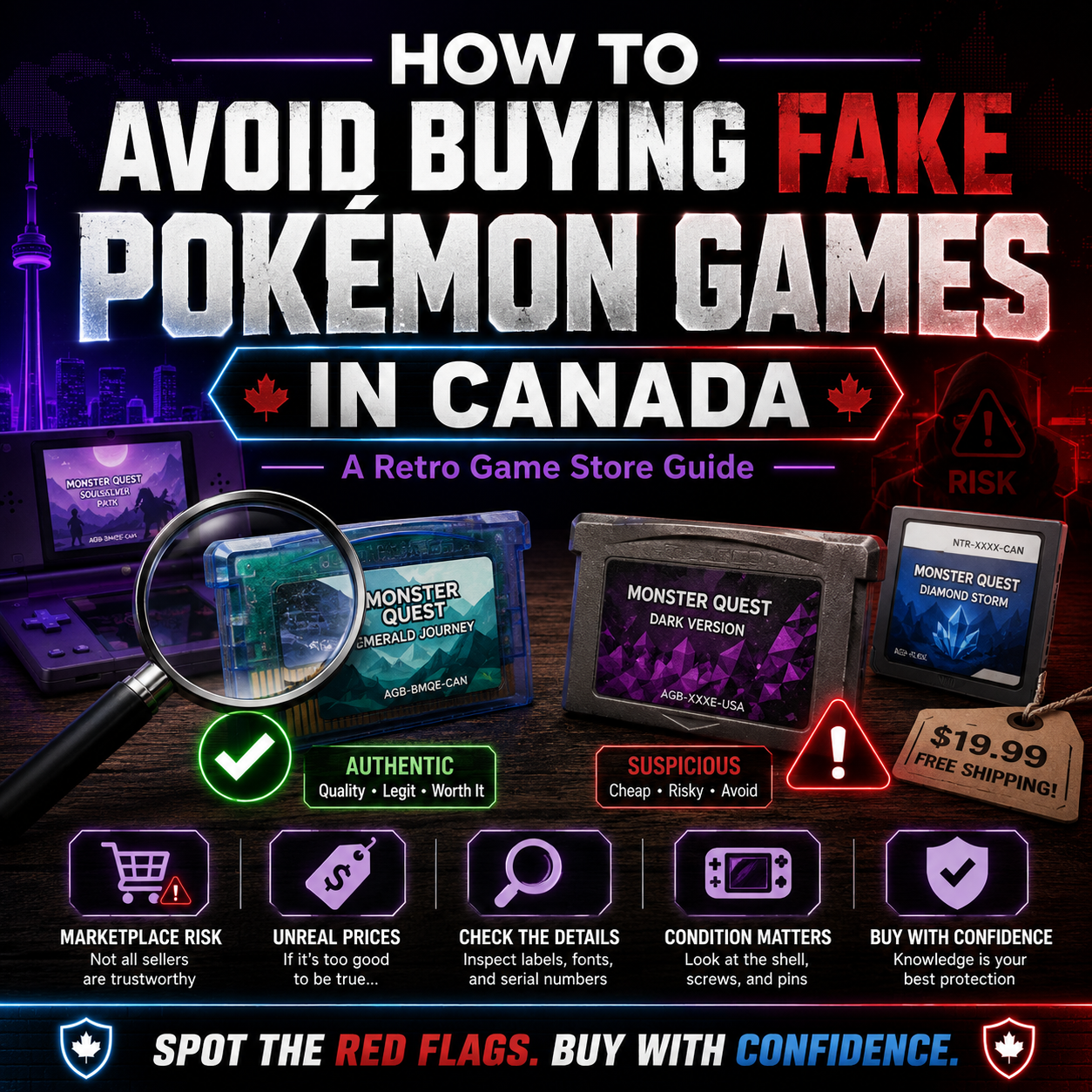
Fake Pokémon games are common enough that collectors and casual buyers need to be careful. The goal of this guide is not to turn every shopper into a cartridge authentication expert. The goal is to help you avoid the biggest risks before you hand over your money.
Summary
Pokémon games are some of the most commonly questioned titles in the used game market, especially on Game Boy Advance and Nintendo DS. Games like Pokémon Emerald, FireRed, LeafGreen, Platinum, HeartGold, SoulSilver, Black 2, and White 2 can be expensive, which makes them attractive targets for reproductions, counterfeits, and misleading listings.
You do not always need comparison photos to protect yourself. The biggest warning signs are usually price, seller behaviour, listing language, lack of real photos, vague answers, too-good-to-be-true condition, and whether the seller can confidently stand behind authenticity.
Buying used Pokémon games should be exciting. For a lot of players, these games are childhood favourites. For collectors, they are some of the most important handheld games ever released. For parents, they are often gifts for kids who want to experience the older Pokémon titles they have heard so much about.
Unfortunately, Pokémon games are also one of the biggest problem areas in retro game collecting.
Fake cartridges, reproduction carts, misleading online listings, and suspicious marketplace deals have become common enough that buyers need to slow down before purchasing. This is especially true for older Game Boy Advance and Nintendo DS Pokémon games, where authentic copies can sell for collector-level prices.
This guide is written from the perspective of a Canadian retro video game store. We are not going to pretend that every fake can be spotted from one quick glance. We are also not going to rely on blurry side-by-side photos or tiny label details that may not help a casual buyer.
Instead, this article focuses on practical warning signs, buyer behaviour, and the difference between a game that simply boots up and a game that is actually authentic.
The most important rule: If the price, condition, seller, or listing feels too good to be true, slow down. With expensive Pokémon games, a “great deal” can quickly become a fake game with no real collector value.
Why Pokémon Games Are So Commonly Faked
Pokémon is the perfect target for counterfeiters because the demand is huge and the original games are still wanted years later. Many people are not just buying these games to play them. They are buying them for nostalgia, collections, gifts, trading, transferring Pokémon, or completing a full series set.
That demand keeps prices high, especially for desirable titles. When a loose cartridge can be worth real money, fake copies start appearing in online marketplaces, local listings, and bulk lots.
The problem is that many fake Pokémon games are made to look convincing enough in a quick photo. Some will even boot up and play. That can make buyers think they are safe when they are not.
The Most Common Pokémon Games to Be Careful With
Any popular retro game can be faked, but Pokémon titles deserve extra caution because they are heavily collected and frequently resold.
Game Boy Advance Pokémon Games
- Pokémon Ruby
- Pokémon Sapphire
- Pokémon Emerald
- Pokémon FireRed
- Pokémon LeafGreen
Game Boy Advance Pokémon games are some of the biggest problem areas for fake cartridges. Some fake copies may start normally, but that does not mean they are authentic, reliable, or collectible.
Nintendo DS Pokémon Games
- Pokémon Diamond
- Pokémon Pearl
- Pokémon Platinum
- Pokémon HeartGold
- Pokémon SoulSilver
- Pokémon Black
- Pokémon White
- Pokémon Black Version 2
- Pokémon White Version 2
Nintendo DS Pokémon games can also be risky, especially the more expensive titles. Platinum, HeartGold, SoulSilver, Black 2, and White 2 are the ones buyers usually need to be most careful with because demand and resale prices are high.
The Biggest Red Flag Is Usually the Price
Most buyers want to believe they found a deal. Sometimes that happens. People clear out old collections, parents sell games without researching them, and sellers occasionally price things lower than market value.
But with Pokémon games, a price that is dramatically below normal market value should immediately raise questions.
If a seller has Pokémon Emerald, FireRed, HeartGold, SoulSilver, Platinum, Black 2, or White 2 listed for far less than every reputable seller, the first question should not be “How fast can I buy it?”
The first question should be: “Why is this so cheap?”
Cheap is not always good. A fake Pokémon cartridge may be cheap because it has no real collector value, may not save properly, may fail during trading or transferring, and may not be something a reputable store would accept for trade-in.
“Reproduction” Does Not Mean Authentic
One of the most confusing words in online game listings is “reproduction.”
Some sellers use “reproduction” clearly. Others hide it at the bottom of the listing. Some use softer words like “repro,” “custom,” “replacement,” “fan made,” “new version,” or “collector copy.”
For buyers, the important thing is simple: a reproduction Pokémon cartridge is not an original authentic Pokémon game.
It may look similar. It may boot up. It may even play. But it is not the same as owning an authentic copy. It should not be priced like an authentic copy, collected like an authentic copy, or represented as an authentic copy.
If you are buying a Pokémon game because you want a real original copy, avoid reproduction listings.
Be Careful With “Brand New” Looking Old Games
A real older Pokémon game can absolutely be clean. Some people took great care of their games. Some cartridges sat in storage for years. Some complete copies were barely played.
But if a loose cartridge is 20 years old and looks freshly made, overly glossy, perfectly unused, and suspiciously new, that should make you look closer.
This is especially true if the seller has multiple copies that all look equally fresh. Real used collections usually have variety. Some labels are nicer than others. Some cases have wear. Some manuals are missing. Some cartridges show normal signs of age.
A pile of expensive Pokémon games that all look recently manufactured is not automatically fake, but it is a warning sign.
Marketplace Warning Signs
Most fake Pokémon game problems start with online marketplaces. Facebook Marketplace, Kijiji, eBay, Amazon marketplace sellers, local buy-and-sell groups, and random online stores can all have legitimate sellers. They can also have sellers who do not know what they have, or sellers who know exactly what they are doing.
Here are the biggest warning signs to watch for.
| Situation | Risk Level | Why It Matters |
|---|---|---|
| The game is far cheaper than normal market value. | High | Counterfeit and reproduction games often compete by being much cheaper than authentic copies. |
| The listing says “repro,” “reproduction,” “custom,” or “replacement.” | Very High | That usually means it is not an authentic original cartridge. |
| The seller uses stock photos instead of photos of the actual game. | High | You cannot inspect the real item you are buying. |
| The seller refuses to send close-up photos. | High | A seller avoiding basic inspection is a major warning sign. |
| The seller has many copies of expensive Pokémon games. | High | Bulk quantities of valuable older Pokémon games should be questioned carefully. |
| The seller says “I do not know if it is real.” | Medium/High | That may be honest, but it means you are accepting the authenticity risk. |
| The game boots up, but saving/trading/transferring was not tested. | Medium/High | A fake game can sometimes start normally but still fail important functions later. |
| The seller has one childhood copy with a believable history. | Lower | This can be a better sign, but it still does not guarantee authenticity. |
Why “It Boots Up” Is Not Enough
One of the most common mistakes buyers make is assuming that a working game is an authentic game.
That is not always true.
A fake Pokémon game may start. It may show the title screen. It may let you begin a save file. It may even play for a while. But that does not mean it is original, reliable, or collectible.
Depending on the fake, problems may show up later. Saving may fail. The game may crash. Trading may not work properly. Transferring Pokémon forward may fail. Certain cartridge-specific features may not behave the way they should. The game may also have little to no trade-in value at a reputable retro game store.
A working fake is still fake. Functionality and authenticity are two different things. A game can boot up and still not be an authentic original copy.
Game Boy Advance Pokémon Games: What Buyers Should Know
Game Boy Advance Pokémon games are some of the most commonly questioned cartridges we see. Ruby, Sapphire, Emerald, FireRed, and LeafGreen are all titles buyers should approach carefully when shopping privately online.
There are visual details that can help with authentication, such as label quality, cartridge shell, screw type, internal board, and manufacturing details. The problem is that these details are hard to explain perfectly without the cartridge in hand. They can also vary enough that casual buyers may become overconfident from one online checklist.
For a regular buyer, the safer approach is to combine multiple clues:
- Does the price make sense?
- Does the seller seem knowledgeable?
- Are the photos clear and of the actual item?
- Is the seller avoiding authenticity questions?
- Does the cartridge look suspiciously new?
- Is the listing using words like “repro” or “replacement”?
- Can the game be returned if it turns out to be fake?
If the answer to several of those questions makes you uncomfortable, walk away.
Nintendo DS Pokémon Games: What Buyers Should Know
Nintendo DS Pokémon games are another major area where buyers need to be careful. The expensive DS titles are especially risky because there is more financial incentive for counterfeits and misleading listings.
Pokémon Diamond and Pearl are common enough that prices can vary, but Platinum, HeartGold, SoulSilver, Black 2, and White 2 are the ones that often make buyers nervous. These are the games where a fake copy can be a very expensive mistake.
Some authentic DS Pokémon games also have features that matter beyond simply loading the title screen. Trading, wireless features, Poké Transfer, infrared-related features, and long-term saving can all matter depending on the game.
That is why “tested and working” is not the same as “confirmed authentic.”
Questions to Ask Before Buying a Pokémon Game Online
Buyer Checklist
- Is this the actual item I will receive, or are the photos reused?
- Can the seller provide clear front, back, and close-up photos?
- Does the seller say the game is authentic, not just working?
- Is the price realistic compared with other authentic copies?
- Does the listing avoid words like reproduction, repro, custom, or replacement?
- Does the seller offer a return if the game is not authentic?
- Does the seller have a believable reason for owning the game?
- Is the condition believable for the age of the game?
- Would I still feel good about this purchase if I could not resell or trade it later?
Red Flag Words in Listings
Some fake or non-authentic listings are easy to spot because the seller gives it away in the wording. Other times, the wording is vague enough that casual buyers miss it.
Be careful with listings that use phrases like:
Listing Language to Watch For
- Reproduction
- Repro
- Replacement cartridge
- Custom cartridge
- Fan made
- Collector copy
- Not original
- Plays like original
- New cartridge version
- For display or collection only
- Cannot confirm authenticity
- No returns
Not every suspicious phrase means the seller is being dishonest. Some sellers are clear that they are selling reproductions. The issue is that buyers need to understand what those words mean before paying authentic-game prices.
Are Reproduction Pokémon Games Worth Anything?
Reproduction Pokémon games may have a small value to someone who only wants a cheap play copy, but they should not be valued like authentic original Pokémon games.
For collectors, authenticity matters. The original cartridge, original label, original board, original case, manual, inserts, and condition can all affect value. A reproduction cartridge does not carry the same collector value because it is not the original product.
At a reputable retro game store, reproduction cartridges are usually treated very differently from authentic games. Many stores will not knowingly buy or sell them at all.
Why This Matters for Trading, Transferring, and Long-Term Play
Pokémon games are different from many retro games because players often care about more than finishing the story. They may want to trade, battle, transfer Pokémon forward, complete a Pokédex, or keep a save file long-term.
That makes reliability important.
A fake copy may seem fine on day one but become frustrating later. If the save fails, if trading does not work, if transfer features do not behave properly, or if the game crashes after hours of play, the cheap copy may not feel like a deal anymore.
For casual play, this is annoying. For collectors, it is worse because the game still does not have authentic collector value.
Private Seller vs Retro Game Store
Buying from a private seller can sometimes save money. There is nothing wrong with finding a good local deal. Many real collections come from regular people selling games they owned for years.
The tradeoff is risk.
When you buy privately, you are often responsible for figuring out authenticity yourself. If the seller is wrong, does not know, disappears after the sale, or refuses a return, you may be stuck with the problem.
When you buy from a trusted retro game store, you are not just paying for the cartridge. You are also paying for the work behind it.
A Retro Game Store Owner’s Perspective
At Power Up Gaming, authenticity matters because trust matters. Customers should not have to become experts in circuit boards, label printing, cartridge shells, and marketplace scams just to buy a Pokémon game with confidence.
When a store checks games before selling them, provides accurate listings, and stands behind what it sells, that has value. It protects casual buyers, collectors, parents buying gifts, and players who just want the real thing.
We do not knowingly sell fake Pokémon games or reproduction cartridges as authentic games. If you are buying an expensive Pokémon title, peace of mind matters.
What to Do If You Already Bought a Questionable Pokémon Game
If you already bought a Pokémon game and now you are unsure if it is real, do not panic. Start by collecting information.
- Keep screenshots of the original listing.
- Keep messages with the seller.
- Take clear photos of the game from multiple angles.
- Check whether the seller described it as authentic, reproduction, or unconfirmed.
- Test saving, loading, and any features you specifically care about.
- If you bought through a marketplace with buyer protection, review your return or dispute options quickly.
- Ask a trusted retro game store or knowledgeable collector to inspect it if you are unsure.
If you paid authentic pricing for a game that turns out to be fake or reproduction, act quickly. The longer you wait, the harder it may be to resolve the purchase.
How to Buy Pokémon Games More Safely
You do not need to avoid every private sale, but you should be careful with expensive Pokémon games. A few extra minutes before buying can save you from a costly mistake.
Safe Buying Checklist
- Buy from a seller who can answer authenticity questions clearly.
- Avoid listings that only show stock photos.
- Be suspicious of prices far below normal market value.
- Avoid reproduction listings if you want an authentic game.
- Do not rely only on “tested and working.”
- Ask about returns before buying.
- Be extra careful with Emerald, FireRed, LeafGreen, Platinum, HeartGold, SoulSilver, Black 2, and White 2.
- When authenticity really matters, buy from a reputable retro game store.
Our Take
Fake Pokémon games are frustrating because they take advantage of excitement, nostalgia, and trust. Most buyers are not trying to become experts. They just want the game they paid for.
The safest approach is to slow down, question deals that seem too good, read listing language carefully, avoid reproduction cartridges when you want originals, and buy from sellers who can stand behind authenticity.
A fake Pokémon game may still boot up. It may still play for a while. But it is not the same as owning the real thing.
For collectors, players, and anyone buying a special gift, authenticity matters.
Looking for Authentic Pokémon Games?
Browse Power Up Gaming for Pokémon games, Nintendo handheld titles, and retro favourites. Looking to trade in your old games? We can help with that too.
Shop Pokémon Games Shop Game Boy Advance Shop Nintendo DS Trade In Your GamesFAQ
Are fake Pokémon games common?
Fake and reproduction Pokémon games are common enough that buyers should be careful, especially with valuable Game Boy Advance and Nintendo DS titles.
Can fake Pokémon games still work?
Yes. Some fake Pokémon games may boot up and play, at least for a while. That does not make them authentic, reliable, or collectible.
Can fake Pokémon games save properly?
Some may save, some may not, and some may fail later. Saving is one reason “it turns on” is not enough to confirm a Pokémon game is authentic or reliable.
Can fake Pokémon games trade with real games?
Some fake games may have problems with trading, transferring, wireless features, or other cartridge-specific functions. If those features matter to you, authenticity becomes even more important.
Are reproduction Pokémon games authentic?
No. A reproduction cartridge is not an original authentic Pokémon game. It may be playable, but it should not be represented or priced as an authentic original copy.
Are reproduction Pokémon games worth collecting?
For most serious collectors, no. Collectors usually value authentic original cartridges, labels, cases, manuals, inserts, and condition. Reproductions do not carry the same collector value.
How can I tell if my Pokémon game is real?
The safest answer is to inspect multiple factors: price, seller history, listing language, label quality, cartridge shell, internal board, game behaviour, and whether the seller can stand behind authenticity. For expensive games, professional inspection is often worth it.
Does Power Up Gaming sell reproduction Pokémon games?
Power Up Gaming does not knowingly sell fake Pokémon games or reproduction cartridges as authentic games. Authenticity and customer trust are important parts of buying from a real retro game store.
Should I buy Pokémon games from Facebook Marketplace or Kijiji?
You can find real games privately, but the risk is higher. Ask for actual photos, avoid suspicious prices, question vague answers, and make sure you understand the return situation before buying.
What is the safest way to buy older Pokémon games?
The safest option is to buy from a trusted seller or retro game store that checks authenticity, accurately describes condition, and stands behind what it sells.
Source note: This article is a buyer-protection guide from Power Up Gaming. Nintendo’s public Intellectual Property & Piracy FAQ identifies counterfeit games and systems as a form of video game piracy. eBay Canada’s counterfeit item policy states that counterfeit or fake items are not allowed on the platform. This article is general consumer guidance, not legal advice.