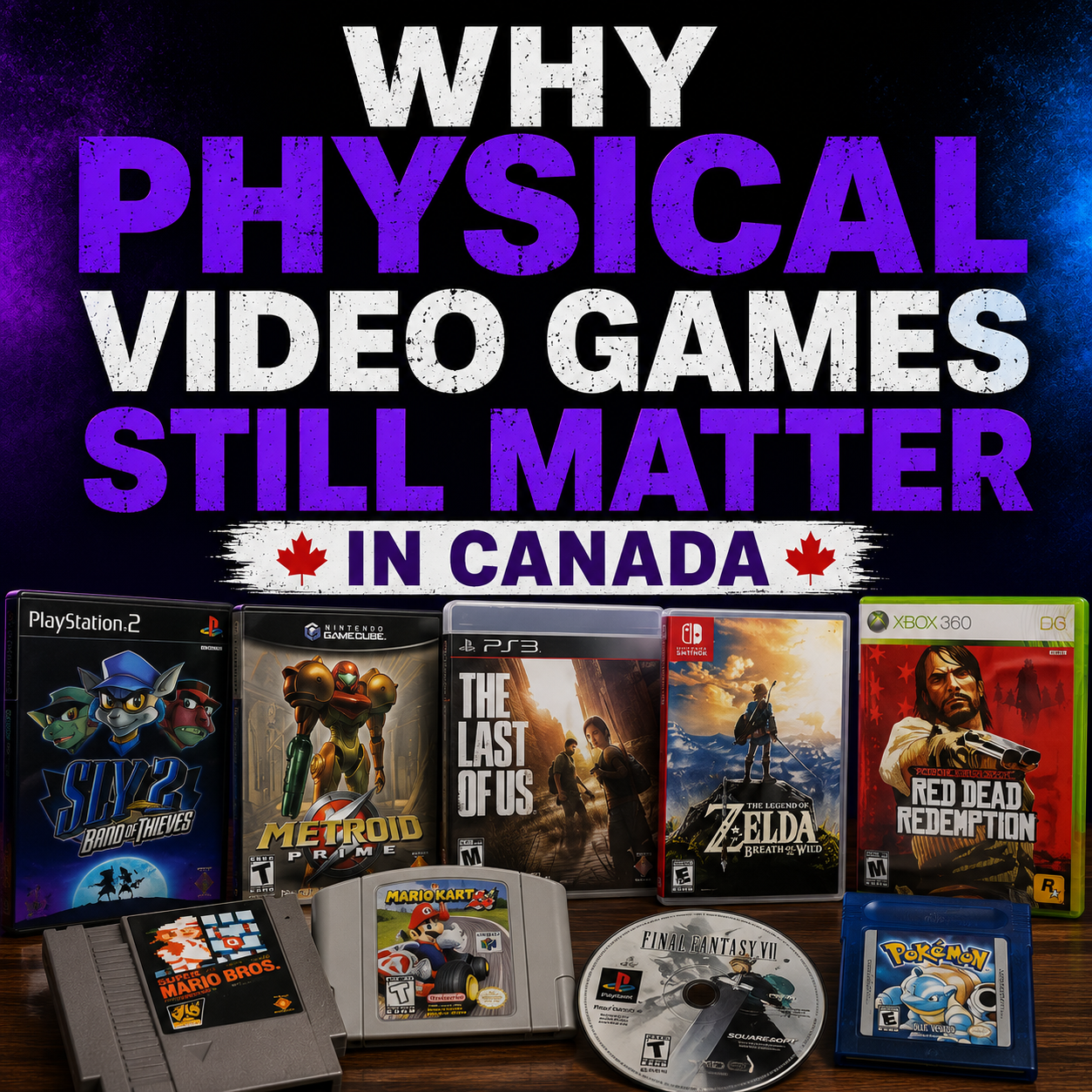
Why Physical Video Games Still Matter in Canada
Physical video games are not just nostalgia. They still matter for ownership, trade-ins, collecting, affordability, preservation, gifting, and consumer choice. As gaming moves further toward digital access, physical games give Canadian players something digital purchases often do not: control.
Summary
Physical video games still matter because they can be owned, traded, resold, gifted, collected, preserved, and played years later. Digital games are convenient, and many players prefer them, but digital access is not the same as physical ownership.
For Canadian gamers, physical games help keep gaming affordable through used copies, trade-ins, local game stores, and the ability to resell finished games. For collectors, physical games preserve the cases, manuals, cartridges, discs, artwork, and history that make gaming culture tangible.
This is not about saying digital games are bad. Digital gaming is useful. The issue is what happens when digital becomes the only option.
There has never been a more important time to talk about physical video games.
Digital libraries are growing. Subscription services are everywhere. Some modern physical releases require downloads. Some games are sold as codes in boxes. Nintendo Switch 2 game-key cards have made the line between physical and digital less clear. Sony’s move away from new physical PlayStation discs has pushed the conversation even further.
For some players, none of this matters. They like digital convenience. They want quick downloads, no cases, no discs, no cartridges, and no shelf space.
That is fair.
But for many gamers, especially collectors, families, retro fans, and used-game buyers, physical games still matter a lot.
The short version: Digital games are convenient. Physical games are ownership, trade-in value, collecting, preservation, gifting, and consumer choice.
Physical Games vs Digital Access
The most important difference between physical and digital games is control.
When you buy a physical game, you have an item. You can lend it to a friend. You can trade it in. You can sell it privately. You can give it as a gift. You can put it on a shelf. You can keep it in a collection. You can bring it into a store like Power Up Gaming and turn it into value toward something else.
When you buy digital, you usually have access tied to an account, a storefront, a device, licensing terms, and platform support.
That access may last for years. It may be convenient. It may be exactly what you want.
But it is not the same thing as owning a physical copy.
Why Ownership Matters
Ownership matters because games are not always available forever.
Digital storefronts can change. Games can be delisted. Licenses can expire. Servers can shut down. Accounts can be lost. Hardware can change. A game that is easy to buy today may be much harder to access years from now.
Physical games are not perfect. Modern discs and cartridges can still require updates, patches, downloads, or online features. But a physical copy still gives players something digital access often does not: a transferable object that exists outside one account.
That matters for players. It matters for collectors. It matters for parents. It matters for used game stores. It matters for preservation.
Why Used Games Matter in Canada
Gaming in Canada is expensive. New releases, consoles, accessories, taxes, and shipping can all add up quickly.
Used games help make gaming more affordable.
A customer can buy a used game for less than new. Another customer can trade in a game they already finished. A parent can stretch a gaming budget further. A collector can hunt for older titles. A casual player can try something without paying full new-release pricing.
That used-game cycle only works because physical games exist.
When games become digital-only, there is no used copy. There is no trade-in. There is no local resale. There is no lending a cartridge to a friend. There is no finding a childhood favourite on a shelf years later.
Digital-only removes the second-hand market. When there is no physical copy, customers lose the ability to trade, resell, lend, gift, or buy used copies of that game.
Trade-Ins Help Keep Gaming Affordable
Trade-ins are one of the biggest reasons physical games still matter.
When you finish a physical game, you still have something with value. You can keep it, sell it, lend it, or trade it toward something else.
That matters because not every customer wants to build a permanent collection. Some people want to play a game, finish it, and move on. Trade-ins let those customers keep gaming without paying full price every time.
At Power Up Gaming, trade-ins help keep physical games moving from one player to another. A game that one person is finished with becomes the next person’s new favourite.
That is good for affordability. It is good for sustainability. It is good for local gaming communities.
Physical Games Make Collecting Possible
Collecting is about more than playing the software.
Collectors care about cartridges, discs, cases, manuals, cover art, maps, inserts, boxes, variants, labels, condition, and history. A complete-in-box game is different from a loose copy. A clean original case is different from printed cover art. A real cartridge is different from a reproduction. A childhood copy has a story attached to it.
Digital games cannot fully replace that.
A digital library can be convenient, but it does not give you the same feeling as finding a game you loved as a kid, completing a shelf, replacing a lost collection, or holding an original copy of something that mattered to you.
That is why retro collecting continues to grow even as digital gaming becomes more common.
Preservation Is Not Just for Museums
Video game preservation sounds like something only museums, archives, and hardcore collectors care about.
It is bigger than that.
Preservation is why people can still play old games. It is why someone can walk into a retro game store and find a console from their childhood. It is why a parent can show their kid the games they grew up with. It is why a collector can rescue an old library from a basement and put it back into circulation.
The Video Game History Foundation found that 87% of classic games are not currently in release, which shows how many older games are not easily available through modern official channels. That makes physical copies, used games, private collections, and retro stores an important part of keeping gaming history alive.
Physical games are practical preservation. They are not perfect, but they keep games moving, visible, playable, and discoverable long after their original release window.
Why Parents and Gift Buyers Still Like Physical Games
Physical games are easier to gift.
A wrapped game feels better than a code in an email. A physical case gives someone something to open. It is easier for grandparents, parents, partners, and friends to understand. It also avoids some of the awkwardness of account-specific digital purchases.
Physical games are also easier to manage for families.
If a child is done with a game, it can be traded. If siblings share a console, a physical game can be shared more easily. If a parent wants to buy used, they can save money. If a game is not a hit, it still has resale or trade value.
Digital games can work well for families too, but physical copies offer flexibility that many households still value.
Physical Games Support Local Game Stores
Physical games also support local businesses.
Retro game stores, independent game shops, collectors, repair technicians, resellers, and local gaming communities all rely on physical products moving through the market.
When customers buy, sell, and trade physical games locally, that money circulates in the community. It supports staff, storefronts, events, local collectors, and Canadian businesses.
Digital-only purchases usually send the entire transaction through a platform holder’s storefront. That may be convenient, but it removes local stores from the process.
Physical games give local stores a reason to exist and give customers a place to browse, ask questions, trade, discover, and connect.
Physical Does Not Always Mean What It Used To
One of the reasons this conversation matters now is that “physical” is becoming more complicated.
Some physical games contain the full game. Some need patches. Some include only part of the game. Some are download codes in a box. Some Nintendo Switch 2 game-key cards act as a key to download the full game instead of containing all the game data on the card.
That does not mean every modern physical release is bad. It means buyers need to pay attention.
If you care about collecting, preservation, trade-in value, or long-term access, it is worth checking what is actually included before buying a physical game.
Before Buying a Modern Physical Game, Check:
- Does the disc or cartridge contain the full game?
- Is it a game card, game-key card, or download code?
- Does it require a large download before playing?
- Does it require online servers to function?
- Is the physical copy still useful if the storefront changes later?
- Will it have resale or trade-in value?
- Does the package clearly explain what is included?
When Digital Still Makes Sense
This is not an anti-digital article.
Digital games can be excellent. They are convenient, fast, easy to access, and perfect for many players. Digital sales can be strong. Indie games often thrive digitally. Some players do not want shelves full of cases. Some people prefer having everything attached to one account.
There is nothing wrong with choosing digital when it works for you.
The problem is not digital existing. The problem is physical disappearing as an option.
Gaming is better when customers have a choice.
Physical vs Digital: Quick Comparison
| Factor | Physical Games | Digital Games |
|---|---|---|
| Ownership feel | Tangible item you can hold, display, lend, trade, or sell | Access tied to an account and storefront |
| Used game market | Can be bought used, traded, resold, or gifted | Usually cannot be resold or traded |
| Convenience | Requires storage space at home and swapping discs/cards | Fast access, no physical storage, easy downloads |
| Collecting | Cases, manuals, discs, carts, artwork, and condition matter | Useful library access, but less tangible collector appeal |
| Gifting | Easy to wrap, give, and understand | Can be convenient, but often account/platform dependent |
| Long-term access | Can survive outside one account or storefront | Depends on account, licensing, storefront, and platform support |
A Retro Game Store Owner’s Perspective
Physical Games Keep Gaming History Moving
At Power Up Gaming, we see every day that physical games still matter.
Customers bring in childhood collections. Parents buy older games for their kids. Collectors hunt for complete copies. People trade finished games toward something new. Someone finds a game they have not seen in 20 years and suddenly remembers exactly where they were when they first played it.
That only happens because physical games survived. A digital-only future may be convenient, but it removes a lot of what makes gaming culture feel alive, shared, and lasting.
Our Take
Physical video games still matter in Canada because they give players options.
They make gaming more affordable through used copies and trade-ins. They make collecting possible. They help preserve gaming history. They support local stores. They give parents and gift buyers something simple and tangible. They let customers keep some control over what they buy.
Digital games are not the enemy. Digital convenience is real, and for many players it is the right choice.
But physical games should continue to exist as a choice.
Because once physical games disappear, players lose more than plastic cases, discs, and cartridges.
They lose ownership, resale value, trade-in value, lending, gifting, collecting, preservation, and a major part of gaming culture.
That is why physical video games still matter.
Keep Physical Gaming Alive
Browse Power Up Gaming for physical video games, retro consoles, used games, complete-in-box favourites, and collectibles. Finished with old games? Trade them in and keep the cycle going.
Shop Physical Games Shop Retro Games Shop Complete In Box Trade In Your GamesFAQ
Why do physical video games still matter?
Physical games still matter because they can be owned, traded, resold, gifted, collected, preserved, and shared. They give players more control than digital-only purchases.
Are digital games bad?
No. Digital games are convenient and useful. The issue is not digital games existing. The issue is physical games disappearing as an option.
Are physical games better than digital games?
It depends on the buyer. Physical games are better for ownership, collecting, trade-ins, resale, and gifting. Digital games are better for convenience, fast access, and avoiding physical storage.
Can physical games still require downloads?
Yes. Some modern physical games require patches, updates, downloads, or online access. Buyers should check what is actually included on the disc or cartridge before buying.
Why do used games matter?
Used games help keep gaming affordable. They let customers buy games for less, trade finished games, and keep physical copies moving from one player to another.
Why are physical games important for collectors?
Collectors care about original cartridges, discs, cases, manuals, inserts, cover art, condition, variants, and complete copies. Digital games cannot fully replace that physical collecting experience.
Do physical games help with preservation?
Yes. Physical games help keep older games visible, playable, and discoverable long after their original release window. They are an important part of practical video game preservation.
Are physical games good for gifts?
Yes. Physical games are easy to wrap, give, understand, and exchange. They also give the recipient something tangible instead of just a code or digital receipt.
Do physical games support local stores?
Yes. Physical games support local game stores, trade-ins, used game markets, repairs, collectors, and local gaming communities.
Should I buy physical or digital games?
If you value convenience, digital may be best. If you value ownership, resale, trade-ins, collecting, gifting, or preservation, physical is worth considering whenever it is available.
Are physical games going away?
The industry is moving more toward digital, subscriptions, and download-dependent formats, but physical games still matter to many players, collectors, families, and stores. Supporting physical releases helps keep them available longer.
Source note: This article is a buyer-education and opinion guide from Power Up Gaming based on our experience selling physical video games, retro consoles, trade-ins, used games, and collectibles in Canada. The Video Game History Foundation has reported that 87% of classic games are not currently in release. Nintendo’s Switch 2 game-key card format and Sony’s 2028 physical-disc shift are also examples of how the meaning of physical ownership is changing in modern gaming.