
Summary
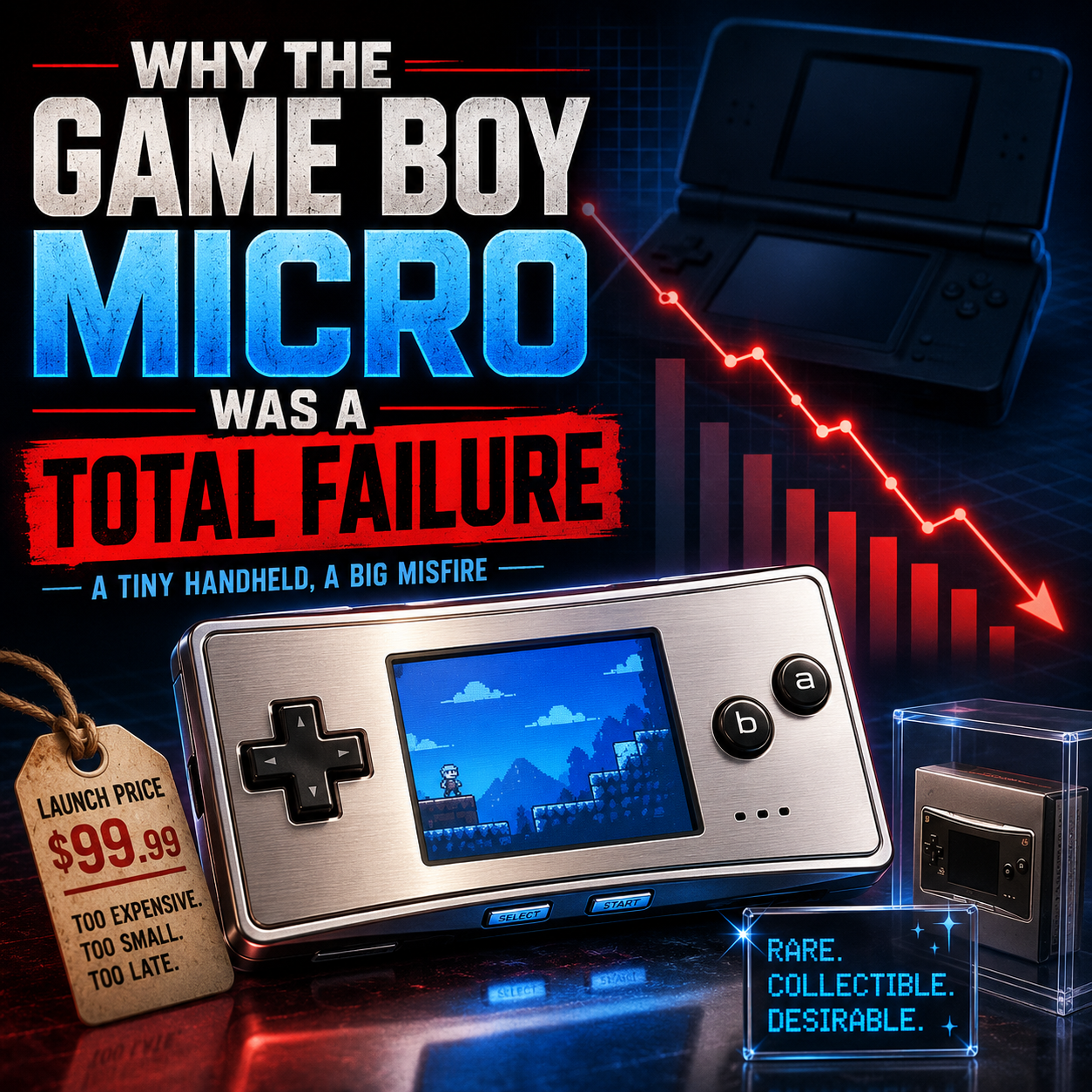
The Game Boy Micro is one of Nintendo’s strangest handhelds. It was beautifully built, incredibly portable, stylish, bright, sharp, and genuinely impressive when you held one in your hands. It was also a commercial failure.
Released in 2005 near the end of the Game Boy Advance era, the Micro arrived after the Nintendo DS had already launched and started pulling attention away from the Game Boy brand. It only played Game Boy Advance games, dropped compatibility with original Game Boy and Game Boy Color cartridges, used its own charger and link cable, had a tiny 2-inch screen, and cost almost as much as a Nintendo DS.
Nintendo later admitted that Game Boy Micro sales did not meet expectations. Satoru Iwata explained that the Micro lost momentum because Nintendo had to focus so much energy on marketing the DS, and that consumers did not understand the Micro’s value unless they physically touched it.
The funny part? The Game Boy Micro failed at retail, but it won long-term as a collector’s item. Today, clean Game Boy Micro consoles are harder to find than regular Game Boy Advance and Game Boy Advance SP systems, and special editions can be especially desirable.
The Game Boy Micro Was Not a Bad Console
Let’s get this out of the way first. The Game Boy Micro was not junk.
In fact, from a design perspective, it was kind of amazing.
Nintendo took the Game Boy Advance hardware and shrank it into a tiny metal-bodied handheld that measured roughly 4 inches wide, 2 inches tall, and 0.7 inches thick. It weighed about 2.8 ounces, had a bright backlit 2-inch screen, and included a standard headphone jack, something the Game Boy Advance SP annoyingly did not have without an adapter. (Game Developer)
For quick gaming sessions, the Micro was fantastic. It slipped into a pocket easily, looked more like a trendy electronic gadget than a toy, and had one of the sharpest screens Nintendo had ever put into a handheld up to that point. The smaller screen made Game Boy Advance games look crisp and colourful, and the build quality felt more premium than people expected from a Game Boy.
That is part of why the Game Boy Micro is such an interesting failure. It did not fail because Nintendo made something cheap, lazy, or poorly designed. It failed because Nintendo made a beautiful little machine for a market that had already moved on.
The Sales Numbers Tell the Story
The Game Boy family was a monster. The original Game Boy and Game Boy Color line sold over 118 million units worldwide, and the Game Boy Advance family sold over 81 million units worldwide. Nintendo’s own sales data lists the Nintendo DS at over 154 million units sold, making it one of the best-selling video game systems ever. (任天堂ホームページ)
The Game Boy Micro did not come close to those numbers.
By March 31, 2007, the Game Boy Micro had sold about 2.42 million units worldwide. Compared to the Game Boy Advance SP, which sold over 43 million units, the Micro barely made a dent. (Wikipedia)
For most companies, selling a couple million handhelds would sound great. For Nintendo, during the Game Boy era, that was a disappointment. This was not some random accessory. It was the final official system in the legendary Game Boy line. It should have been a victory lap. Instead, it became a weird little footnote.

The Nintendo DS Crushed Its Momentum
The biggest reason the Game Boy Micro failed was not the screen size. It was not the faceplates. It was not even the lack of backwards compatibility.
The biggest problem was the Nintendo DS.
The DS launched in North America in November 2004, less than a year before the Game Boy Micro arrived. It had two screens, a touch screen, built-in wireless features, a growing library of exclusive games, and it could still play Game Boy Advance cartridges. That last point was brutal for the Micro. (Wikipedia)
From a customer’s perspective, the choice was awkward:
You could buy a Game Boy Micro for around $99 USD and play only Game Boy Advance games.
Or you could spend a bit more and get a Nintendo DS, which played Nintendo DS games and Game Boy Advance games.
That made the Micro feel like old technology in a cute shell. The DS felt like the future. Even if the Micro looked cooler, the DS offered more value.
Nintendo also dropped the DS price to $129.99 in 2005, which made the comparison even worse. Suddenly the Micro was only about $30 cheaper than a much more capable system. (Wikipedia)
That is a brutal position for any product. The Game Boy Micro was not competing against Sony, Sega, or some random third-party handheld. It was competing against Nintendo’s own next big thing.

Nintendo Did Not Know How to Sell It
Nintendo eventually admitted that the Micro’s marketing failed.
At a 2006 corporate briefing, Satoru Iwata said the Micro’s sales did not meet Nintendo’s expectations. He explained that people who physically touched the system at events were impressed, but regular consumers had to judge it without that hands-on experience. Nintendo failed to communicate why the Micro was special, so many shoppers decided it was not worth the price. (任天堂ホームページ)
That is the heart of the Game Boy Micro problem.
The Micro made sense in your hand.
It did not make sense on a shelf.
When you held one, you understood the appeal. It felt premium. It looked sleek. The screen popped. The tiny size was charming instead of silly. But if you were just staring at a box in a store, the pitch was not obvious.
“Here is a smaller Game Boy Advance that costs more than some older models, plays fewer games than the SP, and costs almost as much as a DS.”
Yeah. That is a rough sell.
Nintendo had always been great at letting people experience hardware. The Wii made sense when you saw someone swing the controller. The DS made sense when you tapped the touch screen. The Game Boy itself made sense the second you played Tetris on the go.
The Game Boy Micro needed that same hands-on magic. It did not get enough of it.
The Price Was Wrong
The Game Boy Micro launched at around $99 USD. That price was not insane in isolation, but it was a problem in context.
By 2005, the Game Boy Advance was no longer new. The Game Boy Advance SP had already been on the market for years. The Nintendo DS was already available. The PSP had launched in North America earlier in 2005 as a more powerful multimedia handheld, even though it was much more expensive. (WIRED)
The Micro sat in an uncomfortable middle ground. It was not the cheapest way to play Game Boy Advance games. It was not the most advanced handheld. It was not the most versatile. It was a premium redesign of aging hardware.
Collectors understand that kind of product now. In 2005, most parents and casual shoppers did not.
If the Micro had launched at a much lower price, it may have performed better as an impulse buy or secondary handheld. But at $99, it needed to justify itself. For many people, it simply did not.
It Lost Backwards Compatibility
The Game Boy Advance and Game Boy Advance SP could play Game Boy Advance games, Game Boy Color games, and many original Game Boy games. That made them incredibly useful systems for anyone with an older library.
The Game Boy Micro could only play Game Boy Advance games.
That was a huge step backward.
To be fair, this was not because the Game Boy Advance library was weak. The GBA has an outstanding lineup, including games like Metroid Fusion, The Legend of Zelda: The Minish Cap, Mario Kart: Super Circuit, Pokémon Ruby, Sapphire, Emerald, FireRed, LeafGreen, Advance Wars, Golden Sun, Castlevania: Aria of Sorrow, and many more.
But losing Game Boy and Game Boy Color compatibility still hurt. The Game Boy brand had always been built around continuity. You could carry your library forward. The Micro broke that expectation.
If you already had a Game Boy Advance SP, the Micro did not add much. If you had old Game Boy games, the Micro actually did less. That made it feel like a luxury item instead of a practical upgrade.
The Tiny Screen Was Both a Strength and a Weakness
The Game Boy Micro’s screen is one of the most debated parts of the system.
On one hand, it looked excellent. The smaller size made the image appear sharp and colourful. It was backlit, bright, and much nicer to look at than the original non-lit Game Boy Advance screen.
On the other hand, it was tiny.
For younger players with sharp eyesight, that might not have mattered much. For adults, longer play sessions could become uncomfortable. RPGs, text-heavy games, and action games with small details were not always ideal on a 2-inch display.
This is where the Micro became a very specific kind of handheld. It was amazing for quick sessions, short bursts, and portable play. It was less amazing if you wanted to sit for hours grinding through a long RPG.
That did not make it bad. It made it niche.
And niche hardware needs a clear audience. Nintendo did not successfully define that audience.
The Faceplates Were a Cool Idea That Never Fully Landed
The Game Boy Micro had interchangeable faceplates, which should have been a brilliant idea.
Customization was becoming a bigger part of consumer electronics. Phones, iPods, cases, colours, and accessories were becoming part of how people expressed personal style. Nintendo clearly wanted the Micro to feel fashionable.
In theory, the faceplates gave players a way to personalize their system.
In practice, the feature was underused and messy.
Faceplates were regionally inconsistent, not always easy to find, and not marketed strongly enough to become a major selling point. In some markets, the customization angle barely mattered because extra faceplates were limited or difficult to obtain. (Wikipedia)
The faceplates also scratched easily, which is a nightmare now for collectors. A Game Boy Micro with a clean original faceplate is much more desirable than one that looks like it spent 10 years in a junk drawer with loose change and keys.
Great idea. Weak execution.
Classic “almost brilliant” Nintendo weirdness.
The Charger and Link Cable Situation Was Annoying
Nintendo also changed the port on the Game Boy Micro, which meant regular Game Boy Advance SP chargers and link cables did not work without Micro-specific accessories or adapters.
That might sound minor, but it mattered.
By 2005, many players already had GBA chargers, link cables, wireless adapters, and accessories. The Micro did not fit cleanly into that existing ecosystem. It needed its own charger. It needed its own link cable solution. Some accessories simply were not compatible.
For a system that was already hard to justify, every extra inconvenience hurt.
The Micro needed to be simple. Instead, it created friction.

The Game Boy Brand Was Already Being Replaced
Nintendo originally tried to position the DS as a “third pillar” alongside the Game Boy and home consoles. In theory, the DS was not supposed to replace the Game Boy right away.
In reality, it absolutely did.
The DS became too successful. Nintendo’s energy moved there. Developers moved there. Customers moved there. Retailers moved there. The Game Boy Micro arrived as the final gasp of a legendary handheld brand while the next era was already taking over.
That is why the Micro feels so strange historically. It is technically the final Game Boy system, but it does not feel like a grand finale. It feels like Nintendo released it while already looking over its shoulder at the DS.
Even Reggie Fils-Aimé later described the Micro as a mistake from a business perspective, noting that Nintendo of America was not aligned with Japan on the product and that the system launched to lacklustre results. (VGC)
When even Nintendo’s own leadership had doubts, the product was already in trouble.
Was the Game Boy Micro Really a “Total Failure”?
Commercially? Yes.
As a product? Not really.
That distinction matters.
The Game Boy Micro failed because it was expensive for what it offered, launched too late, lost backwards compatibility, had poor accessory compatibility, and had to compete with the Nintendo DS. Nintendo also failed to explain its value to regular consumers.
But as a piece of hardware, it has aged beautifully.
The Micro is stylish, compact, durable, sharp-looking, and unique. It feels more like a collector’s gadget now than a failed handheld. It is also much harder to find in nice condition than a standard Game Boy Advance or Game Boy Advance SP.
Modern pricing reflects that collector demand. PriceCharting currently tracks loose Game Boy Micro systems at over $200 USD, with complete and special editions often higher depending on condition and variant. (PriceCharting)
So yes, the Game Boy Micro failed at retail.
But it absolutely did not fail at becoming interesting.

Why Collectors Love the Game Boy Micro Today
Collectors love the Game Boy Micro because it checks a lot of boxes:
It was the final Game Boy system.
It sold poorly compared to other Game Boy models.
It has a premium metal feel.
It has a sharp backlit screen.
It came in multiple colours and special editions.
It is small enough to display easily.
It represents one of Nintendo’s weirdest transitional moments.
That combination makes it a perfect collector piece. It is not just another handheld. It is a conversation starter.
At Power Up Gaming, we see this kind of thing all the time. The systems that struggled during their original retail life often become fascinating later because fewer people bought them, fewer survived in clean condition, and collectors eventually realize how unusual they are.
The Game Boy Micro is exactly that kind of system.

Should You Buy a Game Boy Micro Today?
The Game Boy Micro is worth buying if you specifically want a collectible, premium-feeling way to play Game Boy Advance games. It is not the best choice for everyone.
You may love it if you want something rare, stylish, compact, and historically interesting.
You may want to skip it if you need a bigger screen, want to play original Game Boy or Game Boy Color games, or simply want the best value for everyday GBA gaming.
For most players, a Game Boy Advance SP is still the more practical option. It plays more games, has a larger screen, folds shut to protect the display, and is generally easier to find.
But for collectors? The Micro is special.
It is the tiny Nintendo handheld that failed because the world did not need it in 2005, then became desirable because the world eventually realized how odd and charming it really was.
That is the Game Boy Micro in one sentence:
A retail failure, a collector success, and one of Nintendo’s coolest mistakes.
Looking for Game Boy Advance Consoles or Games?
If you are looking for Game Boy Advance games, Game Boy Advance SP consoles, or hard-to-find retro Nintendo items, check out Power Up Gaming at powerupgaming.ca.
We buy, sell, test, and clean retro video games and consoles, and our inventory changes constantly. Game Boy Micro systems do not show up every day, especially in good condition, but Game Boy Advance and retro Nintendo collectors should always keep an eye on what is available.
FAQ
Why did the Game Boy Micro fail?
The Game Boy Micro failed because it launched too late in the Game Boy Advance lifecycle, cost too much compared to the Nintendo DS, only played Game Boy Advance games, and lacked strong marketing. Nintendo later admitted that it failed to communicate the Micro’s value to consumers. (任天堂ホームページ)
Was the Game Boy Micro a bad console?
No. The Game Boy Micro was actually a very well-built handheld with a sharp backlit screen, premium feel, and excellent portability. Its problem was not quality. Its problem was timing, price, and limited compatibility.
Can the Game Boy Micro play original Game Boy games?
No. The Game Boy Micro can only play Game Boy Advance cartridges. It cannot play original Game Boy or Game Boy Color games.
Can the Game Boy Micro play Pokémon games?
Yes, but only Game Boy Advance Pokémon games. It can play Pokémon Ruby, Sapphire, Emerald, FireRed, and LeafGreen. It cannot play Pokémon Red, Blue, Yellow, Gold, Silver, or Crystal because those are original Game Boy and Game Boy Color games.
Is the Game Boy Micro rare?
It is not impossible to find, but it is much less common than the Game Boy Advance or Game Boy Advance SP. Clean units, original faceplates, boxes, manuals, and special editions are harder to find and can be expensive.
Why is the Game Boy Micro so expensive now?
The Game Boy Micro is expensive today because it sold poorly compared to other Game Boy models, was the final Game Boy system, and has become popular with collectors. Condition matters a lot, especially because the faceplates scratch easily.
Is the Game Boy Micro better than the Game Boy Advance SP?
For everyday use, the Game Boy Advance SP is usually better. It has a larger screen, folds shut, and plays Game Boy, Game Boy Color, and Game Boy Advance games. The Micro is better as a collectible or ultra-portable GBA-only system.
Does the Game Boy Micro use the same charger as the Game Boy Advance SP?
No. The Game Boy Micro uses its own charger port, so it requires a Game Boy Micro charger or compatible replacement.
Is the Game Boy Micro worth buying today?
It is worth buying if you are a collector or specifically want a small, premium way to play Game Boy Advance games. If you only care about value and compatibility, a Game Boy Advance SP is usually the smarter choice.
Was the Game Boy Micro the last Game Boy?
Yes. The Game Boy Micro was the final system released under the Game Boy name. After that, Nintendo’s handheld future fully shifted toward the Nintendo DS line.

1 comment
nkyg
Talk about bad marketing, somehow I didn’t even know this one existed till now! Then a double flop with how terrible it looks. I never would have guessed this was released after DS.