Summary
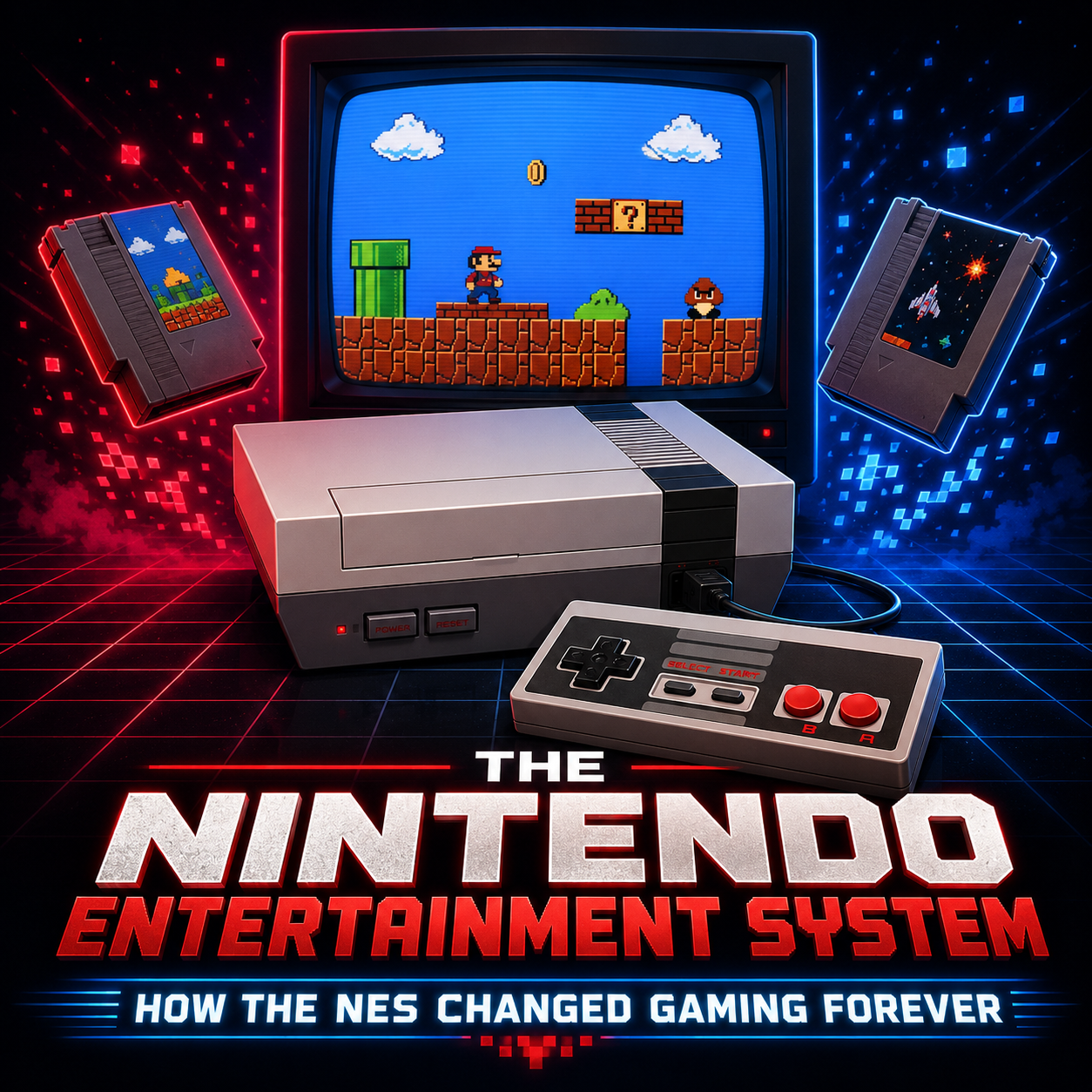
The Nintendo Entertainment System, better known as the NES, was not just another video game console. It was the machine that helped rebuild trust in home gaming after the North American video game crash of the early 1980s. Originally released in Japan as the Family Computer, or Famicom, in 1983, Nintendo redesigned and rebranded the system for North America in 1985 as something that looked less like a traditional game console and more like a home entertainment device. (si.edu)
With legendary games like Super Mario Bros., The Legend of Zelda, Metroid, Mega Man, Castlevania, Final Fantasy, and Duck Hunt, the NES turned living rooms into adventure zones. It introduced stricter game licensing, the Official Nintendo Seal, iconic accessories like the Zapper and R.O.B., and a generation of players to franchises that still dominate gaming today.
For retro gamers, collectors, and anyone who wants to understand how modern video games became what they are, the NES is one of the most important consoles ever made.

Before the NES: When Home Gaming Hit Rock Bottom
To understand why the Nintendo Entertainment System mattered so much, you have to rewind to the early 1980s.
Home video games were everywhere. Atari had turned gaming into a household activity, arcades were booming, and companies rushed to get a piece of the action. The problem was that too many companies were making too many games, and not enough of them were good.
Store shelves became flooded with rushed, confusing, poorly made games. Consumers lost faith. Retailers lost patience. The North American video game market crashed hard between 1983 and 1985, with oversaturation and poor quality often cited as major causes. (Wikipedia)
By the time Nintendo looked at bringing its console to North America, many retailers did not want anything to do with video games. To them, video games looked like a dead fad.
Nintendo had to do something bold. It could not just sell another “video game console.” It had to sell the idea that gaming was worth trusting again.

From Famicom to NES: Nintendo’s Big Reinvention
The NES began life in Japan as the Family Computer, better known as the Famicom. Released in 1983, the Famicom was a compact red-and-white console that used cartridges and focused on bringing arcade-style experiences into the home. Nintendo had already found success in arcades with games like Donkey Kong, and the Famicom gave the company a way to build a home gaming ecosystem around its own characters and software. (Wikipedia)
But Nintendo knew the North American market was different. After the crash, the word “video game” had baggage. Retailers were skeptical. Parents were skeptical. Customers were skeptical.
So Nintendo redesigned the Famicom into the Nintendo Entertainment System.
The NES looked nothing like the colourful Japanese Famicom. It was grey, boxy, and serious. Its front-loading cartridge slot was designed to feel more like a VCR than a traditional game console. Even the cartridges were called Game Paks, a small wording choice that helped Nintendo distance itself from the failures of the previous generation.
That little grey box was not just a redesign. It was a strategy.
Why Nintendo Called It an “Entertainment System”
The name Nintendo Entertainment System was not accidental.
Nintendo was trying to sneak video games back into stores by presenting the NES as something more refined, more controlled, and more family-friendly than what came before. The console was marketed less like a toy that played games and more like a full home entertainment product.
That is where accessories like the Zapper light gun and R.O.B. the Robot came in.
R.O.B., short for Robotic Operating Buddy, was not the reason most people kept playing the NES, but it helped Nintendo get attention at a time when retailers were wary of another failed video game product. The Zapper, on the other hand, became a genuine icon thanks to Duck Hunt, one of the most recognizable NES games of all time. Nintendo used these accessories to make the NES feel futuristic, different, and safer than the consoles that had burned retailers before. (WIRED)
Was R.O.B. essential to the future of gaming? Not really.
Was R.O.B. a brilliant marketing Trojan horse? Absolutely.
The Risky North American Launch
Nintendo did not immediately launch the NES everywhere in North America. Instead, it started with a limited test launch in New York City in 1985. That alone shows how risky the move was. Nintendo was not storming into a healthy market. It was trying to revive one that many stores thought was already dead.
Reports from the time describe Nintendo using a no-risk retail strategy, where stores could carry the system without being stuck with unsold inventory. That helped Nintendo convince hesitant retailers to give the NES a chance. (WIRED)
The NES later expanded into more markets before becoming a North American phenomenon. It was not an overnight miracle in the way nostalgia sometimes makes it sound. It was a slow, careful, stubborn comeback.
And once it caught on, it changed everything.

The Games Were the Real Magic
Marketing got the NES into stores, but the games made it legendary.
The NES library is one of the most important in video game history because it helped define what home console gaming could be. These were not just quick arcade-style distractions. NES games built worlds, characters, genres, and long-term fan loyalty.
Super Mario Bros. showed how smooth, creative, and addictive a side-scrolling platformer could be. It was not just about jumping over pits. It had secrets, shortcuts, power-ups, hidden blocks, warp zones, and level design that still gets studied decades later.
The Legend of Zelda gave players a sense of adventure that felt massive for the time. It encouraged exploration, experimentation, map-making, and discovery. For many players, it was one of the first games that felt like a true quest.
Metroid brought atmosphere, isolation, and nonlinear exploration to the NES. It helped lay the foundation for what players now call “Metroidvania” design.
Mega Man made boss weapons, stage selection, and pattern learning into an art form.
Castlevania mixed horror themes, tight action, and brutal difficulty into one of the most memorable side-scrolling series of the era.
Final Fantasy helped prove that role-playing games could find a passionate audience on home consoles, eventually growing into one of the biggest RPG franchises in the world.
The NES was not just a console with good games. It was a console where many of gaming’s most important ideas became mainstream.

Nintendo’s Quality Control Changed the Industry
One of the biggest reasons the NES succeeded was Nintendo’s strict control over its game library.
Before the crash, part of the problem was that almost anyone could push software into the market, whether it was polished or not. Nintendo took a different approach. NES games had to be licensed. Packaging was standardized. The Official Nintendo Seal of Quality told customers that a game had been approved for the system.
The NES also used a lockout chip to prevent many unlicensed cartridges from working on the console. This gave Nintendo tighter control over what could appear on the platform. (Wikipedia)
This strategy was not without controversy. Nintendo’s licensing rules were restrictive, and they became part of broader debates about console manufacturers, publishers, and market control. But from a consumer-trust standpoint, it worked.
Nintendo made buying games feel less like gambling. After the chaos of the crash, that mattered.
The Controller That Defined a Generation
The NES controller is one of the most iconic controller designs ever made.
It was simple: a directional pad, A and B buttons, Start, and Select. That was it. No analog sticks. No triggers. No touch screens. No motion controls. Just a clean rectangle that somehow helped define the muscle memory of an entire generation.
The D-pad was especially important. Nintendo had already used similar directional controls on its Game & Watch handhelds, and the NES helped make that layout the standard for home consoles. The influence is still obvious today. Modern controllers are far more advanced, but the basic language of console control still owes a lot to the NES.
Move with your thumb. Jump with a face button. Pause with Start.
Simple. Perfect. Brutal when your sibling yanked the controller cord.
The NES Made Characters Matter
Before the NES, video game characters existed, but the NES helped turn them into household names.
Mario became more than the guy from Donkey Kong. He became Nintendo’s mascot. Link became the face of adventure. Samus became one of gaming’s most important sci-fi heroes. Mega Man, Simon Belmont, Kirby late in the NES era, and countless others helped make the 8-bit generation feel alive.
These characters mattered because they carried forward. The NES did not just give players games to beat. It gave them worlds to return to.
That is a huge part of why retro gaming still has such emotional power. People are not only nostalgic for pixels. They are nostalgic for the first time a game world felt like somewhere they could disappear into.
Nintendo Power and the Pre-Internet Gaming Community
Before YouTube walkthroughs, Discord servers, Reddit threads, and endless strategy guides online, players had magazines.
Nintendo Power became a major part of NES culture. It gave players tips, maps, previews, secrets, and that wonderful feeling that you were part of something bigger than just the games on your shelf.
NES games were often hard. Sometimes they were cryptic. Sometimes they were borderline cruel. Players traded tips at school, phoned friends, drew maps, and flipped through magazines looking for that one clue that would get them past a dungeon, boss, or impossible jump.
Nintendo Power helped create a shared language around gaming. It made players feel connected long before online gaming made that normal.
Why NES Games Were So Hard
Anyone who grew up with the NES knows the truth: those games did not mess around.
Many NES games were designed with arcade logic still baked into them. They expected repetition. They expected failure. They expected players to memorize enemy patterns, level layouts, boss weaknesses, and secret paths.
Part of the difficulty came from technical limitations. Developers had limited memory, limited space, and limited tools. Extending gameplay often meant making games harder.
But that difficulty became part of the appeal. Beating an NES game felt like an achievement. There were no trophies popping up on screen. No achievement lists. No autosaves every thirty seconds. You either finished the level, wrote down the password, found the save battery-backed game, or started again.
Was it fair? Sometimes.
Was it memorable? Always.
The NES and the Rise of Living Room Gaming
The NES helped re-establish the living room as a gaming space.
Arcades were still important, but the NES made home gaming feel legitimate again. Families gathered around the TV. Friends took turns. Parents watched kids play Duck Hunt. Siblings fought over whose turn it was. Sleepovers revolved around trying to beat one more level.
The NES made gaming social in a very physical way. One console. One TV. Two controllers. Maybe a Zapper. Maybe a stack of cartridges with names written on the back because nobody trusted anyone at a friend’s house.
There was a ritual to it.
Take out the cartridge. Put it in. Push it down. Hit power. Hope it worked.
And yes, everyone blew into the cartridges, even if that was not exactly the best idea.

Collecting NES Games Today
Today, the NES is one of the most popular systems for retro game collectors.
Part of that is nostalgia. Part of it is history. Part of it is that the NES library is loaded with games that still matter. Even players who did not grow up with the system can appreciate how important it was.
For collectors, condition matters. Original labels, clean contacts, authentic cartridges, working save batteries, manuals, boxes, and overall presentation can all affect value. Some NES games are common and affordable. Others have become serious collector pieces.
At Power Up Gaming, we know retro collecting is not just about grabbing the first copy you see. It is about finding games that are tested, authentic, and in the condition you expect. Whether someone is rebuilding their childhood collection, hunting for a specific cartridge, or finally buying the NES they always wanted, the details matter.
A clean copy of Super Mario Bros. / Duck Hunt hits differently when it actually works the first time.

Why the NES Still Matters
The NES matters because it did more than succeed. It rebuilt confidence in an entire category.
It proved that home consoles still had a future. It proved that quality control mattered. It proved that characters could carry brands for decades. It proved that a console library could become a cultural foundation.
Nintendo reported lifetime NES hardware sales of 61.91 million units worldwide, making it one of the defining consoles of its era. (任天堂ホームページ)
But numbers only tell part of the story.
The NES shaped how games were designed, sold, collected, discussed, and remembered. It gave the industry a blueprint for console ecosystems. It helped move gaming from a fading fad back into mainstream culture.
Without the NES, the history of gaming looks completely different.
No NES comeback means no Nintendo dominance in the late 1980s. No massive Mario boom. No Zelda as a household name. No Nintendo Power shaping playground conversations. No easy path to the Super Nintendo, Game Boy, Nintendo 64, or the generations that followed.
The NES was the comeback story that gaming desperately needed.
Final Thoughts
The Nintendo Entertainment System was more than a grey box with cartridges.
It was a rescue mission, a marketing masterstroke, a design classic, and a doorway into some of the most important games ever made. It arrived when confidence in home video games was at its lowest and helped turn the industry into something stronger, smarter, and more controlled.
For many players, the NES was their first real gaming memory. For collectors, it remains one of the most important systems to own. For the industry, it was the machine that proved video games were not a fad.
They were the future.
And honestly, not bad for a console that made us slap the top, wiggle the cartridge, blow into it like we were casting a spell, and pray to the 8-bit gods that the red light would stop blinking.
Frequently Asked Questions About the Nintendo Entertainment System
What does NES stand for?
NES stands for Nintendo Entertainment System. It was Nintendo’s 8-bit home video game console released in North America in the mid-1980s.
When was the NES released in North America?
The NES had a limited test launch in New York City in 1985 before expanding to other markets and eventually reaching a wider North American release in 1986. (WIRED)
What was the NES called in Japan?
In Japan, the system was called the Family Computer, commonly shortened to Famicom. It was released there in 1983. (Nintendo of Europe SE)
Did the NES save the video game industry?
The NES is widely credited with helping revive the North American home console market after the video game crash of the early 1980s. It did this through stronger quality control, better branding, memorable games, and a more careful retail strategy.
Why did Nintendo include R.O.B. with the NES?
R.O.B. helped Nintendo market the NES as something different from previous video game consoles. It made the system look more like a futuristic toy or entertainment device, which helped get retailer attention after the video game crash.
What are the most famous NES games?
Some of the most famous NES games include Super Mario Bros., The Legend of Zelda, Metroid, Duck Hunt, Mega Man 2, Castlevania, Final Fantasy, Contra, Kirby’s Adventure, and Super Mario Bros. 3.
Why were NES games so hard?
Many NES games were influenced by arcade design, where difficulty kept players engaged longer. Developers also had limited cartridge space, so challenge, repetition, memorization, and limited lives were often used to extend gameplay.
What was the Nintendo Zapper?
The Nintendo Zapper was the NES light gun accessory used for games like Duck Hunt, Hogan’s Alley, and Wild Gunman. It became one of the most recognizable accessories of the NES era.
What was the Official Nintendo Seal of Quality?
The Official Nintendo Seal of Quality was a mark used on licensed Nintendo products. It helped reassure customers that a game had been approved by Nintendo, which was especially important after the flood of low-quality games that contributed to the earlier market crash.
Is the NES still worth collecting today?
Yes. The NES remains one of the most collectible retro gaming systems. Many games are still fun to play, the library is historically important, and original cartridges, manuals, boxes, and accessories are highly sought after by collectors.
Does Power Up Gaming sell NES games and consoles?
Yes. Power Up Gaming carries retro video games, consoles, and accessories, including NES products when available. Since retro inventory changes constantly, it is always worth checking powerupgaming.ca or visiting the store to see what is currently in stock.