Summary
The Super Nintendo Entertainment System, better known as the SNES, is one of the most beloved video game consoles ever released. Arriving in North America in 1991 after the Japanese launch of the Super Famicom in 1990, Nintendo’s 16-bit powerhouse helped define an entire generation of gaming.
The SNES gave players richer graphics, better music, deeper storytelling, stronger controllers, and some of the most legendary games of all time. Super Mario World, The Legend of Zelda: A Link to the Past, Super Metroid, Donkey Kong Country, Chrono Trigger, EarthBound, Final Fantasy III, Super Mario Kart, Street Fighter II, and many more helped turn the system into a true gaming icon.
At Power Up Gaming, the Super Nintendo is one of those systems we never get tired of talking about. Whether you grew up with one under the family TV, discovered it through retro collecting, or are finally building the SNES library you always wanted, this console still holds up beautifully. It was not just a step up from the NES. It was a massive leap forward in how games looked, sounded, played, and felt.

The World Before the Super Nintendo
To understand why the Super Nintendo mattered so much, you have to rewind back to the 1980s.
The original Nintendo Entertainment System changed everything. After the video game crash of 1983 damaged consumer confidence in home consoles, Nintendo helped rebuild the North American market with the NES. It gave families a reason to trust video games again. It brought Mario, Zelda, Metroid, Mega Man, Castlevania, Contra, Punch-Out!!, Dragon Warrior, and countless other classics into living rooms.
But technology was moving fast.
By the late 1980s, the NES was still popular, but players were starting to see what newer hardware could do. Sega had entered the 16-bit race with the Genesis, known as the Mega Drive outside North America. NEC had the TurboGrafx-16. Arcades were showing off bigger sprites, better music, and faster action than home consoles could usually match.
Nintendo needed a successor. Not just a slightly better NES, but a system that could keep Nintendo at the top while answering the growing challenge from Sega.
That answer was the Super Famicom in Japan, and eventually the Super Nintendo Entertainment System in North America.

From Super Famicom to Super Nintendo
Nintendo released the Super Famicom in Japan on November 21, 1990. It was sleek, compact, colourful, and powerful. The system was an immediate success, with demand quickly proving that Nintendo’s next machine had serious momentum behind it.
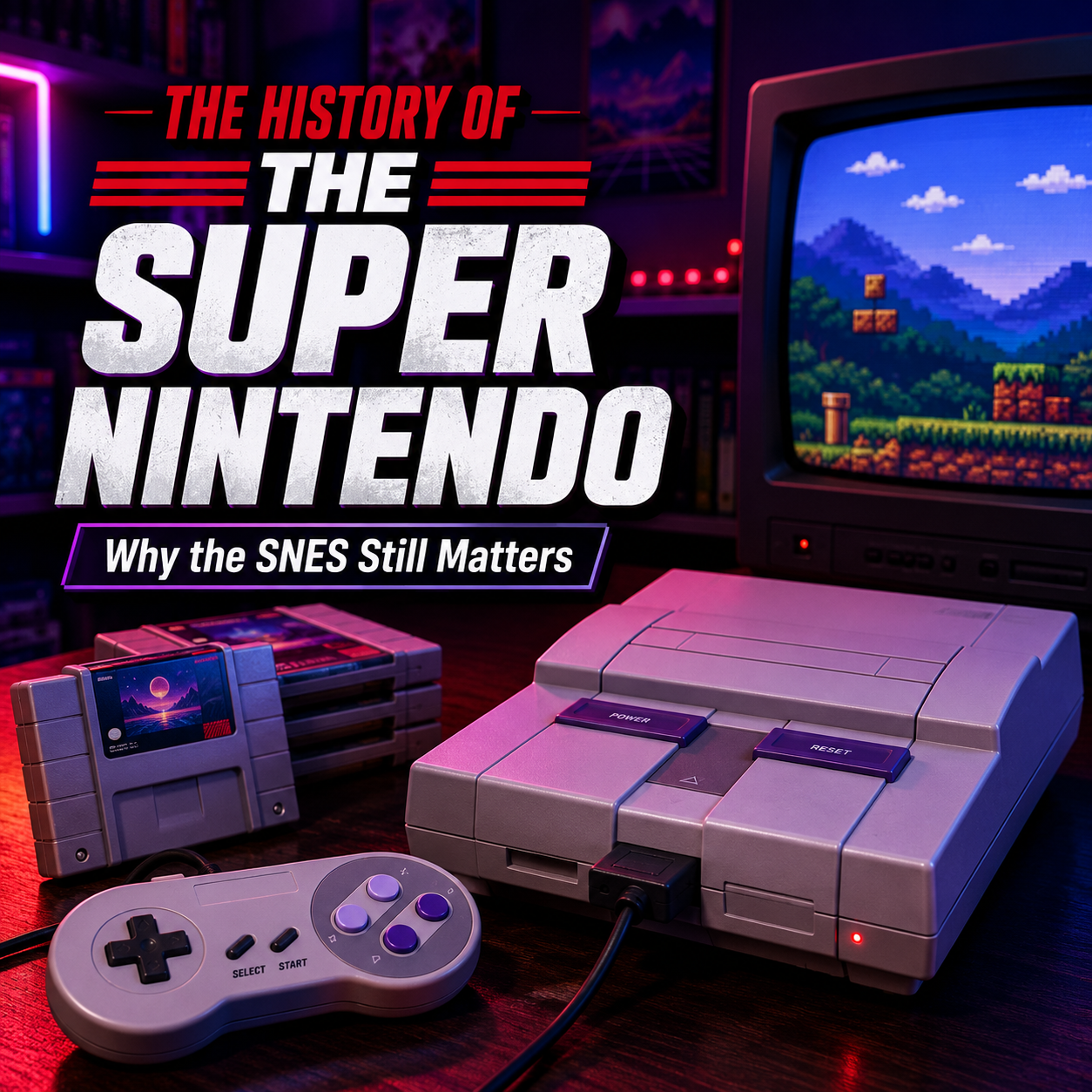
North America received its version, the Super Nintendo Entertainment System, in 1991. The North American SNES had a different physical design than the Japanese and European models. It was boxier, with purple buttons and a grey shell that has become instantly recognizable to retro gamers.
The launch bundle included Super Mario World, which was basically Nintendo walking into the room and saying, “Yes, we still know exactly what we are doing.”
And honestly? They did.
Super Mario World was the perfect introduction to the SNES. It looked brighter, moved smoother, sounded better, and felt bigger than anything most NES players had experienced at home. Dinosaur Land felt alive. Yoshi became an instant star. Secret exits, branching map paths, ghost houses, hidden switch palaces, and tons of replay value made it clear that the SNES was not simply about better graphics. It was about bigger ideas.

What Made the SNES So Impressive?
The SNES was part of the 16-bit generation, but “16-bit” was only part of the story. The real magic came from how Nintendo used the hardware.
The system featured colourful visuals, layered backgrounds, smooth scrolling, strong sprite work, and an incredible sound chip that gave composers room to create music that still hits hard today. Many SNES soundtracks are still considered some of the best in gaming history.
Games like Super Metroid, Final Fantasy III, Chrono Trigger, Secret of Mana, EarthBound, Donkey Kong Country, Mega Man X, and The Legend of Zelda: A Link to the Past did not just sound good for the time. They still sound good now.
The SNES also became famous for Mode 7, a graphical technique that allowed backgrounds to rotate and scale, creating a pseudo-3D effect. This made games like F-Zero and Super Mario Kart feel fast, flashy, and futuristic. Today, we can look back and see the tricks behind the curtain, but in the early 1990s, Mode 7 felt like wizardry.
Then there were enhancement chips built directly into certain cartridges. The most famous was the Super FX chip, used in games like Star Fox. Instead of asking the console to do everything by itself, some games included extra hardware inside the cartridge to push the system further. That is such a wild little piece of gaming history. Imagine buying a game and the cartridge itself has special hardware inside to make the game possible. Very “mad scientist in a plastic shell,” and I respect it.
The SNES Controller Changed Everything
The SNES controller deserves its own praise.
The NES controller was iconic, but it was also simple: D-pad, Select, Start, B, and A. The SNES controller expanded that layout with four face buttons and two shoulder buttons. That design became one of the most important controller blueprints in gaming history.
Those extra buttons mattered. They made fighting games work better. They made action games feel more flexible. They gave developers more options without making the controller feel too complicated.
Street Fighter II on SNES would not have felt the same without that six-button-friendly layout. Super Metroid used the controller beautifully for jumping, shooting, aiming, weapon switching, and movement. Super Mario World used it in a way that still feels natural decades later.
Modern controllers owe a lot to the SNES. Shoulder buttons, four face buttons, and a comfortable shape became standard for a reason.

The Console War: Super Nintendo vs Sega Genesis
You cannot talk about the SNES without talking about the Sega Genesis.
The 1990s console war was intense. Sega came in loud, aggressive, and cool. Their marketing had attitude. Sonic the Hedgehog was fast, colourful, and full of personality. Sega positioned the Genesis as the edgier system, the console for older kids who wanted speed, sports, arcade action, and a bit more bite.
Nintendo, meanwhile, leaned into quality, polish, and its incredible first-party and third-party library.
The Genesis had Sonic, Streets of Rage, Phantasy Star, Golden Axe, Gunstar Heroes, NHL games, and a strong arcade feel. The SNES had Mario, Zelda, Metroid, Donkey Kong, Final Fantasy, Chrono Trigger, EarthBound, Star Fox, Kirby, F-Zero, and a monster lineup of third-party hits.
The rivalry made both companies better. Sega pushed Nintendo to loosen up. Nintendo pushed Sega to keep swinging. Gamers won.
At Power Up Gaming, we see love for both systems all the time. Some customers are die-hard Genesis fans. Some are SNES loyalists. Some collect both because they have excellent taste and apparently hate having shelf space. The 16-bit era was special because both consoles had strong identities.
Still, the SNES built a legacy that has only grown over time.

The Games That Made the SNES Legendary
A console is only as good as its games, and this is where the SNES becomes almost unfair.
The library is stacked. Not just “good for the time” stacked. We are talking about games that still appear on best-of-all-time lists more than thirty years later.
Super Mario World
Super Mario World is one of the best pack-in games ever made. It took the foundation of Super Mario Bros. 3 and expanded it with a connected world map, secret exits, Yoshi, better movement, and a huge amount of replay value.
It was welcoming for new players but packed with secrets for dedicated ones. That balance is pure Nintendo.
The Legend of Zelda: A Link to the Past
A Link to the Past is still one of the most important Zelda games ever made. It refined the top-down adventure formula, introduced a massive dual-world structure, and set design standards that influenced Zelda for decades.
The light world and dark world concept made Hyrule feel mysterious, dangerous, and layered. It is one of those games that still feels shockingly playable today.
Super Metroid
Super Metroid is atmospheric, lonely, intelligent, and beautifully designed. It does not hold your hand. It teaches through level design, sound, exploration, and tension.
It helped define what people now call the “Metroidvania” genre. That alone makes it historically massive, but the best part is that it is still fun. The pacing, map design, upgrades, boss fights, and mood are all incredible.
Super Mario Kart
Before Mario Kart became a global multiplayer giant, it started on the SNES. Super Mario Kart used Mode 7 to create its racetracks and introduced a formula that Nintendo is still refining today.
Pick a character. Grab items. Ruin friendships. Repeat forever.
It was simple, chaotic, and brilliant.
Donkey Kong Country
By 1994, many players were already looking toward newer systems. Then Donkey Kong Country arrived and made the SNES look like it had discovered a secret second life.
Developed by Rare, Donkey Kong Country used pre-rendered 3D-style graphics to create visuals that looked far beyond what people expected from the hardware. It was a massive commercial and technical statement: the SNES was not finished yet.
It also revived Donkey Kong as a major Nintendo character and introduced Diddy Kong, one of the greatest little sidekicks in platforming.
Star Fox
Star Fox was a technical showcase thanks to the Super FX chip. Its polygon graphics were primitive by modern standards, but at the time, seeing 3D-style space combat on a home console was unforgettable.
It gave the SNES a futuristic edge and introduced Fox McCloud, Falco, Peppy, Slippy, and the immortal wisdom of “Do a barrel roll!” even if that exact phrase became more famous later.
Chrono Trigger
Chrono Trigger is one of the most beloved RPGs ever made. Developed by a dream team that included talent connected to Final Fantasy and Dragon Quest, it combined time travel, multiple endings, memorable characters, an incredible soundtrack, and tight pacing.
Even people who do not usually love RPGs often make an exception for Chrono Trigger. It is that good.
Final Fantasy III
Known as Final Fantasy VI in Japan, Final Fantasy III on SNES gave North American players one of the most ambitious RPG stories of the era. It had a large cast, dramatic storytelling, emotional music, and one of gaming’s most memorable villains in Kefka.
For many players, this was the game that proved console RPGs could deliver stories with real weight.
EarthBound
EarthBound was strange, funny, emotional, awkward, and completely unlike anything else on the system. It did not become a massive hit in North America at launch, but over time it became one of the most cherished cult classics in gaming.
Its modern setting, weird enemies, offbeat humour, and emotional undercurrent helped it stand apart from fantasy RPGs of the era.
Street Fighter II
Street Fighter II was an arcade phenomenon, and its arrival on SNES was a huge deal. It brought competitive fighting into living rooms and helped make the SNES a must-own console for arcade fans.
The fighting game genre exploded in the 1990s, and Street Fighter II was one of the biggest reasons why.
Why RPG Fans Love the SNES
The SNES may be the greatest RPG console of all time. Yes, that is a spicy take, but it is not exactly a reckless one.
The system had Final Fantasy II, Final Fantasy III, Chrono Trigger, Secret of Mana, EarthBound, Super Mario RPG, Breath of Fire, Lufia II, Illusion of Gaia, Robotrek, Ogre Battle, and many more.
This was the era where console RPGs became more cinematic, more emotional, and more mechanically interesting. Developers were learning how to tell bigger stories with limited storage, pixel art, music, and clever writing. The result was a golden age of 16-bit role-playing games.
Collectors know this too. Many SNES RPGs are among the most sought-after games for the system. At Power Up Gaming, SNES RPGs tend to draw attention fast because they are not just games. They are pieces of gaming history.

The SNES and Multiplayer Memories
The SNES was also a fantastic multiplayer system.
Super Mario Kart, Street Fighter II, NBA Jam, Super Bomberman, Teenage Mutant Ninja Turtles: Turtles in Time, Contra III, Mortal Kombat II, Secret of Mana, and many sports games made the console a living room staple.
This was couch multiplayer at its finest. No accounts. No updates. No online lobbies. Just two controllers, one TV, and someone yelling that you only won because you spammed the same move.
Which, to be fair, was probably true.
The SNES and Arcade Ports
Arcades were still a major force during the SNES era, and home ports mattered. Players wanted arcade experiences without constantly feeding quarters into a machine.
The SNES delivered strong versions of Street Fighter II, Mortal Kombat II, Teenage Mutant Ninja Turtles: Turtles in Time, Final Fight, NBA Jam, and many others.
Not every port was perfect. Some had missing content, altered visuals, or compromises because arcade hardware was often more powerful. But the idea that you could bring so much of the arcade experience home was a huge part of the SNES appeal.
The SNES Kept Evolving Through Its Cartridges
One of the coolest things about the SNES is how its cartridges helped extend its life.
Unlike disc-based systems, SNES cartridges could include extra chips and special hardware. That meant developers could push the system in surprising ways.
Star Fox used the Super FX chip for polygon graphics. Yoshi’s Island used the Super FX 2 chip for effects like scaling, rotation, and wild visual tricks. Some games used special chips for faster processing, better math, or expanded capabilities.
This made SNES collecting especially interesting. The cartridge was not always just a storage device. Sometimes it was part of the hardware magic.
The Late-Life Power of Donkey Kong Country and Yoshi’s Island
By the mid-1990s, the gaming industry was moving toward 32-bit consoles, CD-ROMs, and full 3D worlds. The Sony PlayStation and Sega Saturn were on the horizon, and Nintendo was preparing the Nintendo 64.
But the SNES still had fight left in it.
Donkey Kong Country launched in 1994 and looked so impressive that many players could not believe it was running on the same system that launched with Super Mario World. Then Yoshi’s Island arrived in 1995 with a hand-drawn art style, creative level design, and technical effects that gave it a completely different personality.
These games helped prove that great art direction and smart design can matter just as much as raw power.
The Super Nintendo’s Legacy
The SNES sold tens of millions of systems worldwide and built one of the strongest game libraries in history. But its real legacy is bigger than sales.
It shaped controller design. It helped popularize console RPGs in North America. It made couch multiplayer unforgettable. It gave us some of Nintendo’s greatest sequels. It helped define the 16-bit era. It proved that pixel art, strong music, and tight gameplay could create experiences that last for generations.
The SNES also became a collector’s dream. Complete-in-box games, rare RPGs, clean consoles, manuals, posters, and accessories continue to be sought after by retro gaming fans. Some players collect for nostalgia. Some collect for preservation. Some collect because they finally have adult money and childhood unfinished business.
We understand this deeply at Power Up Gaming. Retro gaming is not just about old plastic and cartridges. It is about memories, craftsmanship, and the feeling of picking up a controller and instantly being transported back.

Buying a Super Nintendo Today
Buying an SNES today can be incredibly rewarding, but condition matters.
Original consoles are now decades old. Yellowing plastic, dirty cartridge slots, worn controllers, dead save batteries, damaged labels, and untested games are all common issues in the retro market.
That is why buying from a trusted retro game store matters. At Power Up Gaming, we focus on tested products, clean inventory, and helping customers understand what they are buying, with used products backed by our warranty and return policy. Whether you are hunting for a console, a replacement controller, a classic cartridge, or a heavy-hitter for your collection, we know how important condition and reliability are.
For SNES games, always check:
- Cartridge label condition
- Back label condition
- Connector cleanliness
- Whether the game has been tested
- Whether the game uses a save battery
- Whether the save function still works
- Whether the cartridge shell has cracks, marker, stickers, or rental store wear
Rental stickers can be charming to some collectors and a dealbreaker to others. Same with label wear. Some people want museum-clean copies. Others just want the game to play properly. There is no wrong way to collect as long as you know what you are getting.
Do SNES Games Still Hold Up?
Yes. Very much yes.
Some early 3D games from later consoles have aged awkwardly, but the best SNES games still look and play beautifully because 2D pixel art ages incredibly well. The controls are usually tight, the music is memorable, and the best games were built around gameplay first.
Super Mario World is still fun.
A Link to the Past is still brilliant.
Super Metroid is still a masterclass.
Chrono Trigger still makes RPG fans emotional.
Donkey Kong Country still has style.
Yoshi’s Island still looks gorgeous.
Street Fighter II is still a couch battle machine.
That is the difference between a game that was impressive at launch and a game that was actually designed well. The SNES has a lot of both.
The SNES Classic Edition and Modern Interest
Nintendo brought the SNES back into the spotlight with the Super NES Classic Edition in 2017. This mini console included 21 built-in games, including major titles like Super Mario World, The Legend of Zelda: A Link to the Past, Super Metroid, EarthBound, Final Fantasy III, Donkey Kong Country, Super Mario Kart, Star Fox, and the previously unreleased Star Fox 2.
The SNES Classic reminded a lot of people just how strong the library was. It also introduced younger players to games they may have missed the first time around.
Of course, for collectors, nothing fully replaces original hardware. There is something special about the original console, the real controller, and the cartridge clicking into place. The SNES Classic is convenient, but original hardware has soul.
Why the Super Nintendo Still Matters
The Super Nintendo still matters because it represents one of gaming’s greatest creative periods.
Developers had enough power to create rich worlds, but not so much power that they could rely on spectacle alone. They had to be smart. Every pixel mattered. Every song had to work within the limits of the sound chip. Every level had to justify itself.
That limitation created focus.
The best SNES games are polished, readable, colourful, and full of personality. They are easy to understand but often hard to master. They invite you in, then reward you for paying attention.
That is why the SNES is still loved today. Not just because of nostalgia, but because the games are genuinely excellent.
Final Thoughts
The Super Nintendo Entertainment System was more than a successful follow-up to the NES. It was a creative explosion.
It gave us some of the best platformers, RPGs, action games, racing games, fighting games, adventure games, and multiplayer experiences ever made. It helped Nintendo battle Sega during one of the most exciting eras in gaming history. It pushed 2D game design to incredible heights. It gave players worlds they still revisit decades later.
For many gamers, the SNES is not just a console. It is the console.
Whether you are rebuilding your childhood collection, discovering the system for the first time, or hunting down that one game you foolishly traded away years ago, the Super Nintendo is always worth revisiting.
At Power Up Gaming, we love helping retro gamers find the classics that matter to them. The SNES is one of those systems that never really goes out of style. You do not just play it. You remember it, collect it, talk about it, and pass it on.
And honestly, that is what makes it super.

FAQ
When did the Super Nintendo come out?
The Super Famicom launched in Japan on November 21, 1990. The Super Nintendo Entertainment System launched in North America in 1991.
What was the SNES called in Japan?
In Japan, the system was called the Super Famicom. The North American version was called the Super Nintendo Entertainment System, commonly shortened to SNES or Super Nintendo.
What game came with the SNES?
In North America, the SNES was commonly bundled with Super Mario World, one of the greatest pack-in games of all time.
Why is the SNES considered one of the best consoles ever?
The SNES is loved because of its incredible game library, strong 2D graphics, memorable music, comfortable controller, and major influence on genres like platformers, RPGs, racing games, fighting games, and action-adventure games.
What are the best SNES games?
Some of the most popular and respected SNES games include Super Mario World, The Legend of Zelda: A Link to the Past, Super Metroid, Chrono Trigger, Final Fantasy III, EarthBound, Donkey Kong Country, Super Mario Kart, Street Fighter II, Mega Man X, Secret of Mana, and Yoshi’s Island.
What is Mode 7 on the SNES?
Mode 7 is a graphical technique used by the SNES to rotate and scale background layers, creating a pseudo-3D effect. It was used famously in games like F-Zero and Super Mario Kart.
What was the Super FX chip?
The Super FX chip was an enhancement chip built into certain SNES cartridges. It helped games perform advanced visual effects, including polygon-style graphics in games like Star Fox.
Are SNES games still worth playing today?
Yes. Many SNES games have aged extremely well thanks to strong pixel art, responsive controls, excellent music, and smart game design. Some of the best games on the system are still considered masterpieces.
Are SNES games collectible?
Yes. SNES games are highly collectible, especially popular RPGs, complete-in-box copies, rare titles, and games in excellent condition. Condition, label quality, manuals, boxes, and working save batteries can all affect value.
Do SNES games have save batteries?
Many SNES games that allow saving use internal batteries. Over time, those batteries can die, which may prevent the game from saving properly. This is especially common with older RPGs and adventure games.
Where can I buy SNES games in Canada?
You can shop for SNES games, SNES consoles, controllers, and other retro gaming products through Power Up Gaming at powerupgaming.ca. We specialize in retro games and understand the importance of clean, tested, quality inventory.